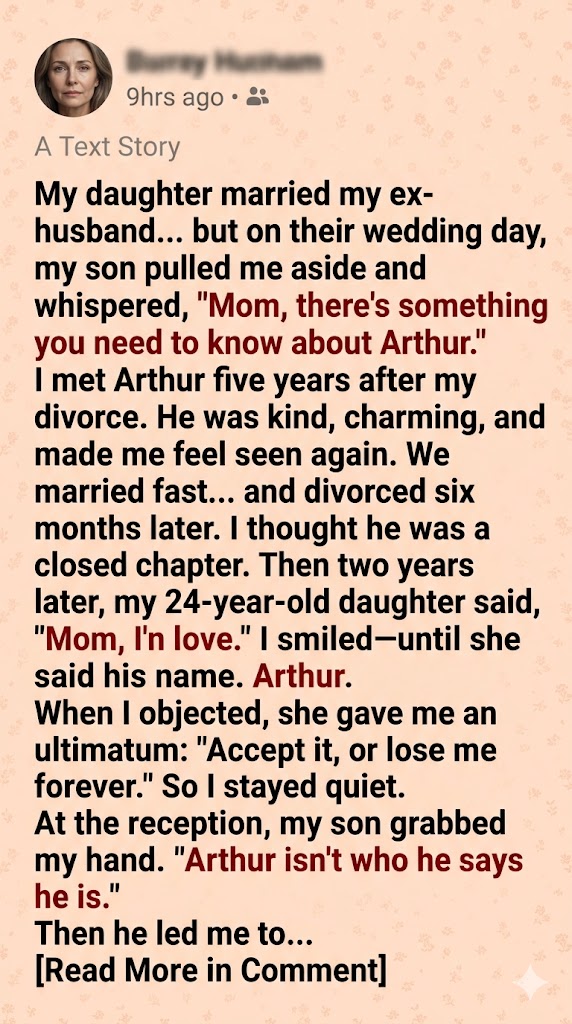
I never imagined I would stand at my daughter’s wedding and watch her promise forever to a man I had once divorced.
But there I was, sitting in the front row, smiling until my cheeks hurt, while my daughter Rowan walked down the aisle toward Arthur.
Arthur.
My ex-husband.
The whole thing still felt impossible.
Years earlier, I had married young. My first husband, Mark, and I had two children — Rowan and Caleb — and spent seventeen years pretending our marriage was stronger than it was. We did not scream. We did not betray each other. We simply became strangers who shared a house, children, and a last name.
When we divorced, it was quiet. Painful, yes, but civil.
Five years later, I met Arthur.
He was different from the men I had known before. Warm, funny, calm, and charming in a way that made me feel safe. He was divorced too, with children of his own, and I thought he understood how complicated life could be.
We married quickly.
Too quickly.
Six months later, it was over.
There was no dramatic scandal. Arthur simply changed. He became distant, vague about money, irritated by questions, and suddenly uninterested in building the future he had once described so beautifully. When we divorced, I told myself some relationships simply fail.
Then, two years later, Rowan came to my house with glowing eyes.
“Mom,” she said, “I’m in love.”
I smiled because mothers smile when their daughters say those words.
Then she said his name.
“Arthur.”
For a moment, I thought I had misheard her.
“My Arthur?” I asked.
She frowned. “He isn’t yours anymore.”
She was twenty-four. Brilliant, stubborn, ambitious, and convinced that love made every objection meaningless. I told her it was wrong. I told her the age gap mattered. I told her he had once been married to me.
She gave me a choice.
“Accept us,” she said, “or lose me.”
So I did what terrified mothers do.
I swallowed my fear and pretended to support her.
A year later, I watched her marry him.
The venue was beautiful — soft lights, white roses, champagne glasses, music floating through the air like nothing ugly could ever happen there. Rowan looked radiant. Arthur looked proud.
I looked composed.
Inside, I felt sick.
During the reception, my son Caleb found me near the hallway.
“Mom,” he said quietly, gripping my arm. “I need to show you something.”
Caleb had always been steady. He was twenty-two, thoughtful, and careful with words. He did not panic easily. So when I saw his face, my stomach dropped.
He led me outside to the parking lot, away from the music and laughter.
“What is it?” I asked.
He pulled out his phone.
“I hired a private investigator.”
I stared at him. “You did what?”
“I didn’t trust Arthur,” he said. “Not with you. Not with Rowan. Something was wrong, and I needed proof before I said anything.”
Then he showed me the documents.
Bankruptcy records.
Defaulted loans.
Credit cards in collections.
Unpaid taxes.
A lawsuit from Arthur’s ex-wife claiming he had hidden money, skipped payments, and manipulated her financially for years.
My hands went cold.
Caleb’s voice shook with anger. “He targets women with money and connections. He tried it with you, but your prenup stopped him. Now he’s doing it to Rowan.”
I remembered Arthur’s reaction before our wedding when I insisted on a prenup. He had smiled, but his eyes had hardened.
At the time, I ignored it.
Now I understood.
“We have to tell her,” Caleb said.
“She won’t believe us,” I whispered. “Not privately. Not today. He’ll twist it.”
Caleb looked toward the glowing reception hall.
“Then we don’t do it privately.”
My heart pounded as we walked back inside.
A few minutes later, Caleb stepped onto the small stage and took the microphone. Everyone clapped, expecting a sweet brotherly toast.
He smiled politely.
“I want to congratulate my sister,” he began, “and I want to say something about marriage. Marriage needs love, yes. But it also needs truth.”
Arthur shifted in his chair.
Caleb turned to him.
“So, Arthur,” he said, his voice carrying through the room, “before you start this new life with my sister, maybe you can explain the bankruptcy, the unpaid taxes, the lawsuit from your ex-wife, and the debts you forgot to mention.”
The room froze.
Rowan’s smile vanished.
Arthur stood. “This is inappropriate.”
Caleb held up his phone. “I have records.”
Gasps spread through the room.
Arthur looked at Rowan. “He’s lying. Your family never wanted us together.”
But Rowan was no fool.
She held out her hand. “Show me.”
Caleb walked to her and placed the phone in her palm.
I watched my daughter read. I watched color drain from her face. I watched the fantasy she had built begin to collapse.
Arthur reached for her wrist.
She pulled away.
“Is this true?” she asked.
He opened his mouth.
Nothing came out.
That silence answered everything.
Rowan stood slowly, removed her ring, and placed it on the table.
“You didn’t marry me,” she said. “You hunted me.”
Then she walked toward me.
For the first time in a year, she looked like my little girl again.
“I’m sorry, Mom,” she whispered.
I held her tightly.
The wedding ended in whispers, cancelled music, and guests leaving with untouched cake on their plates.
It was humiliating. It was heartbreaking.
But it saved my daughter.
Sometimes love blinds us. Sometimes family looks cruel when it is only trying to protect us. And sometimes the truth arrives late — but still just in time.
