I had not felt my legs in twenty years.
Not pain. Not cold. Not pressure. Nothing.
To most people, that sounds like numbness. To me, it was silence. A silence so deep it became part of who I was.
My name is Victor Harlan. Before the accident, I was the kind of man who believed strength could solve everything. I ran marathons, built my own company from nothing, and never asked anyone to carry what I could lift myself.
Then one summer afternoon, everything changed.
I was at a lake with friends when a little girl slipped beneath the dock. People screamed. No one moved fast enough.
I dove in.
I got her out. I pushed her toward her mother’s arms. But as I turned to swim back, my head struck a hidden rock under the water.
When I woke in the hospital, the doctor spoke gently.
My spine had been damaged.
I would likely never walk again.
People called me a hero. They said I had saved a child. They told me I should be proud.
But pride did not help me stand. It did not help me climb stairs. It did not stop me from staring at my shoes and feeling like they belonged to someone else.
Years passed. I adapted. I married, had a daughter, built a larger business, and learned to move through the world in a wheelchair with enough confidence that strangers rarely saw the grief behind it.
But I knew.
Every morning, I woke up hoping for a miracle.
Every night, I went to sleep without one.
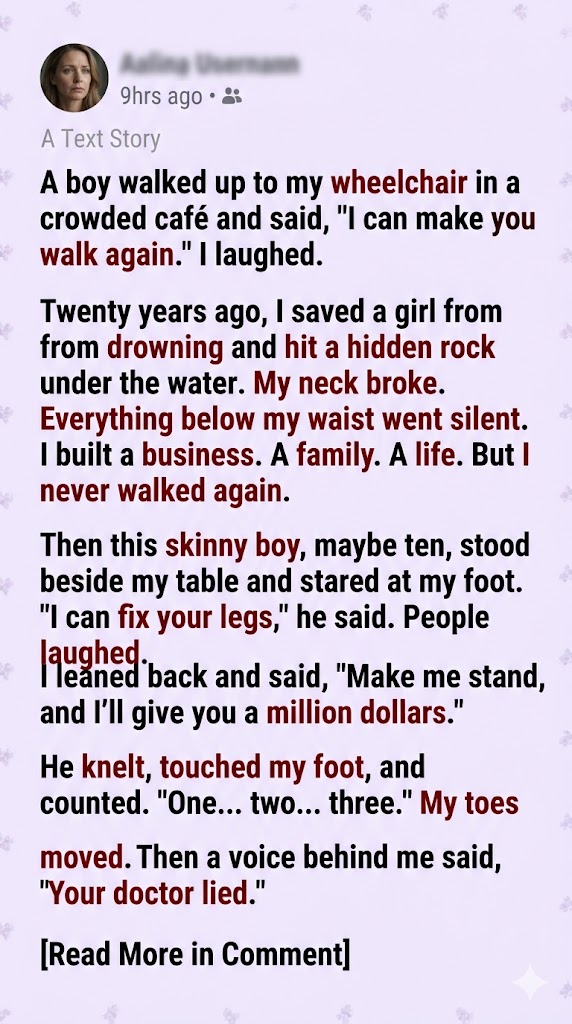
Then, on an ordinary Tuesday, a boy walked up to me in a crowded café and said, “Sir, I can make your legs work again.”
I was having lunch with two business partners. They laughed first, assuming it was some childish joke.
The boy looked about ten. His backpack was torn, his sneakers were too small, and there was dirt beneath his fingernails. But his eyes were steady.
I smiled politely. “That’s kind of you, kid.”
“I’m serious,” he said.
One of my partners chuckled. “What are you, a doctor?”
“No,” the boy replied. “But my brother couldn’t move his hand after an accident. I helped him.”
The table went quiet.
I should have waved him away. I should have told him adults were talking. But something about him held me still.
“What’s your name?” I asked.
“Eli.”
He knelt beside my wheelchair before anyone could stop him. Then he placed his small hand on my shoe.
I felt nothing, of course.
He closed his eyes.
My partner Mark muttered, “Victor, this is ridiculous.”
Maybe it was.
Maybe I was tired.
Maybe some broken part of me wanted to see how far a child’s impossible confidence could go.
“Let him finish,” I said.
Eli touched my ankle, then my shin, pressing gently in places I had not thought about in years.
“Do you feel that?” he asked.
“No.”
He moved his fingers lower.
“What about this?”
“No.”
Then he pressed two fingers near the top of my foot.
Something flickered.
Not movement. Not exactly.
A spark.
My breath caught.
Eli opened his eyes. “There.”
My partners stopped smiling.
“Do that again,” I whispered.
He pressed the same place.
This time, my toes twitched.
Only slightly. Barely enough to see.
But I saw it.
So did everyone at the table.
For twenty years, my feet had belonged to silence. Now one toe moved as if waking from a long sleep.
My coffee cup slipped from my hand and shattered on the floor.
Eli looked up at me, calm as ever. “Your legs aren’t dead. They’re sleeping.”
I wanted to laugh. I wanted to cry. I wanted to demand answers.
Instead, I asked the only question I could form.
“Who taught you this?”
His expression changed. The confidence faded.
“My mom,” he said. “Before she got sick.”
That was when I noticed how thin he was. How carefully he guarded his backpack. How he looked toward the café window like someone might come looking for him.
I asked where his mother was.
He looked down.
“She’s in the shelter clinic. She used to be a physical therapist. She helped people after accidents. She taught me pressure points and exercises because my brother needed them.”
My chest tightened.
This boy had not come to me with magic.
He had come with knowledge, desperation, and a hope so stubborn it looked impossible.
I asked why he approached me.
Eli swallowed. “Because you looked rich. And because my mom needs medicine.”
My partners shifted uncomfortably.
I should have been angry. Instead, I felt ashamed.
I had spent twenty years grieving what I lost while a child was trying to save the person he had left.
I told my driver to take us to the shelter clinic.
Eli’s mother, Nora, was lying on a narrow cot, pale and exhausted. When she saw her son beside me, fear flashed across her face.
“He didn’t steal anything,” I said quickly. “He helped me.”
Then I showed her.
With Eli’s fingers guiding the motion, my toes moved again.
Nora began to cry.
She explained that my injury might not be as completely unresponsive as I had been told. She begged me not to believe in miracles, only in work — therapy, testing, repetition, patience.
So I did.
I paid for her treatment. I hired her legally as part of my rehabilitation team. I found housing for her and her sons. Not as charity, but because she had given me something money had never bought.
Hope.
Six months later, I stood between parallel bars for seven seconds.
Seven seconds.
To anyone else, it was almost nothing.
To me, it was the sound of silence breaking.
And when I looked across the room, Eli was grinning like he had known the ending all along.
