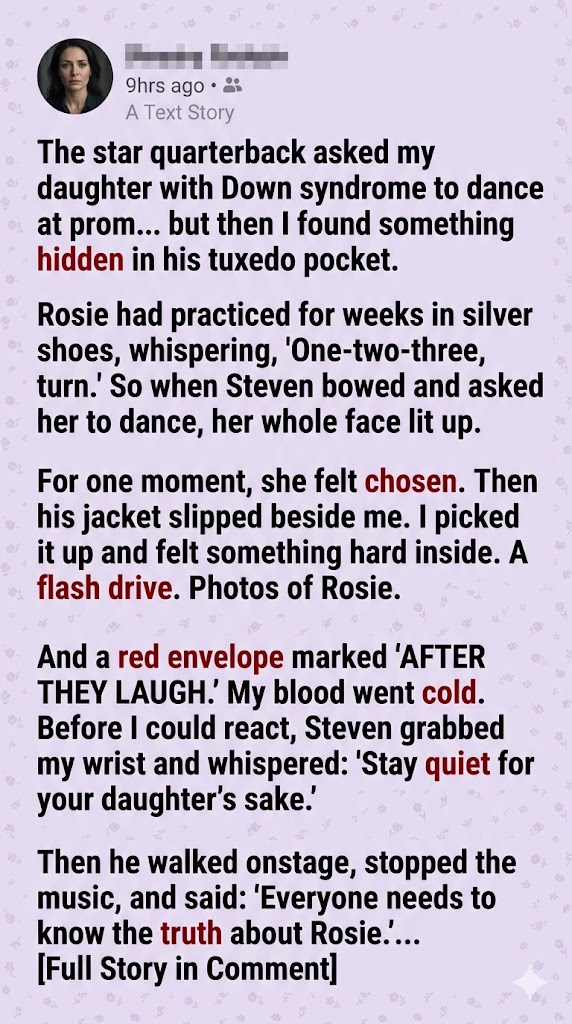
For three weeks, my daughter Rosie practiced dancing in our kitchen.
“One-two-three, turn,” she whispered, counting every step beneath her breath.
She wore silver shoes with her pajama shorts, spinning carefully between the table and the refrigerator like our tiny kitchen was already a ballroom. Every time she turned, her face lit up with a kind of hope I had not seen in years.
Rosie was eighteen and had mosaic Down syndrome. To strangers, her condition was not always obvious at first. But the kids at school noticed enough. They noticed when she needed more time to answer. They noticed when she misunderstood jokes. They noticed when she smiled too easily.
And cruel people always know what to do with innocence.
I had seen the signs: torn sleeves, missing notebooks, mascara streaks she claimed were from allergies, quiet rides home where she stared out the window and said, “I’m fine, Mom.”
So when Steven Harlow, the star quarterback, knocked on our door with a white tulip and asked Rosie to prom, my first feeling was not joy.
It was fear.
He was handsome, popular, confident — the kind of boy who could choose anyone. Rosie, however, looked at him like he had brought sunlight straight into our living room.
“Would you go with me?” he asked her gently.
Rosie covered her mouth. “Me?”
“Yes,” he said. “You.”
I wanted to protect her. I wanted to say no. But then I saw her face, shining with a happiness I had no right to steal.
So I let her say yes.
On prom night, she wore a pale blue dress we had found on clearance. I zipped it slowly, blinking back tears.
“You look like a princess,” I whispered.
She smiled at herself in the mirror. “Do you think Steven will think so?”
“He’d be foolish not to.”
The school gym had been transformed with lights, balloons, and soft music. I stood near the back wall, clutching my purse like a shield while Rosie waited near the dance floor.
Then Steven walked in.
He crossed the room straight toward her, bowed slightly, and held out his hand.
“May I have this dance?”
Rosie’s smile nearly broke my heart.
“Yes,” she whispered.
They moved together under the lights. She counted softly, and he matched her pace. Some students clapped. A teacher wiped her eyes. For one beautiful minute, I allowed myself to believe that maybe kindness had found my daughter.
Then Steven’s tuxedo jacket slipped from the chair beside me.
I bent to pick it up.
Something hard pressed against my fingers inside the pocket.
I should have hung the jacket back up. Instead, I reached inside and pulled out a flash drive, a stack of printed photos, and a red envelope with three words written across the front.
AFTER THEY LAUGH
My stomach turned.
The top photo showed Rosie crying in a bathroom stall. Another showed her sitting alone in the cafeteria while three girls laughed behind her. Another showed her holding a stuffed bear with marker scribbled across its face.
My hands began to shake.
Then Steven appeared beside me.
“Don’t,” he whispered.
I looked up, horrified.
His hand closed gently but firmly around my wrist.
“Stay quiet for her sake,” he said. “Please. You’ll understand in one minute.”
“Let go of me,” I said through my teeth.
He released me immediately, but his face was serious.
“If you hurt my daughter,” I whispered, “I will make sure everyone knows exactly what you did.”
His eyes softened.
“I’m trying to stop the people who already hurt her.”
Before I could answer, he walked toward the stage.
The music cut off. The room fell silent.
Steven stood at the microphone and looked across the gym.
“For two years,” he said, “some of you have treated Rosie like she was a joke. Tonight, everyone is going to see who the joke really is.”
He plugged the flash drive into the laptop.
The screen behind him lit up.
Photo after photo appeared — not to shame Rosie, but to expose the students behind her pain. Madison. Brooke. Caitlin. Their faces were clear. Their laughter was frozen in every frame.
Gasps spread through the room.
Steven’s voice stayed steady.
“I took these pictures after they laughed. After they thought no one was watching. After Rosie walked away pretending she was fine.”
The three girls near the punch table went pale.
A teacher moved toward them. The principal stepped onto the floor. Parents began whispering. Phones lowered. Nobody laughed now.
Rosie stood near the dance floor, confused, tears shining in her eyes.
Steven stepped down from the stage and walked to her.
“I’m sorry I didn’t tell you first,” he said softly. “But I needed everyone to see the truth at the same time.”
Then he pulled a small velvet box from his pocket.
Inside was a silver charm bracelet with a tiny ballerina.
Rosie gasped.
“You once wrote that you wanted someone to watch you dance without laughing,” he said. “Tonight, everyone saw you dance. And nobody gets to laugh at you again.”
Rosie covered her mouth and cried.
Not from humiliation.
From being seen.
I walked toward Steven, my throat tight.
“I thought you were going to hurt her,” I said.
He nodded. “You’re her mom. You were supposed to think that.”
Then he held out his hand to Rosie again.
“May I have one more dance?”
She nodded.
As they turned beneath the lights, I realized I had spent so long looking for danger that I almost missed courage standing right in front of me.
Not everyone who comes close to your child means harm.
Sometimes, the person you fear most is the one brave enough to protect them.
