When my son Ethan was in school, I used to dread the sound of the final bell.
Most parents were happy when their children came home. I was too, in a way. But every afternoon, I watched Ethan step off the bus with his shoulders tight, his backpack hanging low, and his eyes fixed on the pavement.
He always said the same thing.
“I’m fine, Mom.”
He was not fine.
Ethan was gentle, quiet, and brilliant in ways his classmates never cared to understand. He loved drawing machines, taking radios apart, and reading science magazines at the kitchen table. He had asthma, thick glasses, and a habit of stammering when nervous.
That was enough for the bullies.
They called him names. They knocked books from his hands. They hid his backpack in trash cans and laughed when he panicked before class. At lunch, he usually sat alone. When teachers asked why, the other kids claimed he “liked it that way.”
He did not.
I went to the school again and again. I spoke to teachers, counselors, and the principal. Each time, I heard the same soft excuses.
“Kids can be unkind.”
“We’ll keep an eye on it.”
“Ethan needs to learn confidence.”
As if confidence could grow in soil watered with humiliation.
By senior year, Ethan stopped asking to attend school events. No dances. No football games. No graduation party invitations. He walked across the stage, accepted his diploma, and came straight home.
That night, I found him sitting on the back steps.
“Do you think I’ll always be invisible?” he asked.
I sat beside him and put my arm around his shoulders.
“No,” I said. “One day, they’ll see you clearly. But by then, you may not need them to.”
Ten years passed.
Ethan left town for college with one suitcase and a scholarship. At first, he called every night. Then life began opening for him. He found professors who valued his mind, friends who liked his quiet humor, and eventually a team of engineers who believed in the invention he had sketched as a teenager at our kitchen table.
He built medical devices — affordable emergency monitors for small clinics that could not afford expensive hospital equipment. His company grew slowly, then suddenly. Articles were written about him. Hospitals requested demonstrations. Investors called.
But Ethan stayed Ethan.
He still came home for Sunday dinner. He still fixed my toaster instead of letting me buy a new one. He still looked uncomfortable when anyone called him successful.
Then his high school announced a ten-year reunion.
I saw the post online before he did. Photos of the old gym. A cheerful invitation. Names tagged underneath.
Ethan’s name was missing.
I waited a day, then another. No message came. No email. No invitation.
When I finally told him, he gave a small shrug.
“That sounds about right.”
My heart broke all over again.
A week later, the school called him.
Not the reunion committee. The principal.
They wanted Ethan to attend a special alumni ceremony the same weekend. Apparently, his work had become impressive enough to honor publicly. They wanted him to speak to students about perseverance, innovation, and “representing the school well.”
Ethan laughed when he told me.
“They didn’t want me at the reunion, but now they want me on stage.”
“Are you going?”
He was quiet for a long moment.
“Yes,” he said. “But not for them.”
The night of the event, I sat in the front row of the auditorium. Many of Ethan’s former classmates were there, dressed nicely, whispering as they recognized him from news articles and company interviews.
Some looked shocked.
Some looked embarrassed.
Ethan walked onto the stage in a simple navy suit. He looked calm, but I knew him well enough to see the tension in his hands.
He thanked the school politely. Then he looked out at the audience.
“I was not invited to the reunion tonight,” he said.
The room went silent.
“I’m not saying that for pity. I’m saying it because ten years ago, I graduated from this school believing I was someone people could ignore without consequence. Many students feel that way right now.”
A few former classmates lowered their eyes.
Ethan continued.
“I was bullied here. Some people in this room participated. Some watched. Some adults minimized it. But I want every student listening to understand something: being rejected by the wrong people does not make you worthless. Sometimes it means you have not found your people yet.”
I cried quietly into a tissue.
After the speech, students lined up to talk to him. One boy with nervous hands asked if things really got better after school.
Ethan smiled gently.
“They can,” he said. “Especially when you stop believing cruel people are the judges of your future.”
Several former classmates approached him later with apologies. Ethan accepted some. Others, he simply nodded at and walked away.
On the drive home, I asked if he felt better.
He looked out the window for a while.
“I don’t need them to like me anymore,” he said. “That feels better than revenge.”
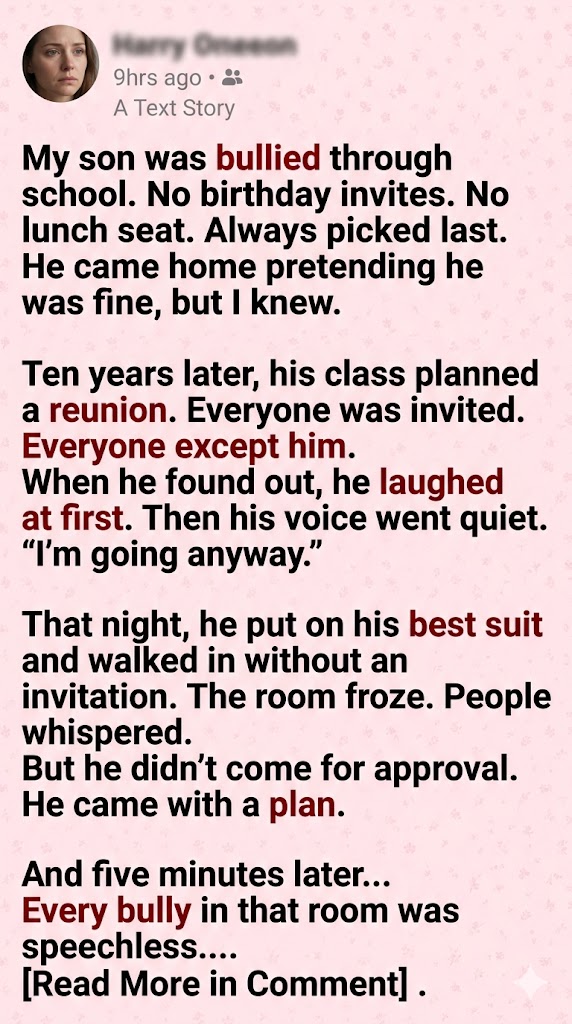
The story premise appears in social posts as “My Son Was Bullied Throughout School — They Didn’t Even Invite Him to the 10-Year Reunion.” (facebook.com)
