The problem with being the load-bearing wall of a family is that no one notices you until the roof starts to sag.
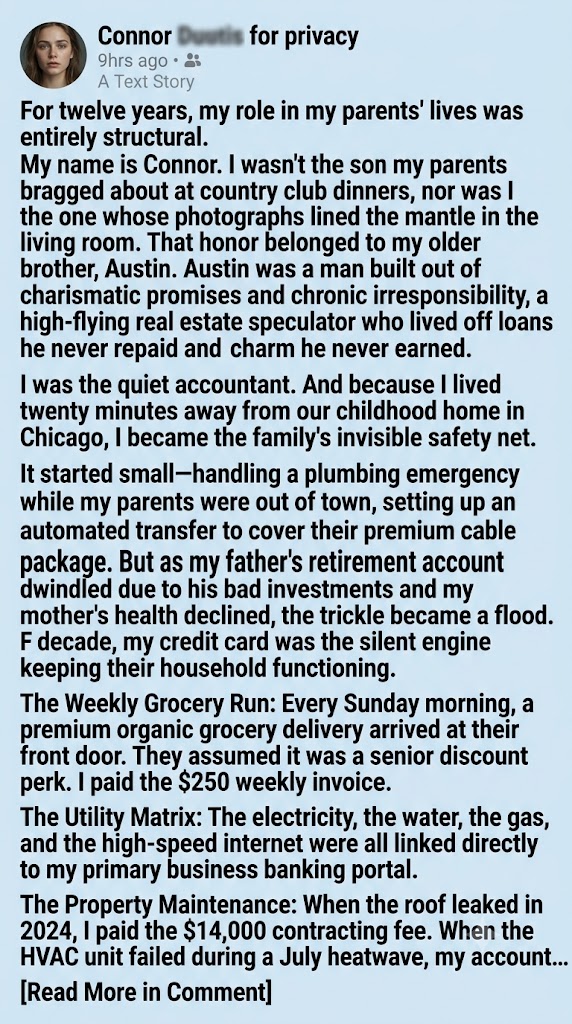
For twelve years, my role in my parents’ lives was entirely structural. My name is Connor. I wasn’t the son my parents bragged about at country club dinners, nor was I the one whose photographs lined the mantle in the living room. That honor belonged to my older brother, Austin. Austin was a man built out of charismatic promises and chronic irresponsibility, a high-flying real estate speculator who lived off loans he never repaid and charm he never earned.
I was the quiet accountant. And because I lived twenty minutes away from our childhood home in Chicago, I became the family’s invisible safety net.
It started small—handling a plumbing emergency while my parents were out of town, setting up an automated transfer to cover their premium cable package. But as my father’s retirement account dwindled due to his bad investments and my mother’s health declined, the trickle became a flood. For over a decade, my credit card was the silent engine keeping their household functioning.
The Weekly Grocery Run: Every Sunday morning, a premium organic grocery delivery arrived at their front door. They assumed it was a senior discount perk. I paid the $250 weekly invoice.
The Utility Matrix: The electricity, the water, the gas, and the high-speed internet were all linked directly to my primary business banking portal.
The Property Maintenance: When the roof leaked in 2024, I paid the $14,000 contracting fee. When the HVAC unit failed during a July heatwave, my account cleared the $8,500 replacement cost.
I didn’t do it for a round of applause. I did it because I believed in the silent compact of family—that you protect the people who built you. I assumed that the quiet equity of my labor was understood.
I was entirely wrong.
The Ledger of Erasure
The illusion dissolved on a cold Thursday afternoon in early April. My father had asked me to stop by his study to help him organize his digital tax archives. While navigating through his encrypted cloud storage to locate an elusive property tax receipt, my eyes caught a folder titled Vance_Estate_Planning_Final_2026.
My forensic accounting instincts took over before my manners could stop me. I opened the primary document. It was a fully executed, notarized copy of my parents’ last will and testament, updated just three months prior.
I read the text three times, waiting for my name to appear on the page. It never did.
The document was a clinical masterpiece of total erasure. The four-bedroom suburban estate—the very house I had structurally reinforced with my own money—was left entirely to Austin. The remaining savings accounts, the family heirlooms, and the liquid investments were all routed directly to his name. I wasn’t even listed as an alternative executor. I was a complete ghost in the narrative of their legacy.
As I sat there staring at the glowing monitor, the door opened and my father walked in, holding two cups of coffee. He didn’t look guilty; he looked entirely unbothered.
“Find that tax receipt yet, Connor?” he asked, setting a cup on the desk.
“Dad,” I said, my voice remarkably flat, pointing to the screen. “I stumbled onto the estate file. I noticed my name isn’t anywhere in the distribution.”
My father didn’t blink. He took a slow sip of his coffee, his expression hardening into that familiar, dismissive patronization he had used my entire life.
“We talked it over with Austin, and we felt this was the most logical route,” he said, completely devoid of emotion. “You’ve always been the stable one, Connor. You have your own accounting firm, you’re financially secure, and you don’t need the help. Austin has a specific lifestyle to maintain, and he needs the foundational backing of the family estate to secure his future. True character is built on independence anyway. You don’t need the house.”
“I see,” I replied.
I didn’t yell. I didn’t slam the laptop closed. I quietly logged out of his cloud server, stood up, and picked up my coat. I had spent twelve years underwriting a family that viewed my stability not as a virtue to be respected, but as a resource to be exploited for the benefit of their favorite son.
If I was independent enough to survive without a legacy, then I was independent enough to stop financing theirs.
The Disconnect
The next morning, I logged into my corporate banking dashboard. With a few clinical clicks, I accessed the recurring vendor authorizations.
One by one, I deleted the accounts. The Commonwealth Edison electric account—Removed. The Peoples Gas portal—Deleted. The automated Sunday morning grocery delivery subscription—Canceled.
I didn’t send a warning text. I didn’t issue an ultimatum. I simply closed the ledger.
The silence lasted for exactly twenty-two days. The automated grace periods built into municipal utility grids are remarkably precise. On the twenty-third day, the temperature in Chicago dropped to freezing, and the digital architecture of my parents’ home ran out of credit.
I was sitting in a board meeting with a new corporate client when my phone buzzed on the mahogany table. The caller ID read Dad. I declined the call. Two minutes later, a text message arrived. There was no “Hello,” no inquiry about my well-being, and no reference to the fact that they hadn’t seen me in nearly a month.
DAD: The power just got shut off! The smart thermostat is completely dead and the house is freezing. The utility company says the primary account holder pulled authorization. What is going on? Call them and fix this immediately.
I stared at the screen for a long moment, the quiet chatter of the boardroom fading into the background. I typed out a single, three-word response:
CONNOR: Not my house.
I flipped the phone face down and returned to my presentation.
The Broken Equilibrium
The fallout from those three words shattered the family ecosystem. Within forty-eight hours, the block filters on my personal phone were working overtime to process the incoming tide of frantic communication.
Because my parents couldn’t reach me, they weaponized Austin. My brother, who hadn’t spoken to me in six months unless he needed a short-term loan, stormed into my corporate office on Monday morning. He didn’t look like a golden child anymore; he looked like a desperate man whose allowance had been abruptly canceled.
“Are you completely insane, Connor?” Austin shouted, slamming his hands onto my desk. “Mom is sitting under three blankets because the gas line is locked down! The resort club dues bounced this morning! Dad had to use his actual emergency cash just to buy basic groceries! How can you be so incredibly petty just because of a piece of paper?”
“It’s not about a piece of paper, Austin,” I said, my voice dropping the temperature of his rage instantly. “It’s about basic physics. A house cannot stand without a foundation. For twelve years, I have paid the utilities, the repairs, the taxes, and the sustenance for that property. Dad explicitly told me that everything belongs to you because you have a lifestyle to maintain. Therefore, the maintenance of that lifestyle is now your operational expense.”
“I don’t have thirty thousand dollars a year to throw at utility bills and structural upkeep!” Austin hissed, his facade completely slipping. “My capital is tied up in market investments!”
“Then I suggest you downsize,” I replied calmly, gesturing toward the door. “Now leave my office before I have building security remove you for trespassing.”
The Foreclosure Finality
Six months passed. The silence was absolute, but the decay of the family estate was rapid. Without my credit card to automatically clear the balances, the true cost of running a five-thousand-square-foot suburban home hit my parents and Austin like a physical blow.
Austin, true to form, didn’t step up to pay the bills. Instead, he convinced my parents to take out a secondary, high-interest equity line of credit against the property to fund his latest “can’t-lose” commercial development scheme. Within five months, that scheme imploded, and the lender initiated formal foreclosure proceedings against the childhood home.
Desperate to salvage the situation before the bank seized the asset, Austin quietly put the house on the market as a distressed sale, hoping to flip it quickly to a commercial developer, clear his debts, and pocket the remaining cash—completely abandoning our aging parents to a small, rented apartment.
He thought he was being clever. But he forgot that I am a forensic accountant, and I monitor the local property registries daily.
The morning of the closing transaction, Austin and my parents sat in the conference room of a prominent downtown title company, prepared to sign away the deed. The door opened, and instead of the developer’s representative, I walked into the room, flanked by my senior corporate counsel.
Austin’s face turned pale. “Connor? What are you doing here? You have nothing to do with this property.”
My attorney stepped forward, sliding a thick, certified legal portfolio across the glass table.
“Actually,” my attorney said, his voice echoing in the silent room, “Mr. Vance has everything to do with this property. Over the last seven years, the current deed holders accepted over $112,000 in direct material improvements, roof replacements, and structural upgrades directly financed by our client’s corporate LLC. Because those funds were never categorized as gifts, and because no repayment strategy was ever established, we filed a formal construction and maintenance lien against the property title three weeks ago.”
I looked at my father, whose jaw had dropped, and then at Austin, who was staring at the documents in absolute horror.
“The buyer’s bank will not clear the funds for a property with an active $112,000 corporate lien,” I told them, my voice smooth and cold as marble. “The foreclosure auction is in twelve days. You cannot sell this house to save Austin’s credit unless you pay me back every single dollar I spent keeping it standing.”
“Connor, please,” my mother wept, her voice trembling. “We’re your parents. You’re going to leave us with nothing?”
“I didn’t leave you with nothing, Mom,” I said gently, looking her in the eyes. “You gave everything to the son who drained your accounts, and you erased the son who kept the lights on. I am simply collecting the invoice for the infrastructure you took for granted.”
The Settled Ledger
The house went to the foreclosure auction. My corporate holding company stepped in, bought the distressed debt from the primary lender at a steep discount, and assumed total ownership of the property.
I didn’t evict my parents. I adjusted the estate’s layout, converted the property into a high-yield corporate asset, and allowed them to reside in a small, managed townhome owned by my firm—under a strict, legally binding lease agreement where Austin is permanently barred from ever stepping foot on the premises.
Austin was forced to declare personal bankruptcy, his luxury leased vehicles repossessed, his carefully curated social media image entirely shattered. My parents now live a quiet, modest life, fully aware that the roof over their heads exists solely because of the grace of the son they wrote out of their lives.
True power doesn’t require a shouting match or a display of theatrical rage. It is found in the quiet, unshakeable reality of numbers. When people assume your kindness is an entitlement and your presence is optional, the most profound thing you can do is pull the plug, step back, and let them learn how to navigate the dark on their own credit.
