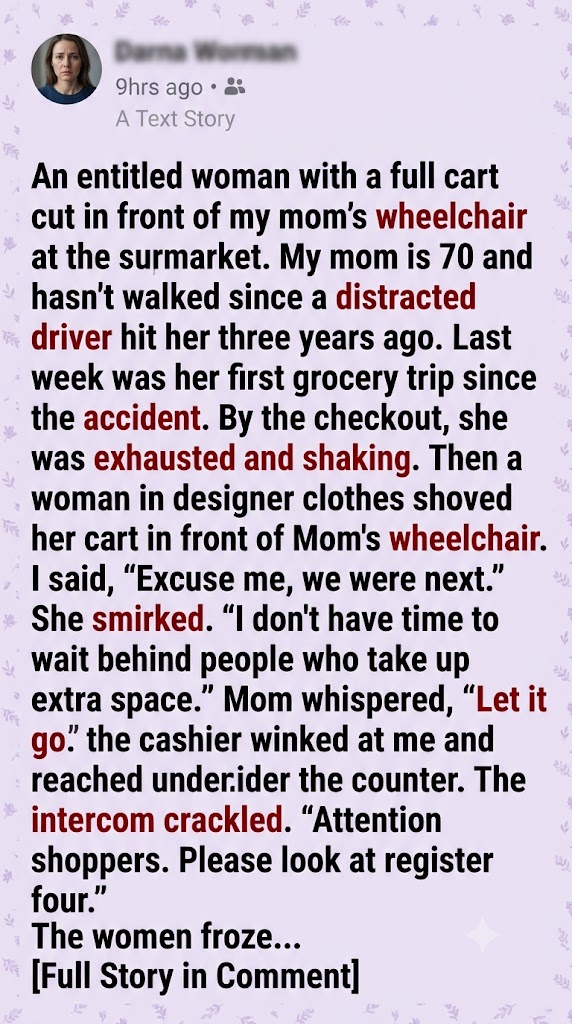
The first time my mother asked to go grocery shopping again, I nearly dropped my car keys.
For almost three years, she had avoided public places. After the accident that left her in a wheelchair, the world became too loud, too crowded, and too full of people who stared before they smiled.
So when she looked at me that Tuesday morning and said, “I want to choose my own apples today,” I knew it was more than a shopping trip.
It was courage.
We went to a small neighborhood market just after breakfast, hoping it would be quiet. Mom wore her favorite blue cardigan and kept smoothing it over her knees, like she was trying to make herself invisible.
“You don’t have to rush,” I told her as I pushed her through the produce aisle.
“I know,” she said softly. “I just don’t want to be in anyone’s way.”
That sentence hurt more than she realized.
We picked apples, flour, butter, and cinnamon. She wanted to bake the pie she used to make every Sunday before the accident. For a while, she seemed almost like herself again. She joked that I still didn’t know how to choose ripe fruit, and I pretended to be offended.
Then we reached the checkout line.
There were only two people ahead of us. Mom looked tired, but proud.
“I made it,” she whispered.
Before I could answer, a woman in a cream-colored coat pushed a cart overflowing with expensive groceries straight past us. She shoved her cart in front of my mother’s wheelchair so suddenly that Mom’s footrest bumped sideways.
“Excuse me,” I said, keeping my voice calm. “We were next.”
The woman barely looked at me.
“I’m in a hurry,” she said, unloading her items onto the belt.
“My mother is in pain,” I replied. “Please go to the back of the line.”
That was when she finally looked down at Mom.
Her expression was cold.
“Then maybe she shouldn’t come shopping during busy hours,” she said. “Some people don’t have time to wait behind special treatment.”
The cashier froze. The man behind us muttered something under his breath. My mother’s face turned pale.
“Please,” Mom whispered to me. “Don’t make a scene.”
But the woman wasn’t finished.
She waved her hand toward the wheelchair and said, “This already takes up half the aisle.”
I felt my anger rise, but before I could speak, the cashier reached under the counter and pressed a button.
A second later, the store intercom crackled.
“Attention, shoppers,” a man’s voice announced. “Could everyone near register three please join us in wishing a very happy birthday to Mrs. Clara Bennett, the woman who helped build this store from the ground up.”
The woman in the cream coat stopped moving.
My mother’s eyes widened.
The voice continued, “Mrs. Bennett spent twenty-six years serving this community with kindness, patience, and respect. She taught every employee here that no customer is ever an inconvenience.”
People turned toward us.
The cashier smiled gently. “Happy birthday, Mrs. Bennett.”
Then one employee began clapping. Another joined. Soon, half the front of the store was applauding.
My mother covered her mouth, overwhelmed.
The rude woman stared at her, then at the employees, then back at the groceries she had dumped onto the belt. Her confidence disappeared piece by piece.
“You own this place?” she asked, her voice suddenly small.
Mom looked at her for a long moment.
“I used to,” she said quietly. “Now my son runs it.”
At that exact moment, my brother Daniel walked out from the office near the registers. He had planned the birthday announcement as a surprise. He stopped when he saw Mom’s face.
“What happened?” he asked.
The cashier answered before anyone else could.
“She cut in front of Mrs. Bennett, hit her chair with the cart, and insulted her.”
The woman quickly lifted her hands. “That’s not what happened. I was just—”
“In a hurry?” Daniel interrupted. “Too hurried to show basic respect?”
The whole store went silent.
Mom touched his sleeve. “Daniel, don’t.”
But he wasn’t angry in a loud way. He was calm, which somehow made it worse.
“Ma’am,” he said to the woman, “you can either apologize sincerely and go to the back of the line, or you can leave without being served.”
Her face turned red.
“I spend a lot of money here,” she snapped.
Daniel looked at her full cart.
“And my mother spent half her life making sure people like you felt welcome here,” he said. “You don’t get to repay that by humiliating her.”
For the first time, the woman looked truly ashamed.
She turned toward Mom, but she couldn’t quite meet her eyes.
“I’m sorry,” she said stiffly.
Mom waited.
The woman swallowed. “I’m sorry I pushed ahead of you. And I’m sorry for what I said.”
Mom nodded once.
“Thank you,” she replied. “Please remember that people in wheelchairs are not obstacles. We are people.”
The woman quietly gathered her purse and moved to the back of the line.
That afternoon, Mom still made her pie.
Her hands shook a little when she rolled the crust, so I helped. Daniel came over after closing the store, and we sat around the kitchen table like we used to.
Before taking her first bite, Mom smiled.
“I was scared to go out today,” she admitted. “But I’m glad I did.”
I asked why.
She looked at both of us and said, “Because I remembered I still have a place in the world.”
And that, more than the applause, was the real victory.
