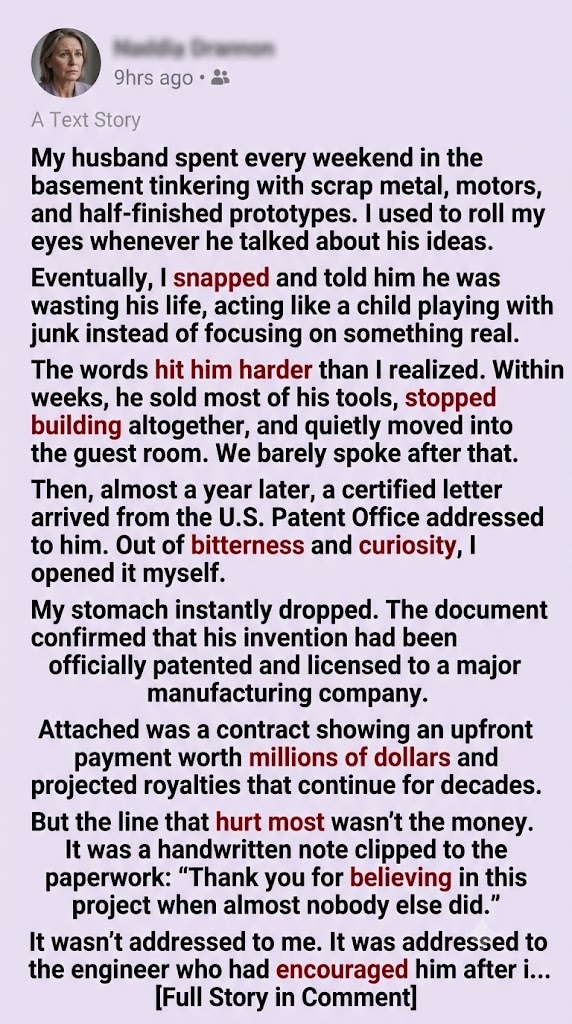
My husband spent every weekend in the basement building strange inventions out of scrap metal.
I told him he was wasting his life.
A year later, I discovered I had destroyed the one dream he never stopped believing in.
Honestly?
At first, I thought it was a phase.
Every Saturday morning, while other husbands played golf or watched football, mine disappeared into the basement.
Hours would pass.
Then entire weekends.
The sound of drills.
Metal grinding.
Motors spinning.
Occasional shouting when something broke.
God.
The basement looked like a junkyard.
Piles of scrap metal.
Broken machine parts.
Old electrical components.
Half-finished prototypes scattered everywhere.
And in the middle of it all sat my husband, Daniel.
Happy.
Genuinely happy.
At first I tolerated it.
Then I became annoyed.
Then embarrassed.
Friends would ask what he did for fun.
I’d laugh and say:
“He’s down there inventing the next spaceship.”
Everyone would chuckle.
Including me.
Honestly?
I thought I was being harmless.
But Daniel never laughed.
Not really.
Then one evening, after another weekend spent in the basement, I finally exploded.
Bills were piling up.
The house needed repairs.
I was frustrated.
And instead of discussing those things like an adult, I attacked the thing he loved most.
God.
I still remember every word.
“You’re fifty years old.”
Daniel looked up.
Confused.
I kept going.
“You’re down there playing with garbage like a little kid.”
Silence.
“You waste every weekend chasing ridiculous ideas that will never go anywhere.”
The room felt suddenly cold.
Daniel stared at me.
Not angry.
Not defensive.
Just hurt.
Deeply hurt.
Then I delivered the sentence I’d spend years regretting.
“Maybe it’s time you focused on something real.”
Honestly?
The look on his face should have stopped me.
It didn’t.
He simply nodded.
Then quietly walked away.
The next morning, I heard noises coming from the driveway.
When I looked outside, strangers were loading equipment into a truck.
His tools.
His workbench.
His welding equipment.
Everything.
God.
My stomach tightened.
I ran outside.
“What are you doing?”
Daniel didn’t even look at me.
“Selling them.”
That was all he said.
Selling them.
Within a month, the basement was empty.
Completely empty.
No projects.
No blueprints.
No tools.
No dreams.
And somehow…
the house felt quieter than ever.
Then something even worse happened.
Daniel moved into the guest room.
Not after a fight.
Not after screaming.
Just quietly.
One pillow.
One suitcase.
One closed door.
Honestly?
That hurt more than any argument could have.
Because it felt permanent.
For the next year, we barely spoke.
We became roommates.
Polite strangers.
Passing each other in hallways.
Eating meals in silence.
Living separate lives under the same roof.
Then one Tuesday afternoon, everything changed.
A certified envelope arrived in the mail.
Official.
Government markings.
Addressed to Daniel.
He wasn’t home.
God forgive me.
I opened it.
Partly from curiosity.
Partly from bitterness.
The moment I unfolded the documents, my heart stopped.
United States Patent Office.
Patent Approved.
I blinked.
Read it again.
Then again.
Because my brain refused to process what I was seeing.
The invention.
His invention.
The one I’d mocked.
The one I’d called garbage.
The one I’d convinced him to abandon.
It had been approved.
Not only approved.
Licensed.
A major manufacturing company had purchased the rights.
Attached to the paperwork was a contract.
I scanned the first page.
Then nearly dropped it.
The upfront payment alone was several million dollars.
Millions.
Projected royalties stretched for decades.
God.
My hands started shaking.
The basement.
The scrap metal.
The prototypes.
The weekends.
All of it had been real.
Every single bit of it.
Then I noticed a handwritten note clipped to the documents.
My stomach dropped immediately.
Because it wasn’t from the patent office.
It was from someone else.
An engineer who had helped Daniel during development.
The note read:
Daniel,
Congratulations.
You earned every bit of this.
Thank you for believing in this project when almost nobody else did.
I stared at that sentence.
Almost nobody else.
God.
I knew exactly who wasn’t included in that belief.
Me.
The person who should have supported him most.
The person who should have believed first.
Instead, I’d become the voice telling him to quit.
The voice telling him he was foolish.
The voice telling him his dream didn’t matter.
Honestly?
The money suddenly felt irrelevant.
Because the real loss wasn’t financial.
The real loss was realizing my husband had achieved something extraordinary despite me.
Not because of me.
That evening Daniel came home.
I was sitting at the kitchen table.
The documents spread out before me.
He saw them immediately.
Saw that I’d opened them.
Then slowly set down his briefcase.
Neither of us spoke.
Finally, I whispered:
“You got the patent.”
He nodded.
“You knew?”
Another nod.
“For how long?”
“A few months.”
God.
A few months.
He’d been carrying life-changing news alone.
Then I asked the question that terrified me most.
“Why didn’t you tell me?”
Daniel looked at me for a long moment.
And honestly?
The sadness in his eyes hurt more than anger ever could.
Then he quietly answered:
“Because you already told me what you thought of it.”
God.
I started crying instantly.
Right there at the table.
Because he was right.
Why would he share his biggest victory with someone who’d mocked the dream itself?
I apologized.
Really apologized.
Not excuses.
Not explanations.
Just truth.
I told him I was ashamed.
Told him I’d been wrong.
Told him I should have supported him.
Then I waited.
For forgiveness.
For comfort.
For something.
Daniel sat silently for a long time.
Then finally said:
“You know what hurt most?”
I shook my head.
Tears streaming down my face.
“It wasn’t that you thought I’d fail.”
His voice cracked.
“It was that you never seemed curious enough to ask why I kept trying.”
God.
That broke me.
Because it was true.
I never asked.
Not once.
Never asked what inspired him.
Never asked what problem he was solving.
Never asked what the invention could do.
I had judged something without ever understanding it.
Months later, Daniel received his first royalty check.
Then another.
Then another.
The money changed our lives.
But not immediately.
Because rebuilding trust took much longer than rebuilding a bank account.
Slowly, we started talking again.
Really talking.
One evening, Daniel brought home a small metal prototype.
The newest version of his invention.
Instead of rolling my eyes, I sat beside him.
Asked questions.
Listened.
Learned.
For nearly two hours.
When he finished explaining everything, he smiled.
The first real smile I’d seen in years.
Then he quietly said:
“I missed this.”
Honestly?
So did I.
Because in the end, the biggest lesson wasn’t about patents or millions of dollars.
It was about something much simpler.
The people we love don’t need us to understand every dream they have.
But they do need us to respect it.
And sometimes the most expensive mistake a person can make isn’t losing money.
It’s making someone they love feel foolish for believing in themselves.
