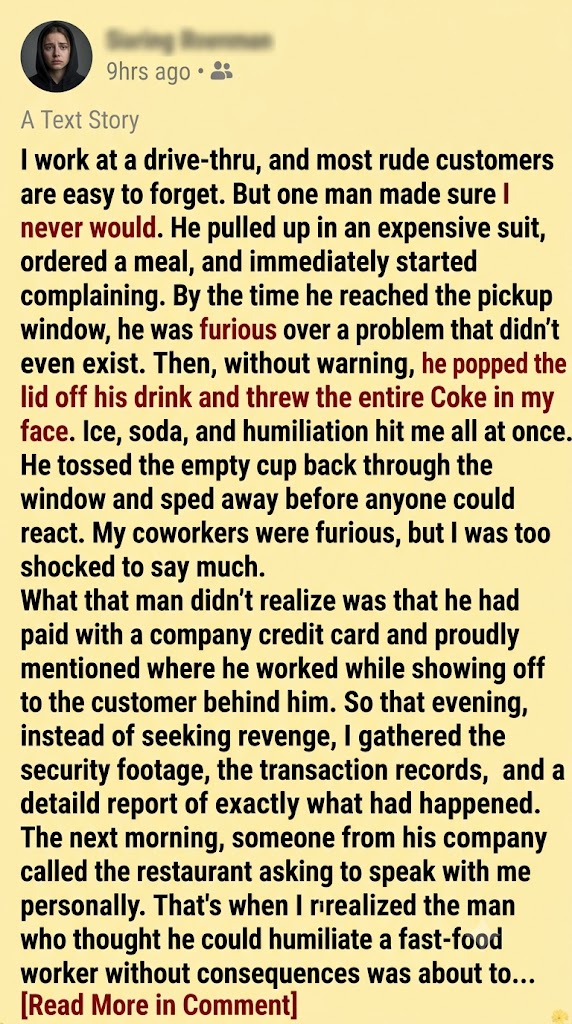
I work at a drive-thru.
After a few years in customer service, you develop a pretty thick skin.
People complain.
People get impatient.
People blame you for things completely outside your control.
Most of the time, you smile, apologize, and move on.
And usually, by the end of your shift, you’ve forgotten all about them.
But one customer made sure I never would.
It was a busy Friday afternoon.
The lunch rush was in full swing.
Cars wrapped around the building.
Orders were flying through the headset.
Everyone was moving as fast as possible.
Then a black luxury SUV pulled into the drive-thru.
The driver immediately sounded irritated.
Before I could even finish greeting him, he started complaining.
The menu was confusing.
The wait was too long.
The prices were ridiculous.
Every sentence seemed designed to start an argument.
I stayed polite.
Customer service mode.
Nothing unusual.
Eventually, he placed his order.
By the time he reached the payment window, he was even angrier.
He insisted we had charged him incorrectly.
We hadn’t.
The total matched the receipt exactly.
My manager checked.
Then checked again.
Everything was correct.
That didn’t matter.
The man kept escalating.
At one point, he even started showing off for the customer in the vehicle behind him.
Talking loudly about his job.
His company.
His success.
How people like him didn’t have time to deal with incompetence.
Everyone could hear him.
Including me.
Finally, he reached the pickup window.
I handed him his food.
Wished him a good day.
And hoped it was over.
Instead, he stared at me.
Then did something I never expected.
Without warning, he removed the lid from his large Coke.
And threw the entire drink directly into my face.
Ice.
Soda.
Everything.
The shock was immediate.
Cold liquid hit my eyes.
My uniform.
My hair.
The floor.
The equipment behind me.
For a second, I couldn’t even process what had happened.
The man tossed the empty cup back through the window.
Then sped away.
Gone before anyone could react.
The entire restaurant fell silent.
My coworkers were furious.
One employee actually started running toward the door.
Another wanted to call the police immediately.
Meanwhile, I just stood there dripping with soda.
Humiliated.
Stunned.
Trying to understand how an adult could behave that way.
Then one of my managers said something important.
“Wait.”
He pointed toward the transaction screen.
The man had paid using a company credit card.
Suddenly, everyone looked at each other.
Because during his performance for the car behind him, he’d repeatedly mentioned where he worked.
Apparently he was very proud of it.
That evening, after I went home and changed clothes, I made a decision.
I wasn’t interested in revenge.
I wasn’t interested in social media.
I wasn’t interested in creating drama.
I simply wanted accountability.
So I gathered everything.
Security footage.
Transaction records.
Witness statements.
A written report describing exactly what happened.
The restaurant’s management reviewed it all.
Then forwarded it to the appropriate people.
The next morning, my phone rang.
The caller identified herself as someone from the company’s human resources department.
Immediately, my stomach tightened.
She asked if I would be willing to describe the incident personally.
I agreed.
The conversation lasted nearly thirty minutes.
She listened carefully.
Asked questions.
Requested copies of documentation.
Then thanked me.
Several times.
Before ending the call, she said something that surprised me.
“I’m very sorry this happened to you.”
Simple words.
But meaningful ones.
Especially after the previous day’s experience.
A few days later, she called again.
This time, her tone was different.
More formal.
She informed me that the company had completed its internal review.
Because the incident occurred while the employee was using a company-issued credit card, wearing company-branded clothing, and actively identifying himself as a representative of the organization, they considered the behavior a serious violation of company policy.
She couldn’t share specific disciplinary details.
But she assured me the matter had been addressed.
Then she apologized again.
A week later, something unexpected arrived at the restaurant.
A handwritten letter.
It was from the man himself.
I honestly wasn’t expecting that.
Inside was a genuine apology.
Not excuses.
Not explanations.
Not attempts to minimize what happened.
Just an apology.
He admitted he had been angry about unrelated personal problems.
He admitted I had done nothing wrong.
And he admitted his behavior was unacceptable.
I don’t know whether the apology came from regret, consequences, or both.
Maybe it doesn’t matter.
What mattered was accountability.
Because that’s what had been missing at the drive-thru window.
People often assume kindness is weakness.
That service workers are easy targets because they’re expected to stay polite no matter what.
But being polite doesn’t mean accepting abuse.
And treating someone with respect shouldn’t depend on their job title.
The lesson wasn’t that I “got even.”
I didn’t.
The lesson was that actions have consequences.
Not because someone seeks revenge.
Because character eventually reveals itself.
That customer thought he was humiliating a fast-food worker who couldn’t do anything about it.
What he forgot is that every person deserves basic dignity.
Whether they’re wearing a business suit or a drive-thru headset.
And sometimes the most powerful response isn’t anger.
It’s simply making sure the truth reaches the people who need to hear it.
