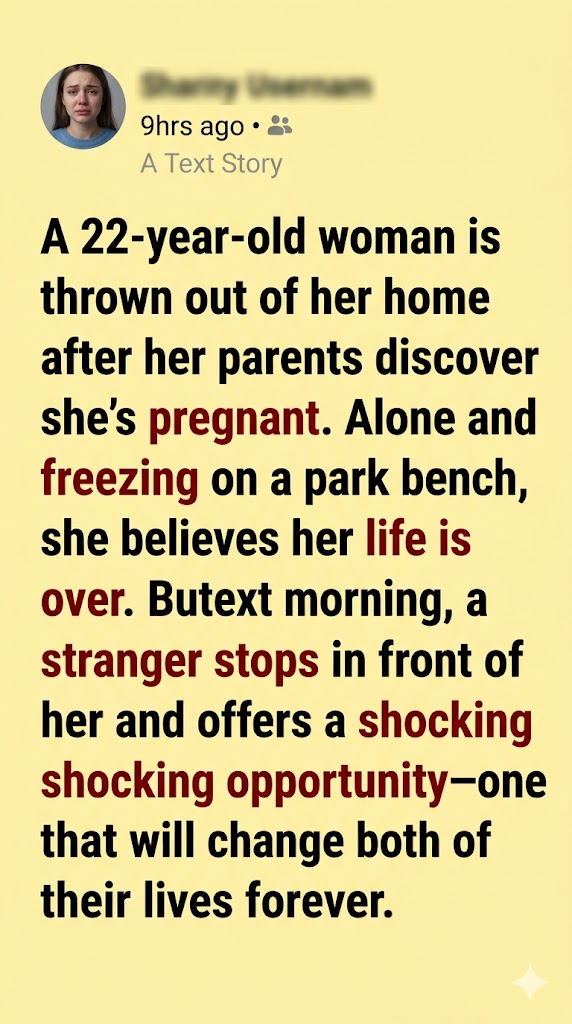
The night fell over the city like an irreversible sentence, bringing with it an icy wind that cut the skin and seeped into the bones. But for Elena, twenty-two, the real cold didn’t come from the November air—it came from the abyss that had opened in her chest only hours earlier. Sitting on an old wooden bench in the central square, knees drawn up and arms wrapped protectively around her seven-month belly, Elena felt like a castaway in an ocean of indifference. The flickering streetlamp above her head buzzed with a constant electric hum, a dull soundtrack to her shattered thoughts.
That very morning, her life had still had order—an everyday structure she believed was unbreakable. She lived in her childhood home with her parents, Lucía and Héctor, in a place that smelled of fresh coffee and floor wax. She worked at the municipal library, shelving books and quietly dreaming of the future. A future that, until recently, included Sergio. Just remembering his name sent a sharp pain through her stomach. Sergio—the law student, the easy smile, the big promises—had been the first to run. When he saw the two pink lines on the pregnancy test, his face changed, all color and warmth draining away. “I have a career, Elena. I can’t do this. I’m sorry.” And he left. Just like that, leaving her alone with a reality growing inside her.
Still, Elena had clung to hope in her parents. They were traditional, yes—strict at times—but they had always said family came first. She had been so wrong. The afternoon replayed in her mind like a horror film on repeat: the envelope with medical results on the plastic-covered table, the heavy silence, and then the shouting. Not worry—rage. Her father, Héctor, face flushed, couldn’t even look at her; he stared at the wall as if he couldn’t bear the sight of his “disgraced” daughter. “There is no place for shame in this house,” he had declared in a voice that allowed no argument. “We’ve lived our whole lives with our heads held high. I won’t have the neighbors whispering behind my back because of your irresponsibility.” Her mother, Lucía, cried silently—but did nothing to stop him. When Héctor opened the door and pointed to the street, Lucía turned her eyes away. That hurt more than any slap. Elena packed a backpack in a panic: two changes of clothes, a toothbrush, a thin blanket, and her grandmother’s photo. Nothing else. With that, she stepped out into the world, hearing the lock slam behind her, sealing her fate.
She walked for hours with no direction, tears drying on her cheeks in the wind. She tried calling a couple of friends, but the excuses came fast and clumsy. No one wanted trouble. No one had space. The city that had always felt familiar suddenly became a hostile maze of shadows and strange noises. Exhaustion finally defeated her in that square. “Everything will be okay, my love,” she whispered to her belly, stroking the tight fabric of her sweater. “Mum will find a way. I don’t know how, but I will.” But doubt gnawed at her. How? She had no money, no roof, and soon she would have a baby in her arms. Fear was paralyzing—an invisible monster hissing that maybe her parents were right, maybe she was a mistake, maybe she deserved nothing good. She closed her eyes, trying to sleep, but every branch creak, every distant footstep made her jolt awake. Being pregnant on the street felt like a physical sensation—a weight at the base of her skull that kept her on high alert.
The hours crawled. The sky shifted from black to a leaden gray as the city began to wake. The first buses rumbled in the distance. That was when Elena heard footsteps—steady, rhythmic—approaching along the gravel path through the park. Her body tensed. She clutched her backpack so hard her knuckles turned white. A policeman? A thief? She didn’t lift her gaze until the steps stopped directly in front of her. She saw immaculate, expensive running shoes. Her eyes traveled up black jogging pants, a technical hoodie, and finally a man’s face. Early thirties, dark hair slightly messy from exercise, a few days of stubble that couldn’t hide strong, noble features. But what caught her were his eyes—dark, deep, and filled with surprise and genuine concern that disarmed her. The man was still catching his breath from his run. He removed his earbuds and crouched slightly so he was closer to her level, keeping a respectful distance. “Good morning,” he said. His voice was low, soft—almost velvety. “Sorry to bother you, but… have you been here all night?”
Elena wanted to answer with pride, to tell him it was none of his business, but her voice betrayed her, coming out as a hoarse thread. “I didn’t have anywhere to go.” The man frowned, and a shadow of pain crossed his gaze, as if her answer had struck something personal. He looked at her belly, then the worn backpack, and finally back into her swollen, reddened eyes. “It’s far too cold to be out here, especially in your condition,” he said, standing and scanning the area like he was searching for a solution in the air itself. “My name is Adrián. I live a few streets from here.” Elena instinctively shrank back. Every warning she’d ever heard about strangers rang in her head. “I don’t need anything, thank you,” she lied—right as her stomach growled loudly, exposing her hunger.
Adrián gave a sad smile, one that didn’t quite reach his eyes yet somehow inspired an unexpected sense of safety. “I’m not offering you anything indecent. I promise,” he said. “I just see someone going through hell, and… let’s say I know that look.” He stepped back to give her space without leaving. “Listen,” he continued. “My housekeeper retired last week. I have a huge house and it’s falling apart from how big it is and how disorganized everything feels. I need someone trustworthy to help run it—organize, cook, keep things steady. I’m offering lodging in a separate guest house, meals, and a salary. It’s real work. You can come, see the place, and if you don’t feel safe, you walk away. But please—don’t spend another night on this bench.” Elena stared at him, searching his face for malice, for a trap. She found only a painful honesty. There was a quiet loneliness in Adrián’s posture that mirrored her own. It was crazy. It was risky. But looking at that hard bench and imagining another night there felt worse. “Why would you do this for a stranger?” she asked, voice shaking. Adrián exhaled and looked toward the horizon, where the sun began to break through the clouds. “Because sometimes all we need to not drown is for one person to reach out a hand,” he said. “And today, I can be that person.”
Elena didn’t know it then—when she took Adrián’s outstretched hand and let him pull her up—but that moment under the gray dawn wasn’t just the end of her worst night. It was the beginning of storms and revelations that would shake everything she believed about love, family, and forgiveness. Adrián’s mansion wasn’t simply a house—it was a fortress of solitude dressed in luxury. In one of the city’s most exclusive neighborhoods, high stone walls and wrought-iron gates guarded an immense, perfectly kept garden where silence reigned. When they entered that first morning, Elena felt tiny beneath such opulence. But Adrián kept his word exactly. He took her straight to the guest house—a small building at the back of the garden, cozy, with its own kitchen and bathroom, surrounded by roses. “This is your home now,” he said, handing her a set of keys. “No one will come in here without your permission. Rest. Eat something. Shower. We’ll talk about work tomorrow. Today you just recover.”
The first days passed in a haze of disbelief. Elena kept waiting for the dream to crack—for Adrián to demand something in return, or throw her out over a mistake. It never happened. Adrián was a successful businessman, owner of a hotel chain, and spent much of the day away. When he was home, he was calm and polite, treating Elena not like a servant but like someone helping bring order back into a life that had lost its center. Elena threw herself into the work with fierce devotion: cleaning, organizing, cooking simple homemade meals that filled the vast kitchen with warmth. She wanted to prove she wasn’t charity—that she was worth the chance she’d been given. And slowly, the cold, sterile house began to feel alive: fresh flowers in vases, stew simmering, curtains opened to let sunlight in.
As weeks passed, the strictly professional relationship softened. They began sharing morning coffee in the kitchen, talking about small things—news, weather, books. Elena discovered that Adrián, despite his wealth, carried an old sadness. Sometimes she found him in his office staring out the window, or turning an old baseball in his hands like it was a piece of his past. One stormy afternoon, while Elena dusted shelves in the library, a box of photos fell and scattered black-and-white memories across the floor. Adrián, reading nearby, stood quickly to help. Their hands brushed as they picked up one photo: two boys smiling—one taller and strong, the other smaller and pale—hugging in front of a modest house. “That was Hugo,” Adrián said, voice barely above a whisper. “My little brother.” Elena held the photo carefully. “He had a beautiful smile. Where is he now?” Adrián sat on the floor, back against the bookcase, as if the memory had weight. “He died when he was eight,” he said, swallowing hard. “He was born with a heart condition. Fixable—a routine surgery for people with money. But we… we were very poor. My parents worked themselves to exhaustion. I quit school at fourteen to work construction. We saved every cent, sold everything we had. But it wasn’t enough—at least not fast enough. The public system had an endless waiting list, and for private care we were short by a few thousand. He died one night in my arms, waiting.”
Elena’s eyes burned with tears. She sat beside him without speaking, offering only her presence. “That day,” Adrián continued, voice cracking, “at his grave, I swore I’d never be poor again. I swore money would never be the reason I lost someone I loved. I worked like an animal. I built this empire from nothing—fuelled by rage and pain. But when I reached the top… I realized I was alone. My parents died soon after—from exhaustion, from grief. And I stayed here in this golden castle with no one to share it with. Until I found you on that bench.” He looked at her then, and the intensity of his gaze stole Elena’s breath. “When I saw you—so vulnerable, protecting your baby—I saw my mother. I saw everyone the world abandons. Helping you wasn’t charity, Elena. It was… my way of saving myself too. Of making all this money mean something.”
That confession shattered the last wall between them. From then on they weren’t employer and employee—they were two wounded souls slowly healing each other. Adrián began driving her to medical appointments. He got more emotional than she did during the first 4D ultrasound. He bought parenting books, and one evening over dinner, he suggested—almost shyly—painting a room a soft pastel yellow “in case the baby ever wanted to sleep in the main house.” Elena began to bloom. She felt safe, respected, and—though she was afraid to admit it—she was starting to feel something deep for the man who had returned her dignity.
A month before her due date, Elena was in the kitchen humming a lullaby while baking a tart when the intercom at the gate buzzed. Andrés, the security guard, spoke in a grave tone. “Miss Elena, there’s a couple at the gate. They say they’re your parents.” The plate in Elena’s hands slipped and shattered on the marble. Her whole body froze. Adrián, just coming in through the back door, saw her face drain and rushed over. “What is it? Is it the baby?” “It’s them,” she whispered, eyes wide with panic. “My parents.” Adrián didn’t question her. He put a steady arm around her shoulders. “You don’t have to see them if you don’t want to. I can send them away.” “No,” Elena breathed, forcing herself to stand. “I have to face them. I can’t run forever.”
When Lucía and Héctor entered the living room, they looked smaller against the luxury around them, older, more worn. Héctor clutched his hat, eyes fixed on the floor. Lucía’s eyes were red. “Elena…” her mother started, stepping forward. “Don’t come closer,” Elena said. Her voice was firm even as she fell apart inside. Adrián stood at her side, silent strength. “Why are you here? Did you come to see if I ‘fixed the problem’?” Héctor finally looked up. There was pain in his eyes—and something else: desperation. “Daughter, please… We have no right to ask you for anything. We were cruel. We were wrong.” “Wrong?” Elena let out a bitter laugh. “You threw me out pregnant. You left me alone. If it weren’t for him, I’d be sleeping under a bridge.” “We know,” Lucía sobbed. “And God is punishing us for it. Your father… your father is very sick.” The room went dense with silence. “What does he have?” Elena asked. “Severe heart failure,” Lucía said through tears. “He needs urgent valve surgery. If he doesn’t get it this week, he won’t make it. It costs a fortune. We sold the car, mortgaged the house—we don’t even have half.”
The irony hit Elena like a blow. Her father—the man who cast her out to protect reputation—was now facing death because of money. “And you came to me?” she asked, stunned. “To the daughter who was a shame?” “We have no one else,” Héctor pleaded, dropping to his knees, pride dissolved by fear. “Elena, please. I know you hate me—and you should. But I don’t want to die. Forgive me. Help us.” Elena stared at them—broken, begging—then looked at Adrián. He was pale. The same story again: a failing heart, money, desperation. Adrián stepped forward, placing himself between Elena and her parents. His posture carried absolute authority. “Stand up,” he ordered Héctor coldly. Héctor obeyed, trembling. “I’ve heard your story,” Adrián said. “And I know Elena’s. I know what you did. You threw her away to protect your ‘reputation.’” “Sir, we were wrong—” Lucía tried. “Regret tends to arrive when something is needed,” Adrián cut in. “You don’t deserve Elena’s help. You barely deserve to be in her presence.” Elena felt a flicker of pain for her parents—but also a profound validation. Someone was defending her. Someone was setting boundaries.
“However,” Adrián continued, and his voice softened into something human, “I know what it is to lose someone because you don’t have money. I know that pain, and I wouldn’t wish it on anyone. Not even you.” He pulled out his chequebook. The scratch of pen on paper was the only sound in the room. He tore out the cheque and held it up—but didn’t hand it over. “This covers the surgery, recovery, and the best specialists in the city. Everything.” Lucía and Héctor’s eyes widened; it was more money than they’d ever seen. Héctor reached for it, shaking, but Adrián withdrew it slightly. “Not so fast. This isn’t a gift. It’s a contract—with conditions.” “Anything,” Héctor cried. “Anything.” “First,” Adrián said, locking eyes with Héctor, “you will apologize to your daughter. Not because you need money. You will apologize every day for the rest of your lives—with actions, not words. You will respect her choices, her life, and her child. That baby is your grandchild, and you will love that child the way you refused to love her mother. If I hear one reproach, one criticism about her being a single mother, I will make sure you regret it.” “I swear it,” Héctor sobbed. “I swear on my life.” “Second,” Adrián added, turning to Elena with tenderness, “you will understand she no longer belongs to you. She is free. If she chooses to see you again, it will be because she wants to—not because she owes you. You lost your rights the night you threw her out. Now you will earn them back from zero.” Adrián handed over the cheque. Lucía and Héctor took it as if it were sacred, crying, thanking God, thanking Adrián, thanking Elena—then they approached Elena but didn’t dare hug her. They kissed her hands, begging forgiveness, before leaving for the hospital.
When the door closed, Elena collapsed onto the sofa. Adrián sat beside her and held her tightly. “Why did you do it?” she asked into his chest. “They hurt you too, indirectly.” “Because hate is heavy, Elena,” Adrián whispered, kissing her hair. “And because I didn’t want your child to be born under the shadow of her grandfather’s death. We broke the cycle today.” Héctor’s surgery was a complete success. During recovery, something slow but real began to change. The fear of death burned the poison of pride out of Elena’s parents. With permission, they visited—not to judge, but to help. Lucía knitted baby clothes. Héctor repaired the family’s old wooden cradle. It wasn’t instant, but it was genuine.
Then, one December dawn, Elena woke with a sharp pain tearing through her back and belly. This wasn’t practice. This was now. She hit the intercom Adrián had insisted on installing beside her bed. Within two minutes he was there, in rumpled pajamas, mind crystal-clear. “It’s time,” Elena gasped. “Breathe with me,” he said. “The car’s ready.” They raced to the hospital through a light snowfall. Adrián drove with one hand and held Elena’s hand with the other, whispering encouragement. The delivery was complicated. The baby was positioned badly, and Elena’s heart rate dropped dangerously. “Adrián, I’m scared!” she cried. “If something happens to me, take care of my baby!” “Don’t say that,” he said, pale but unbreakable, mouth close to her ear. “You’re not leaving. We’re taking this baby home together. You’re my family, Elena. Don’t you dare leave me.” In that raw moment—life and death hovering—the truth surfaced. They weren’t just roommates. They were everything to each other.
Finally, after hours, a strong newborn cry shattered the tension. “It’s a girl,” the doctor announced, lifting a small, furious, pink-faced miracle. Relief flooded the room. They placed the baby on Elena’s chest. Elena sobbed, kissing her daughter’s damp head. Adrián watched from the side, tears streaming freely, feeling more than he’d ever felt from his biggest business victories. “What’s her name?” a nurse asked. Elena looked at the baby, then at Adrián, seeing in his eyes every act of support that had kept her alive. “Her name is Clara,” Elena said. “Because she brought light into my darkness. And her second name… will be Adriana. After you.” Adrián moved closer, trembling. “May I?” he asked, reaching a finger toward the baby’s hand. Little Clara closed her tiny fist around his finger with surprising strength. In that instant, the bond was sealed. Not blood—soul. “Welcome to the world, Clara,” Adrián whispered. “I promise you’ll never lack anything. I promise you’ll always have a home.”
The months that followed were a whirlwind of joy. Adrián stepped into fatherhood naturally—diapers, night feedings, off-key lullabies that made Clara laugh. Elena’s parents, keeping their promise, became present, respectful grandparents, grateful for the second chance. One year after the morning in the square, the mansion garden was transformed with balloons, white tablecloths, and soft music for Clara’s first birthday. Then Adrián asked for silence, holding Clara in his arms, and called Elena forward. She approached glowing in a simple blue dress. “A year ago,” Adrián said, voice steady, “I found a broken angel on a park bench. I thought I was saving her. Giving her a roof. I was wrong. She saved me—from loneliness, bitterness, and the silence of this enormous house. She taught me family isn’t only blood. It’s loyalty. It’s staying when everything collapses.” Adrián lowered himself carefully onto one knee, still holding Clara, and opened a small velvet box. “Elena, you and Clara are my whole life. I don’t want a single day more without the world knowing you are mine and I am yours. Will you marry me—and let me be the official father of this little princess?” Elena covered her mouth, crying. She looked at her parents, who were sobbing and nodding, then at Clara giggling in blissful ignorance, then at Adrián—her rescuer, her love, her best friend. “Yes,” she managed. “Yes, a thousand times yes.” The garden exploded in applause. Héctor hugged Adrián—awkward, sincere—closing old wounds for good. The wedding took place right there, that same day: simple, meaningful, overflowing with real love. And as they danced, Clara asleep on Adrián’s shoulder between them, Elena thought of the cold bench, the fear, the despair—and realized that sometimes life has to break completely to be rebuilt into something far more beautiful. The mansion never felt empty again. Its doors stayed open to those in need, because Elena and Adrián never forgot that a single act of kindness on a freezing morning
can change the fate of generations.
“Exiled Priest Confronts Ruthless Landowner—Hidden Truth About Father’s Death Shocks Entire Village”
There are moments in life when a man feels that bad luck finally gets tired of chasing him and decides to give him a break. That moment came for Daniel Carter one ordinary afternoon at a dusty gas station on the side of the highway, when the radio announcer began reading out the lottery numbers.
Out of pure habit—of someone who clings to hope—Daniel reached into the pocket of his worn flannel shirt and pulled out the crumpled ticket he had bought a week earlier. He checked it once, then twice, then a third time—his hands trembling so much the paper nearly slipped from his fingers, rough from years of cement and construction work.
It wasn’t a life-changing jackpot that would make national headlines, but it was enough. Enough to pay off debts, enough to buy peace, and most importantly—to give back to his parents the years that poverty had stolen from them. Enough for Robert Carter and Helen Carter, who had spent their youth under the brutal sun working corn fields, to finally stop worrying about money for the rest of their lives.
Daniel didn’t cry. He stood frozen beside his old pickup truck, staring at the horizon as if beyond the hills, a new life was opening before him. His first thought wasn’t luxury. It was his mother mending the same clothes over and over, and his father returning home with a broken back and worn-out shoes.
That same night, he packed everything. He was going home. For eight long years, he had worked construction near the border—breathing dust from sunrise to sunset, sending every extra dollar back home. Now he returned with pride.
But as he entered the small town of San Lorenzo, something felt wrong. People avoided his eyes. Whispers followed him. There was pity in their faces. Outside a butcher shop, Mr. Harrison, an old family friend, stopped him. “Your father will be surprised to see you…” Daniel smiled. “I’m heading home right now.” Harrison looked down nervously. “They don’t live there anymore.”
Daniel’s heart dropped. He drove to his childhood home. The house was still there—but painted bright red, with loud music blasting from inside. On the porch sat Patricia Carter, his aunt, drinking beer. “This house is mine now,” she smirked. “Your father sold it to me. Completely legal.”
Daniel said nothing. He drove away.
At the abandoned stable by the river, he found them—his parents, sitting on empty paint buckets. In front of them was a bucket of animal feed. His mother was eating it. Time stopped.
The sound of the spoon hitting the metal bucket echoed through the broken stable. Robert looked up, his eyes filled with shame. Helen began to cry. “We didn’t want you to worry…” But Daniel knew the truth. This was hunger. This was humiliation.
He fell to his knees and held their hands—cold, fragile. “What happened?”
Helen told everything. Patricia had tricked them with fake documents, false debts, and threats of prison. Robert signed everything out of fear. Two weeks later, they were thrown out into a storm. No one helped them. Patricia controlled the town.
That night, Daniel moved them out, buying clothes, food, and shelter. And he made one promise: “I will fix this.”
The next day, he visited a lawyer. The case seemed impossible—until Patricia’s own son, Jason Carter, showed up. “I can’t live with this,” he said, handing Daniel an envelope. Inside were audio recordings, forged signatures, and undeniable proof. Everything changed.
At the town festival, Patricia laughed, drank, and celebrated her victory. Then Daniel walked in with the lawyer, followed by a heavy silence. He played the recording. Her voice—threatening her own brother—echoed through the crowd. The town turned against her. She tried to deny it, panicked, and broke down.
Then Daniel placed the proof of his lottery winnings on the table. “You thought we were powerless,” he said calmly. “You were wrong.”
Within 48 hours, she was arrested—charged with fraud and extortion. Her empire collapsed.
Daniel brought his parents home. The house was restored, and the town began to change. He built a cooperative to help others. But one place remained untouched—the old stable.
“Why keep it?” his father asked.
Daniel looked at it quietly. “So we never forget. Family isn’t blood… it’s loyalty.”
And as he watched his parents laugh under the lemon tree, he finally understood: the real prize wasn’t the money—it was giving back their dignity.
