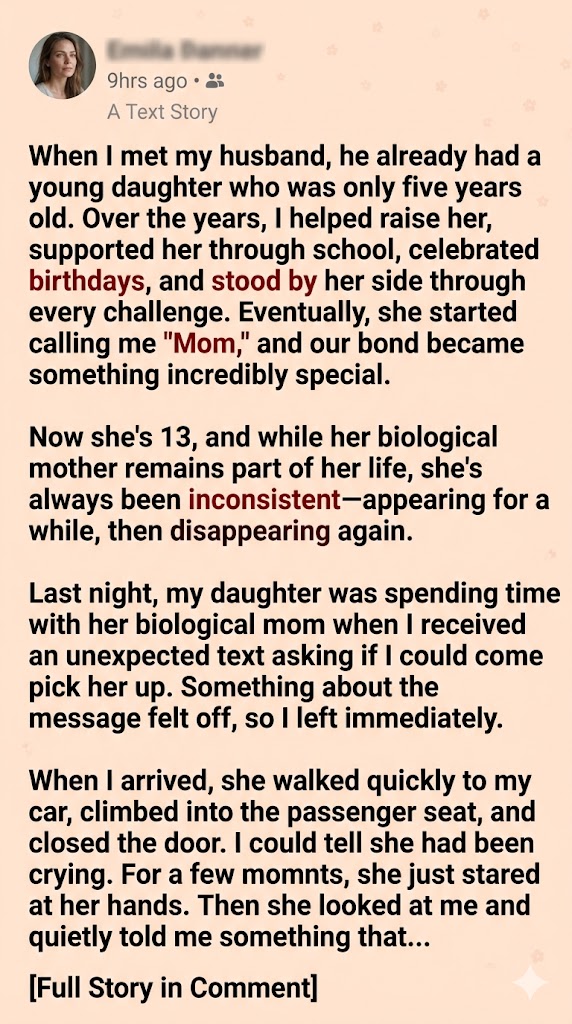
When I met my husband, he already had a little girl.
She was five years old.
Tiny.
Shy.
And still trying to understand why her parents no longer lived together.
I never intended to replace anyone.
I never wanted to.
From the beginning, I told myself that if I was going to be part of her life, I would simply love her the best I could.
Nothing more.
Nothing less.
Over the years, our relationship grew naturally.
Homework at the kitchen table.
Bedtime stories.
School projects.
Birthday parties.
Doctor appointments.
Dance recitals.
Heartbreaks.
Victories.
All the little moments that quietly become a childhood.
Somewhere along the way, she stopped seeing me as just her dad’s wife.
And I stopped seeing her as just my stepdaughter.
We became family.
One day, completely out of nowhere, she called me “Mom.”
I remember trying not to cry.
I never asked for the title.
Never expected it.
But hearing it meant more than I can explain.
Her biological mother remained part of her life.
At least technically.
The problem was consistency.
Sometimes she would show up regularly for months.
Phone calls.
Visits.
Plans.
Promises.
Then suddenly she would disappear again.
Weeks.
Sometimes months.
My daughter never stopped hoping things would change.
No matter how many times she was disappointed.
She always wanted her mother.
And honestly, who could blame her?
Last night, she was spending time with her biological mom.
Everything seemed normal.
Then my phone buzzed.
A text message.
Can you come get me?
That was it.
No explanation.
No details.
Just six words.
Immediately, something felt wrong.
Very wrong.
I grabbed my keys and left.
The entire drive, my stomach was in knots.
When I arrived, she was already waiting outside.
The moment she saw my car, she hurried over.
Opened the passenger door.
Climbed inside.
And quietly shut it behind her.
I noticed her eyes immediately.
She’d been crying.
A lot.
For several moments, neither of us spoke.
She stared at her hands.
I stared at the road.
Giving her time.
Eventually, I asked softly:
“Do you want to tell me what happened?”
Her lips trembled.
Then she looked up.
And said something that completely shattered my heart.
“She told me to stop calling you Mom.”
The words hit me like a punch.
I gripped the steering wheel tighter.
Not because I was angry.
Because I suddenly understood exactly why she’d been crying.
Tears immediately filled her eyes again.
“She said you’re not my real mom.”
I stayed silent.
Listening.
Because this wasn’t about me.
It was about her.
“She said every time I call you Mom, it hurts her feelings.”
My daughter wiped at her face.
Then whispered:
“So I asked why she leaves all the time if she wants to be my mom.”
The car became very quiet.
Painfully quiet.
“She got mad.”
Of course she did.
Children have a way of asking the questions adults spend years avoiding.
My daughter stared out the window.
Then said the sentence that broke me completely.
“I don’t understand why she only wants to be my mom when I’m with you.”
I had no answer.
Because there wasn’t one.
At least not one a thirteen-year-old deserved.
For years, this child had been expected to carry emotions that belonged to adults.
To manage disappointments she didn’t create.
To understand absences she couldn’t control.
And somehow she still loved everyone involved.
That kind of resilience is remarkable.
And heartbreaking.
We sat in the driveway when we got home.
Neither of us in a hurry to get out.
Finally, she looked at me.
“Am I hurting your feelings when I call you Mom?”
I immediately shook my head.
“No.”
“What if I call both of you Mom?”
“No.”
“What if I only call you Mom sometimes?”
I felt tears gathering in my eyes.
Still no.
Then I took her hand.
And told her the truth.
“The word Mom belongs to you.”
She blinked.
Confused.
I continued.
“You get to decide who that word means in your life.”
Tears started rolling down her cheeks again.
This time mine too.
I wasn’t trying to win.
I wasn’t trying to replace anyone.
I never had been.
Because motherhood isn’t a competition.
It’s a relationship.
And relationships aren’t built by biology alone.
They’re built by showing up.
Again.
And again.
And again.
For years.
At bedtime.
At school events.
During illnesses.
During celebrations.
During ordinary Tuesdays that nobody remembers except the child who needed you there.
That night, after she went to bed, I sat alone thinking about everything she’d said.
Especially one sentence.
I don’t understand why she only wants to be my mom when I’m with you.
Because hidden inside those words was the real heartbreak.
Not jealousy.
Not titles.
Not labels.
A little girl wondering why love sometimes feels conditional.
This morning, she came downstairs for breakfast.
Half asleep.
Hair a mess.
Still wearing oversized pajamas.
And before grabbing a bowl of cereal, she smiled at me and said:
“Morning, Mom.”
Just like she always does.
And I smiled back.
Because no matter what anyone else says, some relationships don’t need permission.
They simply grow.
One bedtime story.
One school project.
One hug.
One ordinary day at a time.
And sometimes the people who earn the title Mom aren’t the ones who gave a child life.
They’re the ones who never stop showing up for it.
