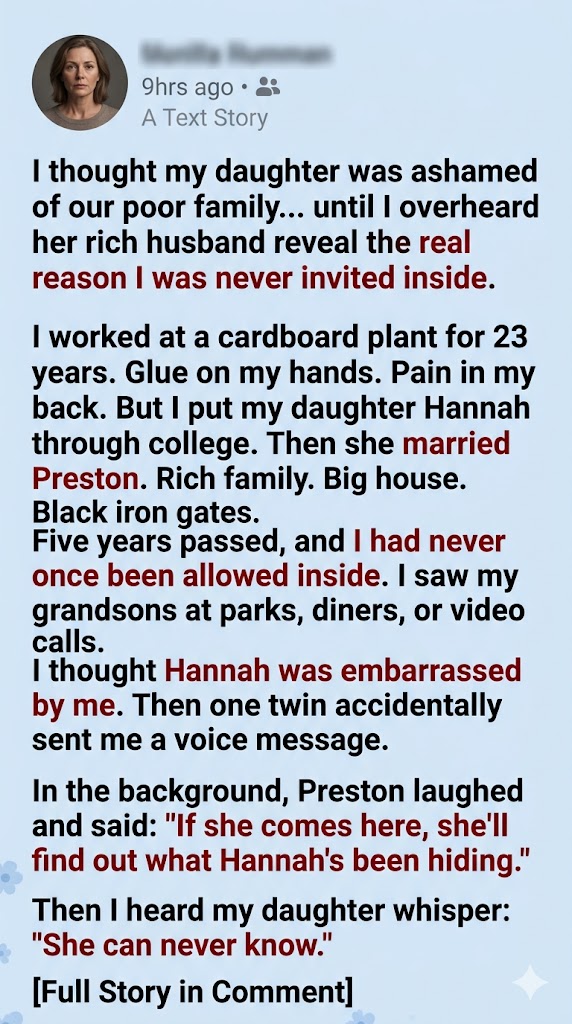
The voice message came through while I was scraping dried oatmeal from a saucepan.
My phone buzzed on the counter beside a stack of unpaid bills and the blue lunch bag I carried to the packaging plant every morning. I almost ignored it. At fifty-four, I had learned that most messages could wait until after dishes, laundry, and whatever else needed doing before bed.
Then I heard my grandson’s laugh.
The message had come from my daughter, Natalie, though it was clearly accidental. At first, there was only noise — cartoons, toy trucks rolling over wood floors, one of the boys yelling about dinosaurs. I smiled and kept the sponge moving around the pan.
Then an older woman’s voice came through.
“Why doesn’t your mother-in-law ever come here?”
The sponge stopped in my hand.
My daughter’s husband, Brandon, answered after a pause. “Because if Margaret comes inside, she’ll figure out what Natalie has been hiding.”
I turned off the faucet.
My daughter’s voice was low. “Brandon, please.”
His mother said something I could not catch. Then Brandon spoke again, tired more than angry.
“She deserves to know the house is tied to her family. She deserves to know where the money came from.”
I set the phone beside the sink and watched water drip from the sponge onto the stainless steel.
For five years, I had told myself not to be hurt.
Natalie married Brandon when she was twenty-eight. He came from money, or close enough that it looked the same from my side of town. His parents had a brick house with a circular driveway, and he wore button-down shirts that never seemed to wrinkle. I had spent twenty-seven years working at the same cardboard packaging plant, where my hands smelled like glue and paper dust no matter how much lemon soap I used.
After the wedding, Natalie and Brandon moved into a big house behind a gated entrance outside town. I saw pictures online at first — a wide front porch, tall windows, stone steps, the kind of kitchen people call “open concept.” Then the pictures stopped.
I had never been inside.
Not when their twin boys were born. Not for birthdays. Not for Christmas morning. Not even when Mason had tubes put in his ears and I offered to bring soup after the hospital. Natalie always had a reason.
“The boys are worn out.”
“Contractors are here.”
“Brandon’s parents are stopping by.”
“It’s easier if we come to you, Mom.”
So they came to my small duplex instead. The boys spilled crackers on my carpet, climbed on my couch, and taped their drawings to my refrigerator with magnets from the insurance office. I loved every minute, then cried some evenings after they left because I could smell their shampoo on the throw pillows.
My sister Ruth was the only one I admitted it to.
“She’s embarrassed,” I told her one Sunday after church, while we ate tuna sandwiches in my kitchen.
Ruth looked at me over her glasses. “Natalie loves you.”
“She loves me at diners and playgrounds.”
Ruth did not have an answer for that.
After the voice message, I barely slept. The next morning, I called my supervisor at the plant and told him I had a family emergency. He grunted like emergencies were poor planning, but said okay.
I drove across town in my twelve-year-old Buick with the service light glowing on the dashboard. When I reached Natalie’s neighborhood, the gate was opening for a landscaping truck, so I followed it in before I could lose my nerve.
Her house looked larger in person. Not glamorous, exactly. More unfinished than the pictures had suggested. A blue tarp covered part of the side porch. Two windows had painter’s tape around the trim. A stack of lumber sat near the garage.
Natalie opened the door wearing leggings, one sock, and the face of someone who had run out of places to hide.
“Mom.”
“I heard the message.”
She gripped the edge of the door. Behind her, one of the twins shouted, “Grandma!” like my arrival was the most natural thing in the world.
“I need you to let me in,” I said.
She stepped back.
The first thing I noticed was not wealth. It was sawdust. Then paint fumes. The foyer had a beautiful staircase, but one wall was bare drywall from waist to ceiling. Boxes were stacked in the dining room. A plastic sheet hung over an opening that should have had French doors.
Brandon came in from the kitchen carrying a coffee mug. He saw me and set it down too carefully.
“Margaret,” he said.
“Nobody needs to perform,” I told him. “Just tell me.”
Natalie covered her mouth with one hand, then dropped it. “I was going to. I kept thinking there would be a better time.”
“For five years?”
She looked toward the stairs, where the boys were sitting halfway up, watching us through the railing.
Brandon pulled a folder from a drawer in the hall table. It was the kind of legal folder people use when they want paper to look less frightening than it is. Inside were copies of a deed, inheritance papers, and an old trust document with my father’s name printed on the top.
My father, Harold Bennett, had worn the same work boots for fifteen years and drove an old Chevy pickup with a cracked windshield. He repaired equipment for three factories in our county and never bought anything new unless the old one had fully quit. When he died, I thought he left behind his house, his tools, and a checking account barely large enough to cover the funeral home.
Apparently, he had left more.
“Dad owned land?” I asked.
Natalie nodded. “More than anyone knew. Some investment accounts too. He put them in a trust.”
“For you?”
“For me,” she said quietly.
The words sat there between us, strange and heavy.
Brandon opened the deed. “This property was part of it. The house was in terrible shape when we started. We thought we’d renovate and tell you once it was done.”
“Why not tell me before?”
Natalie’s face tightened. She looked younger then, more like the girl who used to sit at my kitchen table doing homework while I packed my work boots by the door.
“Grandpa made me promise not to tell you right away,” she said. “He said you’d be angry.”
I almost laughed, but there was nothing funny in it.
“He was right.”
Natalie nodded.
“He watched me work double shifts,” I said. “He saw me worry over rent. He let me drive that old Buick with no heat for two winters.”
Brandon looked down at the folder.
Natalie took a step closer. “He told me you wouldn’t take help. He said you had too much pride.”
“That was his excuse?”
“I don’t know,” she said. “Maybe it was his shame.”
That quieted the room more than I wanted it to.
My father had been a hard man to read. He could fix anything with a motor but could not say sorry without turning it into advice. Maybe he thought leaving something to Natalie made up for all he never gave me directly. Maybe he was only better at planning money than talking to his daughter.
Both things could be true.
“What hurt,” I said, “was thinking you didn’t want me here.”
Natalie’s eyes reddened, but she kept her voice steady. “I was embarrassed, Mom. Not of you. Of this. Of the money. Of Grandpa. Of letting it go so long that every month made it harder.”
One of the twins came down the stairs holding a plastic dinosaur. “Grandma, you want to see our room?”
Natalie wiped her cheek with her sleeve. “Buddy, not now.”
“No,” I said. “I do.”
Their bedroom was at the end of a hallway with unfinished trim. Inside, the walls were painted pale blue, and above the dresser were photographs. Me at the park with the boys. Me feeding them pancakes at the diner. Me sitting between them on my old couch with a storybook open on my lap.
There were more pictures of me in that room than in my own home.
Natalie stood behind me. “They ask why you don’t sleep over.”
I touched the edge of one frame. “I thought I wasn’t welcome.”
“You were always wanted,” she said. “We were just cowards about the truth.”
Downstairs, Brandon made coffee. Real coffee, not the fancy kind with foam. We sat at the kitchen island between a paint sample book and a stack of contractor invoices. He explained the renovation delays, the contractor who disappeared with a deposit, the bathroom flood, the property tax bill that surprised them the second year.
It sounded less like a rich person’s secret and more like ordinary life wearing expensive shoes.
That evening, Brandon grilled burgers on the back patio while the boys chased bubbles through the yard. Natalie sat beside me with her knees pulled close, the way she used to sit as a teenager when she had something difficult to say.
“You still mad?” she asked.
“Yes.”
She nodded.
“But I’m here.”
She reached for my hand and held it without making a speech.
After dinner, Mason fell asleep against my side on the couch. His brother put a dinosaur in my lap and told me it could stay at my house next time. Natalie started to correct him, then stopped.
When I left, she walked me to the Buick.
“Come back Sunday?” she asked.
I looked at the big unfinished house, the porch light flickering over the steps, the blue tarp moving slightly in the evening wind.
“Only if you let me bring potato salad,” I said.
She smiled then, tired and relieved.
At home, I put my lunch bag by the door for work. The bills were still near the microwave. My coffee mug still sat beside the sink.
But the next Sunday, I drove through that gate on purpose.
