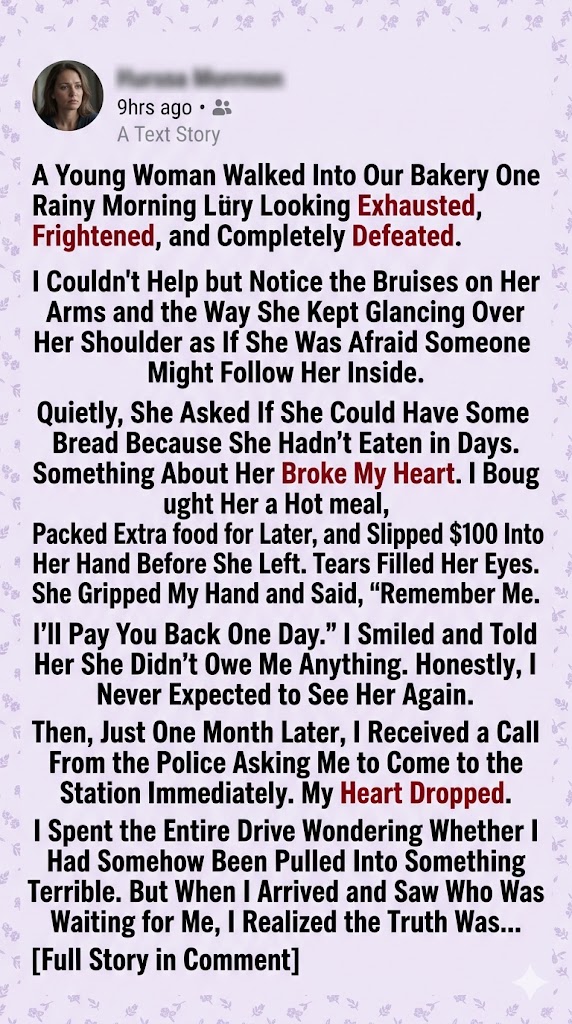
I own a small bakery on the corner of Maple and Third.
Nothing fancy.
Just fresh bread, coffee, and pastries.
Most mornings follow the same routine.
Open at six.
Bake until noon.
Chat with regular customers.
Repeat.
After twenty years, not much surprises me anymore.
Then came the rainy Tuesday morning that changed everything.
Business was slow.
The streets were nearly empty.
Around eight o’clock, the front door opened.
A young woman stepped inside.
Immediately, I knew something was wrong.
She looked exhausted.
Not the kind of tired that comes from a bad night’s sleep.
The kind that settles deep into someone’s bones.
Her clothes were damp from the rain.
Her hands trembled slightly.
And every few seconds she glanced through the front window as if expecting someone to appear.
Then I noticed the bruises.
Faint yellow and purple marks along her arms.
My stomach tightened.
She approached the counter slowly.
Almost apologetically.
“Excuse me.”
Her voice barely rose above a whisper.
“Could I have some bread?”
She hesitated.
Then added:
“I haven’t eaten in a couple of days.”
Something inside me broke.
People ask for help in different ways.
Some are direct.
Others try to hide how desperate they are.
This young woman clearly hated asking.
I didn’t even think about it.
I walked into the kitchen.
Made her a hot sandwich.
Added soup.
A pastry.
A bottle of water.
Then packed another bag with enough food to last several days.
When I returned, her eyes widened.
“I only asked for bread.”
I smiled.
“Good thing I’m giving you more than bread.”
She started crying.
Quietly at first.
Then harder.
I sat beside her while she ate.
Little by little, pieces of her story emerged.
Her name was Lily.
She had recently left an abusive relationship.
No family nearby.
Very little money.
Nowhere stable to stay.
She wasn’t asking for charity.
She was simply trying to survive another day.
Before she left, I slipped a folded hundred-dollar bill into her hand.
At first she tried to refuse.
I insisted.
Finally she accepted.
More tears followed.
Then she squeezed my hand.
Hard.
And said something I still remember perfectly.
“Remember me.”
I laughed softly.
“I’ll try.”
She shook her head.
“No.”
Her voice became stronger.
“I’ll pay you back one day.”
I smiled.
“You don’t owe me anything.”
Then she disappeared into the rain.
Honestly, I never expected to see her again.
Not because I doubted her.
Because life doesn’t usually work that way.
People come.
People go.
You help when you can.
Then you move on.
A month later, my phone rang.
The caller identified himself as a police officer.
Immediately my heart started racing.
“Mr. Daniels?”
“Yes.”
“We need you to come to the station.”
My stomach dropped.
“What happened?”
“I’m afraid I can’t discuss it over the phone.”
That answer didn’t help.
The entire drive there was torture.
Had someone used counterfeit money at the bakery?
Was I a witness to something?
Had Lily gotten into trouble?
My imagination produced a hundred terrible possibilities.
None prepared me for what I actually found.
When I arrived, an officer escorted me into a conference room.
Inside sat three detectives.
A police captain.
And Lily.
For a moment, I didn’t recognize her.
She looked completely different.
Healthy.
Confident.
Safe.
The bruises were gone.
The fear was gone.
The constant scanning of every doorway was gone.
Most importantly, she was smiling.
I stared in confusion.
“What is happening?”
Lily stood.
Then surprised me by throwing her arms around me.
The detectives smiled.
One of them finally explained.
The story was unbelievable.
The abusive boyfriend Lily had fled wasn’t just abusive.
He was wanted.
For years.
Not for domestic violence alone.
For a string of financial crimes, fraud schemes, and several outstanding warrants.
When Lily escaped, she carried information investigators had been trying to obtain for a very long time.
The problem was that she had been too terrified to trust anyone.
Until that day in the bakery.
The detective looked directly at me.
“Your kindness changed the timing of everything.”
Apparently, after leaving the bakery, Lily used part of the money I’d given her to get transportation to a domestic violence shelter.
There, she finally felt safe enough to speak.
One conversation led to another.
Then another.
Within weeks, investigators arrested several people connected to the operation.
The police captain leaned forward.
“She believes she wouldn’t have made it to the shelter without your help.”
I didn’t know what to say.
Because I hadn’t done anything extraordinary.
I bought someone lunch.
That’s all.
Then Lily reached into her purse.
Everyone smiled knowingly.
She removed an envelope.
And slid it across the table.
Inside was exactly one hundred dollars.
The same amount I’d given her.
I laughed.
“No.”
She nodded firmly.
“Yes.”
“I told you that you didn’t owe me anything.”
Her eyes filled with tears.
“You also told me I mattered.”
I froze.
Because I honestly didn’t remember saying that.
Apparently she did.
She remembered every word.
Then she said something I’ll never forget.
“When you’ve spent years being treated like you’re worthless, the first person who treats you like a human being becomes impossible to forget.”
The room grew very quiet.
A few months later, Lily started volunteering at the same shelter that helped her.
A year later, she became a full-time advocate for survivors of domestic violence.
Today, she’s helped hundreds of women rebuild their lives.
Far more people than I could ever reach on my own.
Every Christmas, she still visits the bakery.
She buys coffee.
We talk.
And before leaving, she always says the same thing.
“Remember me?”
I always laugh.
As if I could forget.
People often think kindness changes lives because of the money.
The food.
The gift.
Sometimes that’s true.
But most of the time, kindness changes lives because it reminds someone they still matter.
That rainy morning, I thought I was helping a stranger get through one difficult day.
I had no idea she would go on to help hundreds of others.
Or that one simple act would come back to me in a police station conference room a month later.
Life works in strange ways.
Sometimes the smallest acts create consequences far bigger than we ever see.
And sometimes the people we help end up teaching us something far more valuable in return.
