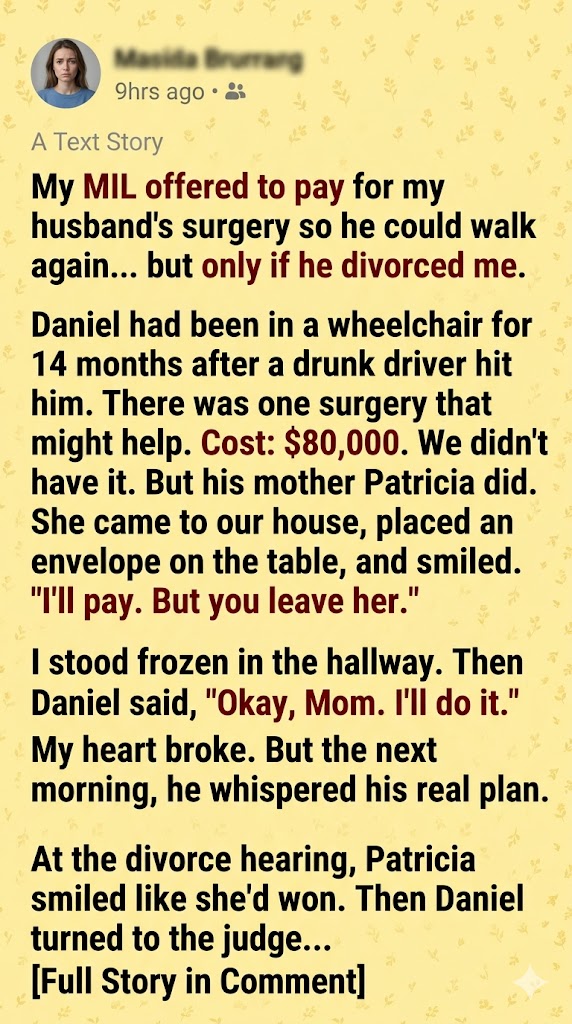
When my husband Daniel lost the ability to walk, I learned that love is not measured by easy days.
It is measured by hospital chairs, unpaid bills, sleepless nights, and the quiet promises you make when the person you love can barely look at himself in the mirror.
Daniel had been injured in a construction accident two years after our wedding. One morning, he left home wearing work boots and carrying coffee in a travel mug. By evening, I was sitting beside his hospital bed while a doctor explained that recovery would be long, uncertain, and expensive.
Daniel survived.
But the man who came home was different.
Not weaker. Never weaker. Just wounded in ways people could see and ways they could not. He used a wheelchair, needed help with basic tasks at first, and hated the pity in strangers’ eyes.
I loved him more fiercely than ever.
But his mother, Patricia, treated his injury like a stain on the family name.
Before the accident, Patricia had never liked me. She thought I was too plain, too working-class, too ordinary for her only son. After the accident, her dislike turned colder.
“You’re young,” she told me once in our kitchen, while Daniel was asleep in the next room. “You don’t have to ruin your life.”
I stared at her. “Taking care of my husband is not ruining my life.”
She smiled sadly, like I was a child who did not understand.
For months, we struggled with medical expenses. Daniel’s insurance covered some therapy, but not the specialist surgery his doctor believed could help him regain movement. The price was impossible for us.
Then Patricia called.
“I’ll pay for it,” she said.
I nearly dropped the phone.
“You will?”
“For Daniel, yes. I have the money.”
For the first time in years, I felt real hope.
That evening, Patricia came to our apartment wearing pearls and carrying a folder. Daniel sat in his wheelchair by the window, hands trembling as she explained everything.
“I can transfer the money directly to the clinic,” she said. “But I have one condition.”
Daniel’s face tightened. “What condition?”
Patricia looked at me.
“You divorce her.”
The room went silent.
I thought I had misheard.
Daniel whispered, “Mom.”
Patricia did not even blink.
“She has held you back long enough. You need a proper life, proper support, and a proper wife. I will pay for the surgery, buy you a new home, and arrange private care. But she walks away.”
My chest felt hollow.
Daniel’s hands gripped the wheels of his chair.
“You’re offering me my legs in exchange for my marriage?”
“I’m offering you a future,” Patricia snapped.
I stood slowly. “No. You’re trying to buy control.”
She turned to me. “This is not about you.”
“It has always been about me,” I said. “You hated that he chose me before the accident. Now you think his pain gives you another chance to erase me.”
Daniel’s voice came low and steady.
“Get out.”
Patricia stared at him.
“What?”
“I said get out.”
Her face reddened. “Daniel, don’t be foolish. Think carefully. This surgery could change everything.”
He looked at me, then back at her.
“She stayed when I could not stand. You disappeared until you found a way to make my injury useful to you.”
Patricia grabbed her folder.
“You’ll regret this.”
For a while, I feared she was right.
We kept fighting for options. I worked extra shifts. Daniel sold his truck. Friends organized a fundraiser. Our church helped quietly. Even strangers donated after Daniel’s old coworker shared our story online.
Three months later, the clinic called.
An anonymous donor had covered the remaining amount.
Daniel cried when I told him.
We later found out the donor was Mr. Hayes, the owner of the construction company where Daniel had been injured. He had followed Daniel’s recovery from a distance and felt responsible for doing more.
The surgery was not magic. It did not turn Daniel’s life into a movie ending overnight. Recovery was slow, painful, and uncertain. Some days he made progress. Some days he threw his therapy towel across the room in frustration.
But he fought.
A year later, Daniel stood beside me in our living room for the first time since the accident. His legs shook. His therapist hovered close. I covered my mouth and sobbed.
He took two steps toward me.
Not perfect steps.
Not easy steps.
But his.
Patricia heard about it through relatives.
She arrived at our door the next week with flowers and tears.
“My son,” she cried, reaching for him. “You’re walking.”
Daniel stepped back.
That small movement said everything.
Patricia looked hurt. “I only wanted what was best for you.”
“No,” he said. “You wanted what was best for your pride.”
She turned to me, suddenly polite. “I made mistakes.”
I nodded. “Yes, you did.”
Daniel did not shout. He did not insult her. He simply told her the truth.
“You taught me something, Mom. You showed me that some people only love you when they can control the terms. My wife loved me when there were no guarantees.”
Patricia left without the forgiveness she expected.
That night, Daniel sat beside me on the sofa and took my hand.
“I’m sorry she treated you like something disposable,” he said.
I leaned my head against his shoulder.
“She never understood,” I replied. “Love is not proven by walking away.”
Daniel squeezed my hand.
“No,” he said. “It’s proven by staying.”
His mother thought she could buy his future.
But she forgot one thing.
A body can heal with doctors, time, and courage.
A marriage survives because two people choose each other when walking away would be easier.
And Daniel had already chosen me.
