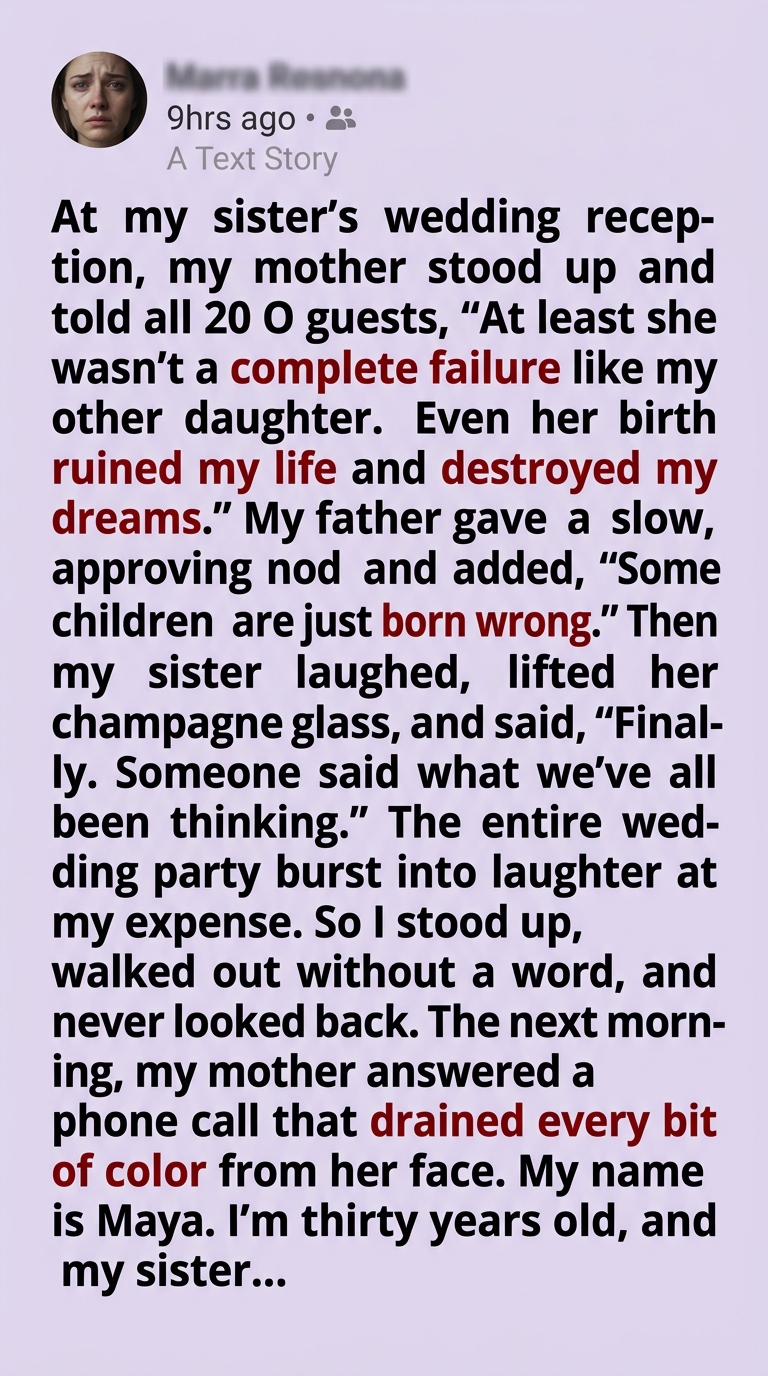
At my sister’s wedding reception, my mother stood in front of two hundred people and said I was the daughter who had ruined her life.
Clara got piano lessons, dance classes, new clothes every season, and birthday parties with custom cakes and matching decorations. I got her hand-me-downs, practical shoes, and long lectures about sacrifice. If Clara had trouble in school, my parents hired tutors and told her she was brilliant. If I struggled, I was told I was lazy or ungrateful. When Clara won something, they framed certificates and hosted dinners. When I accomplished anything, they said things like, “Well, it’s about time.”
The funny thing is, I still turned out fine. Better than fine, actually. I worked for every inch of my life without their support. I earned scholarships, took part-time jobs, studied computer science, and graduated with honors. I joined a startup right after college, survived brutal hours, learned fast, and kept climbing. By twenty-nine, I was a senior software engineer at a major tech company making more money than either of my parents ever expected me to. I bought a house. I traveled. I built a quiet, stable life that belonged entirely to me.
Clara, meanwhile, dropped out of college twice, floated between part-time jobs, and lived at home until she was twenty-seven. But because she was pretty and charming in the exact way my parents loved, none of that ever counted against her. Then she met Eli, a man from a wealthy, well-connected family, and suddenly Clara was being treated like she had won an Olympic medal instead of getting engaged.
From that moment on, our family acted like the engagement was a royal event. Every conversation became about floral arrangements, guest lists, venue deposits, dresses, showers, fittings, and how Clara deserved nothing less than perfection. I was invited just enough to avoid questions from outsiders, but not enough to matter. If I offered an opinion, it was ignored. If I tried to help, I was treated like I was in the way.
A month before the wedding, I offered to pay for a large part of the rehearsal dinner as my gift. My mother actually laughed and said, “We don’t need your charity, Maya. This wedding deserves only the best.” I remember standing there with my wallet still in my hand, realizing she would rather go into debt than accept generosity from me.
The wedding day itself was beautiful, I’ll give them that. Clara looked stunning. Eli seemed happy, or at least hopeful. The venue was elegant, all soft gold lights and white flowers and expensive table settings. My parents had spent money they definitely did not have to make the entire thing look grand. I was seated at table twelve near the back of the ballroom with distant cousins and the kind of relatives people remember only when they need to fill empty chairs.
I brought my boyfriend, Mark, as my plus-one. He had never seen my family at full strength before, but by the time dinner was served, he already understood enough to keep squeezing my hand under the table. The evening was tolerable for a while. I smiled when expected, made conversation, danced once or twice with Mark, and even gave a short toast when family members were invited to speak. I kept it gracious. I wished Clara and Eli happiness. I said nothing that wasn’t kind.
Then, near the end of the reception, my mother stood up from the head table with a champagne flute in one hand and tapped her glass for attention. The room softened into silence almost instantly. Guests turned toward her expecting some sentimental final speech about love and family.
She started exactly that way. She praised Clara’s beauty. Clara’s sweetness. Clara’s grace. Clara’s ability to bring joy into every room. She spoke with the kind of performative emotion she loved most, drawing people in, letting them believe they were witnessing some tender mother-of-the-bride moment.
And then she looked directly at me across the ballroom.
“At least she wasn’t a complete failure like my other daughter,” she said.
The room went still.
My heart dropped so hard I could feel it in my throat. Before I could even process what had happened, she kept going.
“Even her birth ruined my life and destroyed my dreams.”
I remember every second after that with awful clarity. The clink of silverware stopping. A woman at the next table inhaling sharply. Mark’s fingers locking around mine. My own face burning so hot I thought I might pass out. Then my father, emboldened by the cruelty, leaned back in his chair and nodded as if he were offering wise commentary instead of participating in public humiliation.
“Some children are just born wrong,” he said. “It’s not always anyone’s fault. They just never become what they were supposed to be.”
If the earth had split under me right then, I would have been grateful.
But the worst part still hadn’t happened.
Clara threw her head back and laughed. Not a shocked laugh. Not a nervous one. A delighted laugh. She raised her glass and looked right at me.
“Finally,” she said. “Someone said what we all think.”
That was the signal everyone else seemed to need. Some guests laughed because they were cruel. Some laughed because they were uncomfortable. Some laughed because they wanted to follow the room. Even a few members of the wedding party joined in like I was part of some twisted family joke meant to entertain the ballroom.
Two hundred people. White flowers. Crystal chandeliers. My sister in her wedding gown. My parents smiling. And me, sitting there while my entire family turned me into the punchline of the night.
Mark started to stand, furious, but I touched his arm and stopped him. I wasn’t going to give them tears. I wasn’t going to scream. I wasn’t going to break down in front of people who had spent my entire life hoping to see it.
So I stood up quietly, picked up my purse, and walked out.
Mark followed me through the hotel lobby and into the parking lot. I could still hear the laughter behind us as the doors closed. Outside, the night air felt cold enough to cut through my skin.
“Maya,” Mark said, his voice shaking with anger, “that was monstrous. We can go back in there right now and—”
“No,” I said.
My own voice barely sounded like mine.
“We’re leaving. I’m done. I’m done with all of them.”
He looked at me for a long second, then nodded and opened the car door for me. I stared out the window the whole drive home, not crying, not speaking, just feeling something inside me go still in a way I had never felt before. It wasn’t sadness anymore. It was final.
And the next morning, when the phone rang in my mother’s hotel suite and she heard who was calling, her face went white because…” When Mark and I got home, I went straight to the shower and stood under water so hot it stung. I kept hearing the laughter over and over like it was trapped inside my skull.
When I came out, Mark was sitting on the edge of the bed with my phone in his hand. His face looked grim.
“One of Clara’s bridesmaids recorded your mom’s speech,” he said quietly. “She thought it was going to be some emotional mother-of-the-bride moment. Maya… she got everything.”
Not just my mother’s words.
My father nodding.
Clara laughing.
The room joining in.
By sunrise, that video had already spread through guest group chats.
At 8:03 a.m., my cousin Sophie texted me: Call me now. It’s bad.
I answered, and the first thing she said was, “Your mom just got a phone call at the family brunch, and I swear I’ve never seen someone go that pale.”
My stomach dropped.
Then my father agreed.
Then my sister laughed.
And by the time I walked out of that ballroom, I understood something with a clarity that almost felt peaceful: some families don’t break in one dramatic moment.
They erode you slowly, year after year, until one public cruelty simply reveals what has always been true.
My name is Maya.
I was thirty years old that summer, a senior software engineer with a good salary, a house I had bought myself, and a life I had built out of sheer stubbornness.
From the outside, I looked successful.
Stable.
Unbothered.
But success does not magically erase what people did to you in childhood.
It just teaches you how to function while carrying it.
My mother, Helen, spent my entire life treating my birth like a theft.
She had been twenty when she got pregnant with me and was supposed to start law school that fall.
According to her version of history, I was not a child.
I was the event that derailed her destiny.
My father, George, came from a family obsessed with appearances.
He hated that they had to marry young, hated the whispers, hated how ordinary and messy life became.
He never said he wished I hadn’t been born, not in so many words, but he said enough adjacent things that the message landed all the same.
Then Clara came along.
Planned.
Wanted.
Cherished.
My parents loved to say she brought light back into the house.
Imagine being a little girl and hearing that your sister brought back what your own existence supposedly took away.
Clara grew up wrapped in approval.
Lessons.
Parties.
New clothes.
Forgiveness for every mistake.
I grew up in the background, where expectations were high and affection was conditional.
If I did well, it was the bare minimum.
If Clara did the bare minimum, it became proof of her brilliance.
I stopped trying to win their love in high school.
Not because I was healed, but because I was tired.
I put myself through college with scholarships, tutoring work, campus jobs, and a level of discipline that bordered on punishing.
I studied computer science because I liked the logic of it.
Computers, unlike people, do not pretend.
Something works or it doesn’t.
Something breaks for a reason.
By twenty-nine, I was earning six figures and leading major projects at a company whose name my parents loved to casually mention to other people while still acting unimpressed to my face.
That was always their pattern.
They diminished me privately and borrowed status from me publicly.
Clara, meanwhile, drifted through her twenties without urgency.
But then she met Eli Whitmore.
Eli came from one of those polished families who make wealth look hereditary in their posture alone.
His father owned several commercial properties and sat on nonprofit boards.
His mother hosted fundraisers.
Eli himself was not arrogant, at least not in the way I expected.
He seemed decent.
A little sheltered.
Eager to believe the best in people.
My parents adored him instantly, mostly because of his last name.
The engagement turned my family feral with excitement.
My mother started saying things like, “This marriage changes everything.” My father suddenly developed opinions about floral designers and imported champagne.
Clara floated through it all like a queen receiving tribute.
Every event leading up to the wedding reminded me exactly where I stood.
I was invited, but not included.
Present, but peripheral.
When I offered to contribute financially, my mother rejected it with that cold little laugh of hers and said, “This wedding deserves only the best.”
I remember smiling when she said it, because sometimes smiling is the only way to keep from saying something that changes the room forever.
On the wedding day, I made one final mistake.
I hoped.
I hoped they would behave.
I hoped the ceremony would pass without incident.
I hoped that even my parents would understand there are lines you do not cross in front of two hundred guests.
The ceremony itself was lovely.
Clara looked radiant.
Eli looked proud.
The venue glowed with candlelight and white roses.
String music drifted through the hall.
It was the kind of wedding people describe as tasteful because it costs enough money to make restraint look expensive.
Mark came with me.
We had been dating for a little over a year, and he knew my family was difficult, but difficult is such a harmless word for people who specialize in emotional demolition.
He started to understand the scale of it before dinner even ended.
Every time one of my relatives spoke to Clara, their faces brightened.
Every time they spoke to me, their tone changed by half a degree, like I had arrived carrying faint bad weather.
Still, I made it through cocktail hour.
I made it through dinner.
I even stood and gave a small toast when asked, because I would not let my behavior become their excuse.
I wished Clara and Eli a joyful marriage.
I thanked the guests for celebrating with them.
I sat down to polite applause and felt Mark squeeze my knee under the table.
Then my mother stood.
There are moments in life when your body knows disaster a fraction of a second before your mind catches up.
I felt that when Helen tapped her champagne glass.
She had been drinking all evening, but not enough to slur.
Just enough to feel theatrical.
She praised Clara first, of course.
Beautiful.
Graceful.
Kind.
A daughter any parent would be lucky to have.
The room leaned in, smiling.
Then she looked straight across the ballroom at me.
“At least she wasn’t a complete failure like my other daughter,” she said.
The sentence didn’t sound real at first.
It floated for a second, disconnected from meaning.
Then it landed.
“Even her birth ruined my life and destroyed my dreams.”
My face burned.
My chest locked.
I felt Mark go rigid beside me.
My father added his line like he’d been waiting years for a stage.
“Some children are just born wrong.”
And Clara laughed.
That laugh was the cleanest cut of the night.
Cruelty from my parents was familiar.
But watching my sister—my beautiful bride sister in white satin and diamonds—lift her glass and say, “Finally, someone said what we all think,” did something irreversible inside me.
People laughed.
Not everyone.
I know that now.
But enough people did.
Enough for the sound to echo behind me when I rose from my chair, picked up my purse, and walked out without a word.
Mark followed me into the parking lot, furious in a way that made his whole body shake.
He kept saying we should go back in, that he should confront them, that someone should have stopped it.
I just stood there under the hotel lights feeling weirdly calm.
“No,” I told him.
“I’m done.”
He looked at me for a long moment and must have heard something in my voice, because he stopped arguing.
At home, I finally broke.
Not dramatically.
No throwing things.
No screaming into pillows.
I just stood in the shower with water so hot it turned my skin pink, and I cried the kind of tears that come from old wounds reopening all at once.
Mark sat on the closed toilet lid afterward while I wrapped myself in a towel and stared at the floor.
He said, very carefully, “A girl from the wedding party messaged me.”
I looked up.
“Apparently one of the bridesmaids was filming your mom because she thought she was about to give some emotional mother-of-the-bride speech.”
My stomach dropped.
“She got all of it?” I asked.
Mark nodded.
“All of it.
And there are at least two other videos from Eli’s side of the room.”
I closed my eyes.
For a second, shame flared again.
Then something else replaced it.
Not relief exactly.
By midnight, my phone was exploding.
Guests I barely knew sent apologies.
A cousin named Sophie texted: I am so sorry.
What they did was evil.
Another message arrived from someone on Eli’s side: I had no idea your family was like this.
A college friend of Clara’s, who had never once spoken to me before, wrote simply: I’m ashamed I laughed.
I should have walked out with you.
I didn’t answer most of them.
I put my phone facedown and tried to sleep.
I didn’t sleep much.
At 7:18 the next morning, Sophie called.
I almost ignored it, but something told me not to.
Her voice came fast, breathless.
“Maya, are you awake?”
“Yes.”
“Oh my God.
Okay.
I’m still at the hotel because we stayed over, and breakfast just turned into a disaster.”
I sat up in bed.
Mark stirred beside me.
“What happened?”
She lowered her voice.
“Your mom got a phone call during the family brunch.
She answered on speaker at first because she thought it was the florist or something.
It was Eli’s father.”
I said nothing.
Sophie kept going.
“Maya, he was ice cold.
He said Eli had left the honeymoon suite before dawn and was refusing to get on the plane.
He said the Whitmores were canceling the Tuscany trip, suspending the condo gift they were planning for the newlyweds, and reviewing whether Eli wanted to pursue an immediate separation.”
The room went still around me.
“He said after seeing the video from the reception, his family would not finance a future tied to people who thought humiliating their own daughter in public was entertainment.”
I swallowed hard.
“What did my mother say?”
“Nothing at first.
Sophie exhaled.
“Nothing.
She just went white.
Like really white.
Your dad started talking over her, saying it was a joke, that people were misreading the situation.
Then Clara started sobbing and yelling that you must have poisoned Eli against her.”
I laughed once, but there was no humor in it.
“I hadn’t spoken to Eli.”
“I know.
Apparently he watched the video at like three in the morning because one of his groomsmen sent it to him.
He packed a bag and left the suite.
Clara’s losing her mind.”
After I hung up, the first voicemail from my mother arrived.
Her voice was trembling, but not with remorse.
“Maya, call me immediately.
This has gone far enough.”
Then Clara called.
Then my father.
Then Clara again.
I let the phone ring.
Around noon, Eli called.
I answered that one.
He sounded exhausted.
“Maya, I owe you an apology.”
I said nothing.
“I didn’t know,” he said.
“Not really.
I knew they favored Clara, but I didn’t know it was like that.
And when Clara laughed…” He stopped for a second.
“I can’t explain to you what that did to me.
I looked at her and realized I had married someone who could enjoy that.”
He asked if I was okay.
It was such a small question, but it almost undid me.
I told him I would be.
Then he said something I will never forget.
“No decent person watched that happen and stayed the same.”
By evening, my parents were at my front door.
Not to apologize.
To negotiate.
Mark checked the camera feed first and asked if I wanted him to send them away.
I thought about it, then said no.
I wanted to hear what they sounded like when panic finally replaced arrogance.
My mother started with tears.
“Maya, this misunderstanding has gotten out of hand.”
Misunderstanding.
My father tried reason.
“You need to call Eli and his parents and explain that people took things the wrong way.”
“Took what the wrong way?” I asked.
Helen blinked.
“The speech.”
“The speech where you told two hundred guests my birth ruined your life?”
She winced at hearing it said back.
“You know I’d been drinking.”
I looked at her steadily.
“Alcohol doesn’t invent beliefs.
It reveals them.”
Clara, who had been standing behind them in yesterday’s designer travel outfit with mascara streaked down her face, stepped forward.
“He left because of you.”
I almost admired the audacity.
“No,” I said.
“He left because of what you did.”
She started crying harder.
“You always do this.
You always make everything about you.”
I actually laughed then, softly and in disbelief.
My mother flinched like the sound offended her.
“For one night,” I said, “you all made me the center of the room.
You just didn’t like the result.”
My father’s face hardened.
“Watch your tone.”
“No,” Mark said from behind me, calm and deadly.
“You watch yours.”
They all turned, startled, as if they had forgotten I was a woman other people loved.
I handed Helen an envelope.
Inside was a letter from my attorney instructing them not to contact me again except through legal counsel, not to appear at my house, and not to make defamatory statements about me publicly or privately.
I had called a lawyer that morning not because I wanted revenge, but because peace sometimes requires paperwork.
My mother stared at the pages with shaking hands.
“You’re doing this to your own family?” she whispered.
I met her eyes.
“No.
I’m finally refusing to let my family keep doing this to me.”
My father muttered something about ingratitude.
Clara called me heartless.
Helen said, in a voice gone suddenly cold, “After everything we sacrificed for you.”
That was the last lie.
I stepped onto the porch and for the first time in my life, I said every part out loud.
“You did not sacrifice for me.
You resented me.
You neglected me.
You blamed me for choices you made before I could speak.
Then I built a life anyway, and none of you could stand that I did it without your permission.
I am not your failure.
I’m the evidence that I never was.”
No one answered.
Because there is no rebuttal to truth when everyone has already seen the video.
They left angry.
Not sorry.
Never sorry.
Within a week, the story had spread through every social circle that mattered to my parents.
The Whitmores issued a quiet statement about “private family matters” and withdrew from everything connected to the wedding beyond the ceremony itself.
Eli moved into a temporary apartment.
The honeymoon never happened.
The condo gift vanished.
Clara tried to salvage the marriage by framing the speech as dark humor, then as stress, then as my sensitivity.
None of it worked.
Three months later, I heard through Sophie that Eli had filed for an annulment.
My parents were left with wedding debt they had taken on to impress people who no longer returned their calls.
I wish I could tell you that consequence transformed them.
It didn’t.
People like that rarely become different.
They just become louder about their victimhood.
What changed was me.
I blocked their numbers.
I started therapy.
I stopped explaining my boundaries to relatives who wanted reconciliation without accountability.
I let silence do what pleading never could.
And slowly, the air in my life changed.
My house felt like mine in a deeper way.
My work got better because I wasn’t carrying fresh chaos into every week.
I laughed more.
Slept better.
Stopped bracing every time my phone lit up.
One evening, months later, Mark and I sat on the back patio watching the sun go down behind the fence line.
He reached for my hand and said, “You know none of what they said was true, right?”
I looked at him and realized that for the first time, I didn’t need the reassurance the way I once would have.
“I know,” I said.
And I did.
That was the real ending.
Not the canceled honeymoon.
Not the pale face at brunch.
Not the marriage collapsing under the weight of one cruel laugh.
The real ending was this: they humiliated me in public, expecting me to shrink.
Instead, I left.
And once I left, everything rotten in that family had no one left to hide behind.
