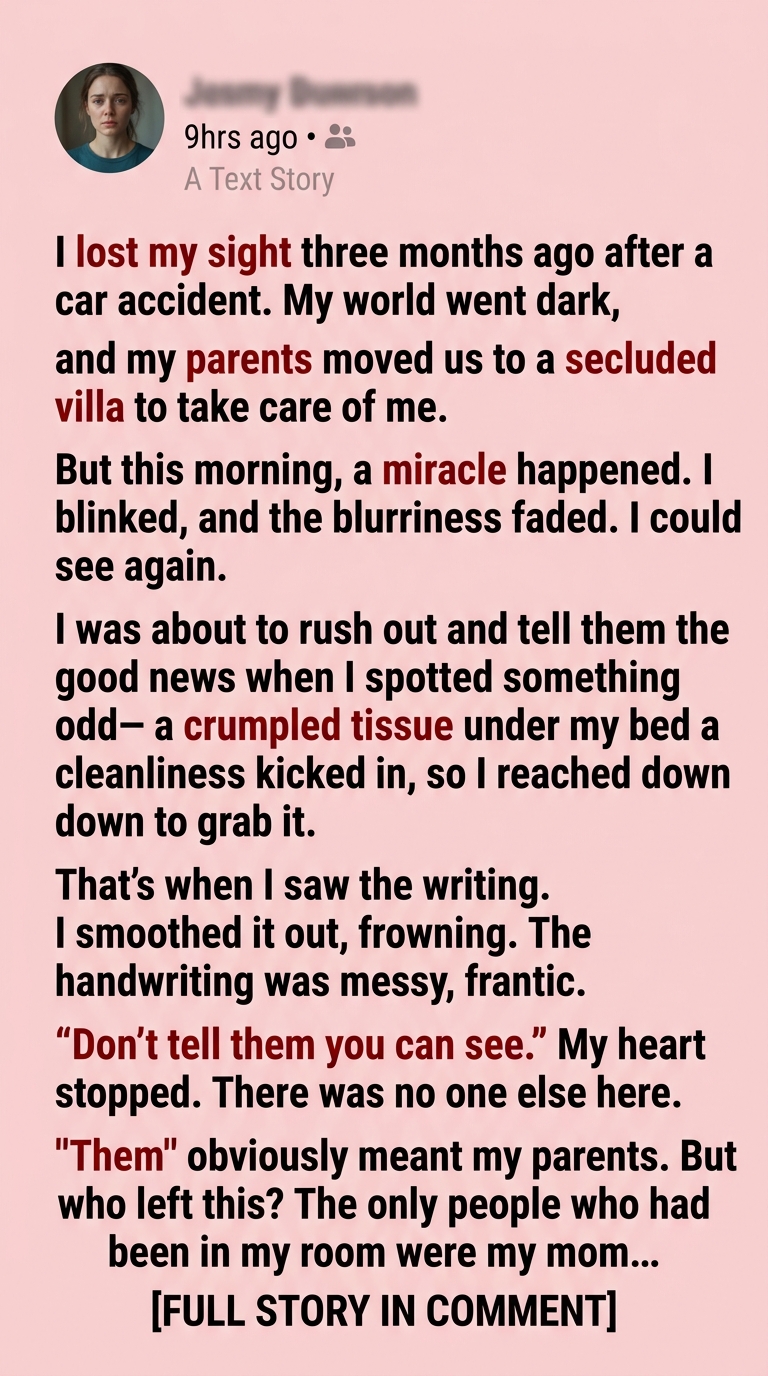
After losing her sight in a terrible car accident, Ella’s entire world changed. For three months she lived in darkness, relying completely on her parents and her husband, Noah. They moved into a secluded villa where they could supposedly care for her in peace while doctors monitored her recovery. The isolation felt strange, but Ella trusted them. She had no reason not to. Then one morning, everything changed.
Ella blinked awake and realized the blur clouding her vision was fading. Slowly, shockingly, she could see again.
Overwhelmed with excitement, she nearly rushed to tell her family, but something caught her eye beneath the bed: a crumpled tissue. Irritated by the mess, she reached for it and unfolded the paper. Written in frantic handwriting were five terrifying words: “Don’t tell them you can see.”
The warning froze her. No one besides her parents and Noah had been near her room. Before she could process it, someone knocked at the door. A woman entered carrying soup and speaking in her mother’s familiar voice.
But she wasn’t her mother.
The resemblance was close enough to fool a blind person, but now that Ella could see, the differences were horrifying. Her real mother had a small scar near her eyebrow and always wore a gold ring with an emerald. This woman had flawless skin and bare fingers. Her perfume was different. Her smile looked rehearsed and unnatural. Yet the voice was identical.
Remembering the warning, Ella pretended to still be blind. She stared past the woman, moved carefully, and acted disoriented. The fake mother watched her suspiciously before finally leaving and locking the door behind her.
Once alone, Ella examined the room. At first glance it looked familiar, but everything was subtly wrong. Photos were blurry copies. Her books had different titles. Personal belongings were missing. The room was not hers—it was a carefully staged imitation designed for someone who could not see the truth.
Then she discovered another line on the tissue: “Trust Noah.”
Soon afterward, a man posing as her father entered. Again, the disguise was convincing only from a distance. He looked similar, but his movements, hair, and mannerisms were wrong. Most disturbing of all, he used the wrong nickname. Her real father had called her “peanut” since childhood. This man called her “pumpkin.”
Fear settled deep inside her. Someone had replaced her parents.
When Noah visited later that day, Ella desperately searched for clues. He looked exhausted and frightened. As he held her hand, he tapped her palm three times—their old private signal meaning “I love you.” Then he traced letters into her skin: P-R-E-T-E-N-D.
Relief nearly made her cry. Noah knew.
Out loud, he calmly handed her medication, but whispered one warning: “Don’t swallow.”
After he left, Ella hid the pills instead of taking them. By evening she realized several horrifying truths. Hidden cameras monitored her room. The fake mother repeatedly checked her eyes with a flashlight, likely testing whether she could see. And the pills were drugging her into confusion and weakness.
That night she overheard the impostors discussing “finishing it tomorrow” and forcing her to sign something. Ella understood she was part of a larger plan.
Near two in the morning, Noah quietly entered her room. Using a hidden phone, he revealed the truth. After the accident, Ella’s real parents had been kidnapped by criminals working for Viktor Hale, a former business partner her father had once fired. The criminals needed access to company accounts and offshore assets, and Ella’s blindness had made it easy to manipulate her. They had hired actors to impersonate her parents while forging her signatures and keeping her sedated.
Most terrifyingly, her real parents were still alive somewhere on the property.
Noah explained that he could not contact authorities earlier because the kidnappers threatened to kill them. But he had secretly gathered evidence and reached out to Detective Ramos, the investigator from Ella’s crash case. Now they had one chance to expose everything.
Despite her weak condition, Ella agreed to help.
Together they slipped through the villa at night. For the first time Ella truly saw the place around her—not a loving family retreat, but a cold, sterile prison filled with cameras and security systems. Noah led her into a study where he opened a stolen laptop connected to the house surveillance network.
One camera feed showed Ella’s real parents tied to chairs in a concrete basement room. They looked exhausted and bruised, but alive.
Ella nearly broke down at the sight of her mother’s real face and her father’s familiar limp. Noah quickly recorded the evidence and sent it to Detective Ramos.
But before they could escape, the fake father appeared in the doorway holding a gun. The fake mother followed with a syringe. Their gentle disguises disappeared instantly, revealing cold, ruthless criminals.
The fake father mocked Ella for regaining her sight. Noah stepped protectively in front of her, demanding they let her go. When violence erupted, instinct took over. Ella grabbed a heavy bronze statue and hurled it at the fake mother, knocking the syringe away. Noah tackled the armed man while Ella slammed a security button that triggered metal shutters and alarms throughout the house.
A gunshot shattered the room.
Then came another sound: police sirens.
Federal agents stormed the villa, overwhelming the kidnappers within seconds. Chaos erupted as officers flooded the halls, shouting commands while alarms blared.
Finally Detective Ramos reached Ella and assured her she was safe.
But she only believed it when she saw her real mother.
Bruised, trembling, wrapped in a blanket—but unmistakably real. The scar near her eyebrow. The emerald ring. The voice calling her “Ellie.”
Ella collapsed into her mother’s arms while her father embraced them both, apologizing through tears for everything they had endured.
As dawn rose over the villa, police carried evidence boxes from the house while ambulances treated the survivors. Sitting beside Noah, Ella reflected on what the nightmare had taught her.
Blindness had shown her how to listen carefully. But regaining her sight taught her something deeper: true vision is recognizing when something feels wrong even if it appears familiar. It is knowing the difference between comfort and love, imitation and truth.
And after months trapped in darkness and deception, Ella finally understood the greatest gift was not simply seeing again—it was seeing clearly.
