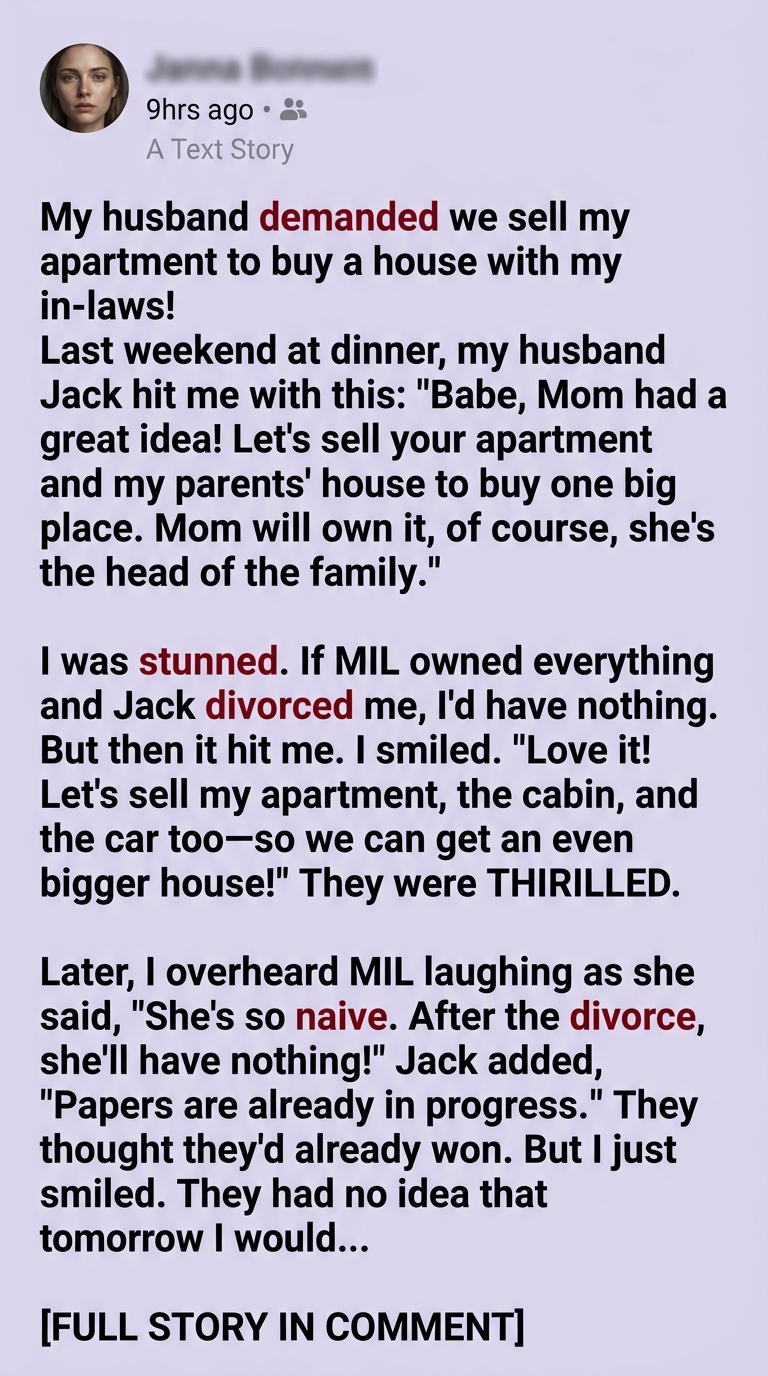
Last weekend at dinner, my husband Jack dropped it like it was the most normal thing in the world.
“Babe,” he said, cutting into his steak, “Mom had a great idea.”
I looked up from my plate.
That tone already made my stomach tighten.
Jack’s mother, Linda, was sitting across from us, smiling too calmly. The kind of smile that never meant anything good for me.
Jack continued.
“Let’s sell your apartment and my parents’ house. We combine everything and buy one big family home.”
I blinked slowly.
“One… big family home?”
Linda leaned forward.
“Yes,” she said smoothly. “And of course, I would oversee everything. I would manage the house. I’d be the head of the family home. It just makes sense.”
I felt something shift in my chest.
Not anger yet.
Something colder.
Calculation.
Because what they were really saying was simple.
Sell everything I own.
Put it into a house controlled by them.
And if anything went wrong?
I would have nothing.
No protection.
No independence.
No exit.
Jack smiled like this was a gift.
“Amazing idea, right?”
I looked between them.
His excitement.
Her confidence.
Their shared fantasy.
And I realized something in that moment.
They had already talked about this without me.
Already planned it.
Already decided my role in their little arrangement.
The silence stretched.
Then I smiled.
Slowly.
Warmly.
“Oh,” I said softly. “I love it.”
Jack relaxed immediately.
Linda’s eyes lit up.
I continued.
“Actually… let’s make it even better.”
They leaned in.
Hooked.
I took a sip of water.
“We sell my apartment… and your parents’ house… AND my car.”
Jack blinked.
“My car?”
“Yeah,” I said casually. “And we pool everything so we can buy something even bigger. Something really impressive. Maybe land too. A big estate.”
Now Linda was fully smiling.
“Oh, I like the way she thinks,” she said.
Jack looked impressed.
I could almost see the greed forming in real time.
They thought I was agreeing.
They thought I was joining their plan.
But what I was really doing…
was letting them talk themselves deeper into it.
That night, they were practically glowing.
Like they had already won.
Like I was already gone.
But what they didn’t know was that I had stopped trusting them a long time ago.
And I had started preparing.
Quietly.
Carefully.
The next morning, I acted normal.
Made coffee.
Kissed Jack goodbye.
Smiled at Linda when she called to “check in.”
But inside, I was already moving pieces on a different board.
Because something Jack said at dinner kept echoing in my mind.
“Mom will own it, of course.”
Not “we.”
Not “us.”
Her.
That single word told me everything.
That wasn’t a family home.
That was a takeover.
By the afternoon, I made three phone calls.
First to a real estate attorney.
Second to a financial advisor.
Third to a friend who worked in property law.
By evening, I knew exactly what they were trying to do.
And I knew exactly how far they had already gone.
Jack hadn’t just “suggested” selling.
He had already been talking to someone.
Drafting ideas.
Exploring paperwork.
Testing the waters.
He just hadn’t told me.
The divorce comment from his mother’s laughter now made sense too.
They weren’t planning a future with me.
They were planning a future after me.
That night, I sat alone in my apartment.
The same apartment they wanted me to give up.
And for the first time, I really looked at it.
Every corner.
Every piece of furniture.
Every memory I had built without their permission.
And I made a decision.
Not emotional.
Not angry.
Strategic.
If they wanted to play games with ownership…
I would show them what real control looked like.
The next day, Jack came home early.
Excited.
Too excited.
“Babe!” he said, dropping his keys. “Mom found a realtor who can move fast. We could list everything this week.”
I nodded slowly.
“That fast?”
“Yeah,” he said. “She already spoke to someone. They’re very professional.”
Of course she had.
Linda didn’t waste time when she thought she was winning.
I smiled gently.
“Okay,” I said.
Jack froze.
“Wait… really?”
“Really.”
He looked relieved.
Then he hugged me.
“I knew you’d understand.”
Behind his shoulder, I stared at the wall.
No.
I didn’t understand.
But I did confirm something important.
They were already committed.
Already moving.
Already assuming I was too emotionally attached to stop it.
That evening, Linda called me directly.
Her voice was sweet.
Almost too sweet.
“I’m so glad you’re being reasonable,” she said.
“I just want what’s best for the family.”
I smiled into the phone.
“Of course you do.”
She continued.
“Once everything is sold, we’ll put the house under my name temporarily. Just for safety.”
Temporarily.
That word again.
Everything about this was temporary—for me.
Permanent—for them.
“I trust you,” I said softly.
She sounded pleased.
“You’re a good girl.”
I almost laughed.
That was the moment I knew exactly what I was dealing with.
Not just manipulation.
Not just greed.
But entitlement.
The belief that I would simply accept whatever they decided for me.
And that belief would be their downfall.
Two days later, I signed nothing.
Instead, I met with a lawyer.
A very calm, very experienced woman who listened to everything without reacting once.
When I finished, she leaned back.
“They’re trying to consolidate assets under family control,” she said.
“Yes.”
“And exclude you later.”
“Yes.”
She nodded.
“Then we don’t stop them emotionally.”
She tapped the table.
“We stop them legally.”
That’s when everything shifted.
Because I wasn’t going to fight loudly.
I wasn’t going to argue.
I wasn’t going to warn them.
I was going to let them proceed.
Just far enough.
To expose themselves completely.
Over the next week, I played my role perfectly.
Supportive wife.
Agreeable daughter-in-law.
Excited partner.
Jack became more confident.
Linda became more controlling.
They started speaking in “we already decided” sentences.
Not “we think.”
Not “we want.”
Already decided.
That’s when people make mistakes.
The final step came on a Friday.
Jack placed documents on the table.
“Just signatures,” he said. “So we can start listing everything.”
Linda stood behind him.
Smiling.
Watching.
Waiting.
I looked at the papers.
Then at them.
And I signed.
Every single one.
Jack’s face lit up instantly.
Linda actually clapped.
“Oh, wonderful,” she said. “Now we can really begin.”
I handed the pen back.
“Actually,” I said softly. “I think you already have.”
Jack frowned.
“What do you mean?”
I stood up.
Calm.
Composed.
And I pulled a folder from my bag.
“You know,” I said, “I spoke to a lawyer too.”
The room went quiet.
Linda’s smile faded slightly.
Jack blinked.
“What lawyer?”
I placed the folder on the table.
“About ownership clarity. About intent. About financial protection.”
Jack’s expression tightened.
“What did you do?”
I opened the folder.
Inside were copies.
Emails.
Financial records.
Timeline notes.
Evidence of pre-planning.
Their conversations about selling my assets without my informed consent.
Every step they had taken.
Documented.
Organized.
Clear.
Linda’s face went pale.
“This is—this is private!”
“No,” I said calmly. “This is legally relevant.”
Jack’s voice rose.
“You went behind our backs?”
I smiled slightly.
“You mean like you did to me?”
Silence.
That was the first time Jack had nothing to say.
Linda tried to recover.
“This is all a misunderstanding.”
“No,” I said. “It’s actually very clear.”
I pushed the folder forward.
“And here’s what’s going to happen next.”
Jack stared at me.
“Excuse me?”
“You’re going to stop the sale process.”
Linda scoffed.
“We don’t have to—”
I interrupted gently.
“Yes, you do.”
My voice stayed calm.
Because I wasn’t guessing.
I already knew.
“And if you don’t,” I continued, “your real estate attorney will receive a copy of everything in that folder.”
The room went silent again.
Jack looked at me differently now.
Not as a wife.
Not as a partner.
As something unfamiliar.
“Who are you?” he asked quietly.
I smiled.
For the first time all week, it was real.
“I’m the person you underestimated.”
Two days later, the entire plan collapsed.
The realtor backed out.
The lawyer stopped responding.
The “family home idea” disappeared like it never existed.
Because once professionals saw intent and documentation of manipulation, everything changed.
Legally.
Financially.
Structurally.
And suddenly, I wasn’t the obstacle anymore.
I was the protected party.
A week later, Jack tried to apologize.
It was too late.
Not because I was angry.
But because I finally understood something important.
Love doesn’t look like pressure.
Love doesn’t look like control.
Love doesn’t require surrendering your entire life to prove loyalty.
It never did.
The final conversation happened quietly.
No shouting.
No drama.
Just truth.
“I thought we were building a future together,” he said.
“We weren’t,” I replied. “You were building it for you and your mother.”
He had no answer for that.
Linda never spoke to me again.
And honestly, I don’t miss her voice.
As for Jack…
He learned something the hard way.
Not everything that looks like agreement is surrender.
And not every quiet person is naive.
Some are just watching.
Waiting.
And preparing.
A year later, I still live in my apartment.
I didn’t sell it.
I upgraded it.
On my terms.
Alone.
And at peace.
Sometimes I think about that dinner.
About how confident they were.
About how easily they assumed I would just give up everything.
And I smile.
Because the truth is simple.
They didn’t lose because I fought harder.
They lost because I understood sooner.
The beautiful thing about toxic people is that they rarely learn their lesson; they just look for a new audience.
After the papers were signed and Jack officially moved back into Linda’s house—the very house they had been so desperate to escape—the silence from their end was blissful. I changed my locks, invested in a top-tier security system, and poured my energy into my career. My apartment, the one they wanted to liquidate, became my sanctuary.
But a year and a half later, the peace cracked.
It started with a text message from Jack.
“Hey. Hope you’re doing well. Look, I know things ended badly, but Mom is in a really tight spot. Her roof is collapsing, and the foundation needs $40,000 in repairs. The bank won’t approve a loan because of her debt-to-income ratio. Since you still have your apartment equity… is there any way you could co-sign or help us out? For old times’ sake? We’re family, after all.”
I stared at the screen. Family. The audacity was almost impressive.
I didn’t reply. I blocked the number. But it got me thinking. Why was Linda, the woman who claimed she could “manage a massive estate,” suddenly drowning in a house that was falling apart?
I called my financial advisor, Sarah—the same woman who helped me dismantle their trap eighteen months ago. Over coffee, I asked her if she knew anything about the local real estate listings in Linda’s neighborhood.
Sarah chuckled, taking a sip of her latte.
“Oh, I know exactly what happened,” Sarah said, leaning in. “Linda and Jack were so convinced they were getting your apartment money that they took out a massive hard-money bridge loan a week before that fateful dinner. They used her house as collateral to put a non-refundable deposit on a mini-mansion.”
My jaw dropped. “They bought a house before I even said yes?”
“They put a down payment on one,” Sarah corrected. “When your apartment money never materialized, they couldn’t close on the new house. They lost the deposit, and the interest rate on that bridge loan ballooned. They’ve been underwater ever since. Jack’s salary is practically going entirely to his mother’s debt.”
I leaned back in my chair.
When you dig a pit for someone else, you usually end up falling into it yourself.
A month later, my company announced it was acquiring a smaller logistics firm in the city to expand our operations. As the Senior Director of Strategy, I was tasked with auditing the incoming staff and restructuring the departments.
On Monday morning, HR handed me the file of the employees we were absorbing.
I flipped through the pages.
Name: Jack Vance.
Role: Operations Coordinator.
Performance Review: Mediocre. Frequently distracted.
My heart didn’t even skip a beat. I just felt a cold, familiar wave of calculation.
I didn’t fire him. That would look like a personal vendetta, and I am, above all things, a professional. Instead, I scheduled a mandatory all-hands meeting for the new department to introduce the corporate restructuring.
When Jack walked into the glass-walled conference room with his new team, he was laughing at a joke a coworker made. Then, his eyes met mine at the head of the table.
All the color drained from his face. He literally stumbled over his own feet, gripping the back of a chair to steady himself.
I was wearing a tailored power suit, sitting next to the VP of Human Resources.
“Good morning, everyone,” I said, my voice smooth and perfectly modulated. “Welcome to the team. For those who don’t know me, I am the director overseeing this transition. Moving forward, every major financial decision, budget allocation, and promotion in this department goes through me.”
Throughout the entire hour-long presentation, Jack couldn’t look me in the eye. He sweated through his dress shirt. He knew that his financial survival—his ability to pay off Linda’s crushing debt—now depended entirely on my signature.
The irony was beautiful.
At the end of the week, Jack requested a private meeting. He walked into my office, looking older, tired, and thoroughly defeated.
“Are you going to fire me?” he asked quietly, refusing to sit down.
“Why would I fire you, Jack?” I replied, closing my laptop. “If you do your job well, you’ll keep it. I don’t mix personal history with corporate assets. You should know that about me by now.”
He swallowed hard. “Mom wanted me to ask if… if you’d consider dropping the restructuring. My current bonus structure is changing, and we really need the money.”
I looked at him, completely detached from the man I used to love.
“Jack,” I said softly, mimicking the exact tone I used at that dinner table two years ago. “Tell your mother that I’m just doing what’s best for the company. I have to oversee everything. I’m the head of this department. It just makes sense.”
He flinched. The ghost of his mother’s own words had come back to haunt him.
“And Jack?” I added as he reached for the doorknob.
He paused, looking back over his shoulder.
“Your direct deposit hits on the 1st,” I smiled warmly. “Make sure you manage it wisely.”
Today, I’m sitting on my balcony, watching the sunset over the city skyline.
Linda and Jack wanted a family home where they held all the power and I held all the risk. Instead, they got exactly what they earned: a crumbling house, a mountain of debt, and the realization that the woman they tried to ruin is now the one signing Jack’s paychecks.
They thought they were playing chess with a naive girl.
They just didn’t realize they were playing against the grandmaster.
