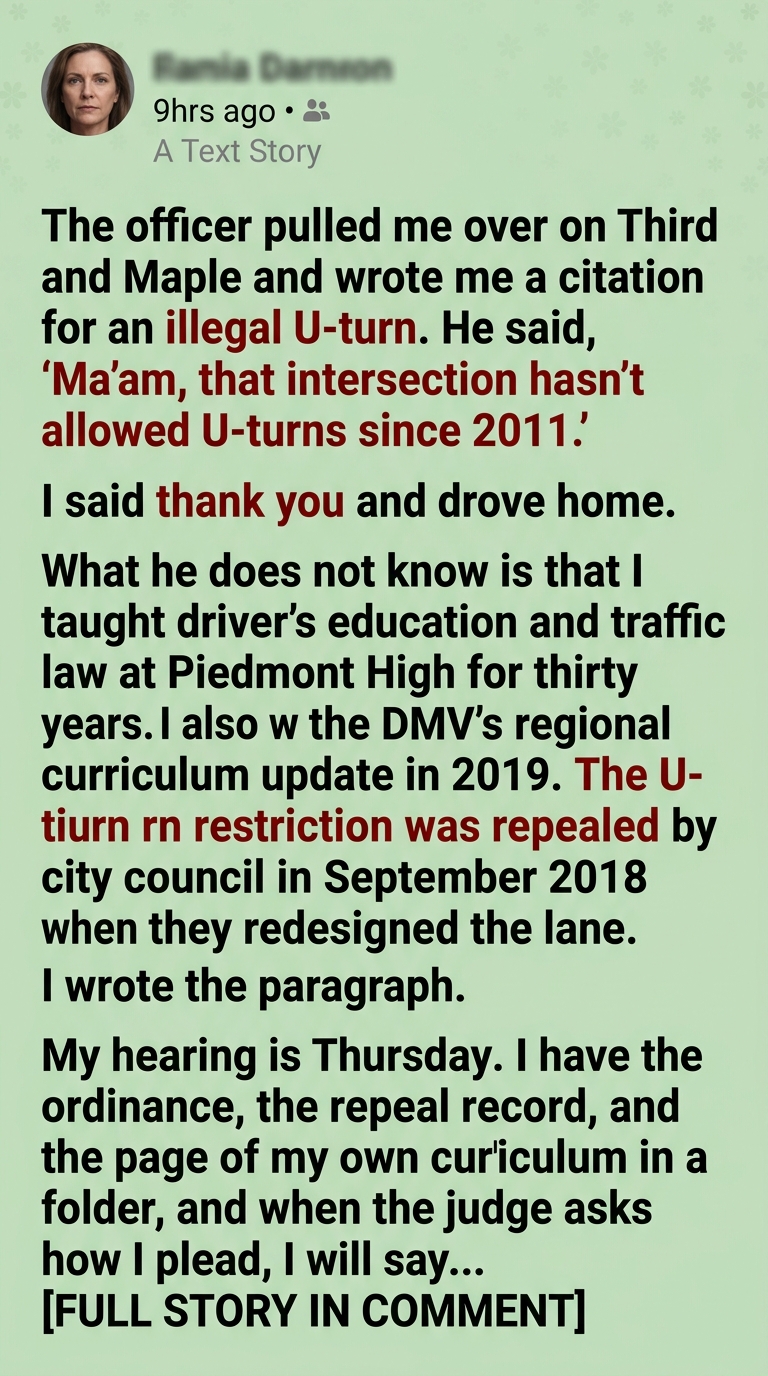
PART 1 : I have always believed that there is a time and a place to argue. The side of a busy road with a police officer who has already made up his mind is rarely the right place. The courtroom, however, is a completely different story.
I’m a 62-year-old retired high school teacher. I drive a reliable, impeccably maintained silver sedan, and I tend to blend into the background of everyday life. I don’t look like a rebel or a troublemaker. I look like someone’s grandmother heading to the grocery store, which is exactly what I was doing on a sunny Tuesday afternoon when I approached the intersection of Third and Maple. It’s a notoriously busy crossing in our town, but the visibility is great if you know how to read the lanes. I checked my mirrors, signaled, waited for a clear break in oncoming traffic, and executed a flawless, perfectly legal U-turn.
Less than thirty seconds later, my rearview mirror was filled with flashing red and blue lights.
I pulled over immediately, ensuring I was far enough onto the shoulder to be safe. I turned off the engine, rolled down my window, and rested both hands on the steering wheel at ten and two. It’s a habit deeply ingrained in me, and I watched in my side mirror as a young officer stepped out of his patrol car. He couldn’t have been more than twenty-five, wearing dark sunglasses and a posture that screamed absolute certainty in his own authority.
He approached my window, looking down at me with a distinctly unimpressed expression. “License, registration, and proof of insurance,” he demanded, skipping any kind of greeting. I handed them over quietly. He looked at my documents, looked back at me, and sighed.
“Do you know why I pulled you over today, ma’am?” he asked.
“I imagine you’re going to tell me,” I replied, keeping my voice perfectly even and polite.
He leaned down slightly, resting his hands on his duty belt, and adopted a slow, heavily enunciated tone. It was the exact voice people use when they assume the person they are talking to is either hard of hearing or intellectually incapable of grasping basic concepts. “You made an illegal U-turn back there at Third and Maple. Ma’am, that intersection hasn’t allowed U-turns since 2011. I’m going to have to write you a citation. It’s a serious safety violation.”
I looked at him for a long moment. I could have spoken up right then. I could have explained that he was operating on outdated information. But as I looked at his smug expression and listened to the condescension in his voice, a quiet sense of resolve settled over me. Why ruin the surprise?
“I see,” I said simply. “Thank you.”
He walked back to his cruiser, spent about ten minutes writing up the ticket, and returned to hand me a citation for $254. He gave me a brief, robotic lecture about paying attention to road signs, told me to drive safely, and walked away. I rolled up my window, placed the ticket neatly in my glovebox, and drove home with a massive smile on my face.
What that officer didn’t know—what he couldn’t have possibly guessed by looking at my gray hair and floral blouse—was my professional background.
For thirty years, I was the head of driver’s education and traffic law at Piedmont High. I didn’t just teach teenagers how to parallel park; I taught them the granular details of the state vehicle code. I lived and breathed traffic law. I attended city council meetings for fun just to keep track of municipal zoning and traffic flow changes.
But my expertise didn’t end when I retired from the high school. Because of my extensive knowledge of the local codes, I was hired as a specialist consultant in 2019 to write the DMV’s regional curriculum update. When the city overhauls roads, the local DMV manuals and testing materials have to be updated to reflect the new municipal realities.
That specific U-turn restriction at Third and Maple? The one the officer swore had been in place since 2011? It absolutely was enacted in 2011. But it was officially repealed by the city council in September 2018 when they secured funding to widen the road and added a dedicated turn lane. The restriction was lifted entirely to improve the flow of traffic toward the new shopping center.
I didn’t just know this piece of trivia. I knew it because I was the exact person who sat at a computer in 2019 and wrote the paragraph updating the municipal traffic code for the regional manual. I literally wrote the book on the law he was trying to enforce.
The weeks leading up to my court date were agonizing, mostly because I was so excited I could barely contain myself. I didn’t tell anyone about my plan, not even my husband, because I didn’t want anyone talking me out of my petty revenge. I went to the stationary store and bought a crisp, heavy-duty manila folder. Inside, I created a masterpiece of a legal defense.
Behind tab one was the original 2011 city ordinance banning the U-turn. Behind tab two was the certified public record from the September 2018 city council meeting, highlighting the exact motion where the restriction was repealed. Behind tab three was the current, updated municipal traffic code. And behind tab four was a certified copy of the 2019 regional DMV curriculum, complete with my name listed as the primary author and editor.
When Thursday finally arrived, I dressed in a neat, conservative navy suit. I walked into the courthouse, passed through security, and found my seat in the traffic court gallery. Traffic court is usually a depressing place. It’s an assembly line of misery, filled with people hoping for a reduced fine and officers looking bored out of their minds.
I spotted my officer near the front. He was chatting with another cop, laughing about something, holding a thick stack of citations he was prepared to defend that morning. He glanced over the crowd, his eyes passing right over me without a hint of recognition.
We sat through an hour of routine cases. People claimed they didn’t see speed limit signs, or that their speedometer was broken, or that they were rushing to the hospital. The judge, a stern-looking man in his fifties with reading glasses perched on the end of his nose, looked exhausted. He was handing out fines and traffic school assignments with practiced efficiency.
Finally, the clerk called my name and case number. I stood up, smoothed my jacket, grabbed my folder, and walked to the defendant’s podium. The officer stepped up to the prosecution’s microphone.
“Officer, please state your case,” the judge said, not looking up from his files.
PART 2 : The officer cleared his throat and delivered a heavily rehearsed, robotic testimony. He stated the date, the time, the weather conditions, and my vehicle’s make and model. Then, with a hint of that same smug confidence he had on the side of the road, he said, “Your Honor, I observed the defendant execute an illegal U-turn at the intersection of Third and Maple. As this court is well aware, that intersection has carried a strict no U-turn restriction since 2011 due to blind spots. I initiated a traffic stop and cited the driver.”
The judge nodded slowly, making a note on his pad. He finally looked up at me. “Ma’am, you’ve heard the officer’s testimony. How do you plead?”
I stood up perfectly straight, looked the judge in the eye, and said, “Not guilty, Your Honor.”
The judge sighed, clearly annoyed that I was going to drag this out. “On what grounds?”
“Your Honor, with the court’s permission, I would like to approach the bench and submit evidence regarding the current municipal code for that specific intersection.”
The judge waved me forward. The officer crossed his arms, looking completely unbothered. I walked up and handed three identical packets to the clerk—one for the judge, one for the officer, and one for myself.
“Your Honor,” I began, my voice ringing out clearly in the quiet courtroom. “The officer is entirely correct that a U-turn restriction was placed on Third and Maple in 2011. However, if you turn to page two of the packet, you will see the certified minutes from the September 14, 2018, city council meeting. On that date, the council voted unanimously to repeal ordinance 42-B, completely lifting the U-turn restriction following the addition of the new dedicated turn lane.”
The judge looked down at the highlighted paper, frowned, and adjusted his glasses. The officer quickly flipped to the second page of his packet, his posture suddenly rigid.
“Furthermore,” I continued, “if you turn to page three, you will find the current, updated municipal traffic code reflecting this change. The turn I made was entirely legal.”
The officer leaned into his microphone, his face flushing pink. “Your Honor, the manual we use at the precinct clearly states…”
“Ah, the manual,” I interrupted gently, smiling at the judge. “Your Honor, if you would direct your attention to the final page of the packet. That is the title page and the relevant intersection index of the 2019 Regional DMV and Law Enforcement Traffic Curriculum.”
The judge flipped to the last page. He read the text in silence for a few moments. Then, he looked up at me, a very slow, very distinct smile creeping onto his face. He looked down at the paper again, then turned his gaze to the officer, who was now staring at his own copy with his mouth slightly open.
“Officer,” the judge said, his voice laced with heavy amusement. “Are you familiar with the author of the current traffic curriculum?”
“I… no, Your Honor,” the officer stammered.
“Well,” the judge said, leaning back in his leather chair. “It appears the primary author and specialist consultant for the 2019 municipal update is a Mrs. Eleanor Vance. The exact same Mrs. Eleanor Vance standing in front of you right now.”
The silence in the courtroom was absolute. You could have heard a pin drop. The officer looked from the paper to me, his face transitioning from pink to a deep, burning crimson. All the swagger, all the condescension, completely evaporated. He looked like a child who had just been caught trying to lecture his math teacher on calculus.
“I…” The officer swallowed hard. “I was unaware of the 2018 repeal, Your Honor.”
“Clearly,” the judge replied dryly. He brought his gavel down with a sharp crack. “Case dismissed. And Officer, I highly recommend you spend the rest of your shift reading Mrs. Vance’s excellent manual. It seems your knowledge of our city streets is about five years out of date.”
I thanked the judge, collected my folder, and walked down the center aisle of the courtroom. As I pushed through the heavy wooden double doors to leave, I could feel the eyes of every single person in that room on my back. I stepped out into the bright morning sunshine, got into my boring silver sedan, and executed a perfectly legal, wonderfully satisfying drive all the way home.
