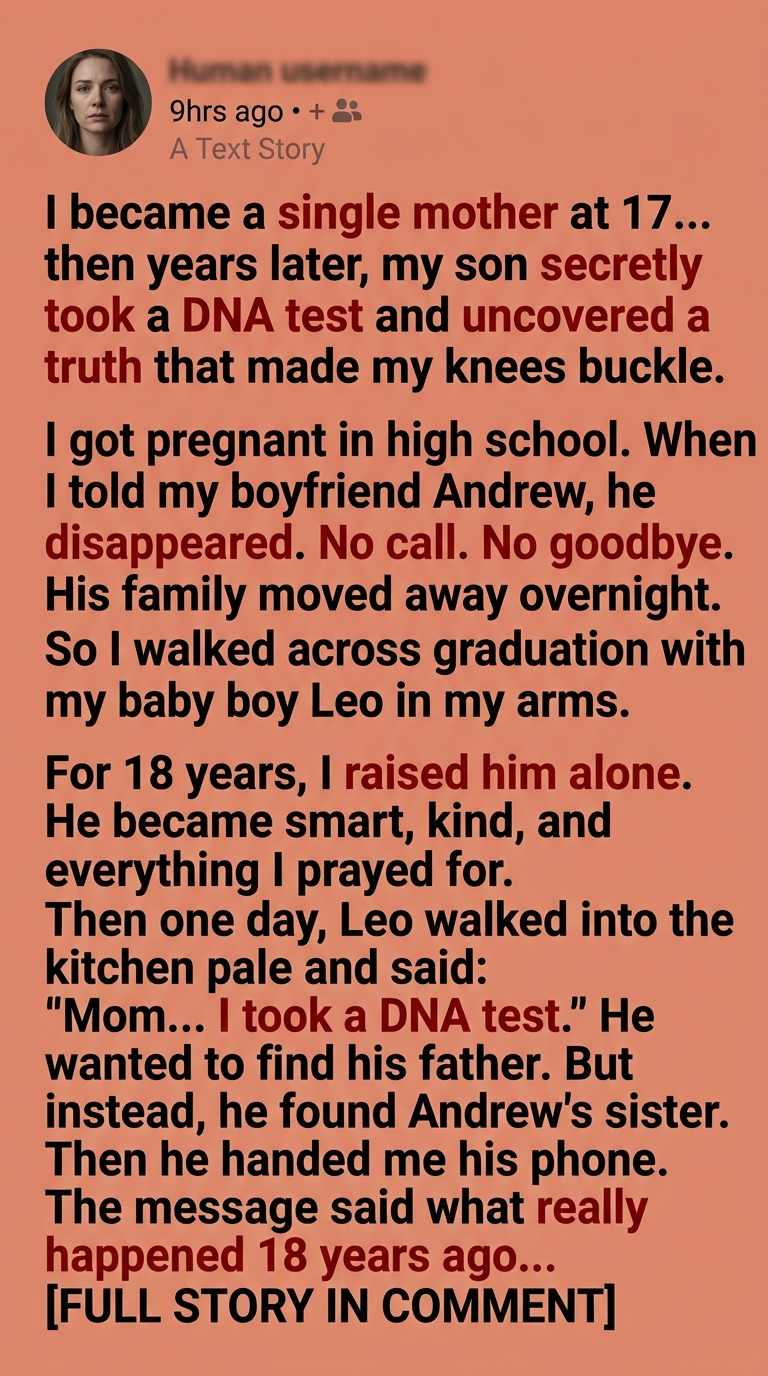
The cake was still in the grocery-store box when my son asked me why I had lied.
It was supposed to be a simple graduation dinner in my kitchen. Nothing fancy. Pulled pork in the slow cooker, coleslaw from the deli, paper plates with blue stripes because that was the only kind left at Walmart. My mother had brought rolls, my father had parked his truck crooked in the driveway, and my son, Caleb, stood beside the refrigerator holding his phone like it weighed more than it should.
“Mom,” he said, “do you know someone named Nora Blake?”
I had not heard that last name in nearly nineteen years.
My name is Erin Parker. I am fifty-four now, and I have had enough time to understand that the past does not always stay where you put it. But that night, I was thirty-five in my head again, then seventeen, then both at once. Caleb had just graduated from high school. I had been proud all day, tired in the good way, the way a mother gets after folding a cap and gown over the back of a chair and realizing a child has reached an edge.
Caleb was born the summer after my junior year.
His father was Daniel Blake, the first boy I loved and the last boy I trusted for a long while. We were from a small town in Pennsylvania where people knew your car before they knew your name. Daniel’s family lived in a white house near the old Baptist church. His mother, Marjorie, wore pearls to the grocery store and corrected people’s grammar at school board meetings.
When I told Daniel I was pregnant, we were sitting behind the baseball field after school. He got quiet, then took my hand and said we would figure it out. He looked scared, but he stayed.
The next day, he was gone.
Their house had a real estate sign in front. The blinds were open, rooms empty. His phone number stopped working. I knocked until an elderly neighbor came out and told me the Blakes had left before sunrise.
For eighteen years, that was the story I lived with.
My parents helped, though help came with its own weather. Dad wanted to drive across state lines and find Daniel. Mom said we had a baby coming and no money for dramatic gestures. We moved my bed into the smaller room, made the nursery out of old curtains and a crib from my cousin, and learned which forms had to be filed at the county office for support we never received.
I crossed the football field at my own graduation with Caleb asleep against my mother’s shoulder.
That was how my adulthood began.
So when Caleb said Nora Blake, I leaned on the counter and tried to keep my voice ordinary.
“Where did you hear that name?”
He looked toward my parents in the dining room, then back at me. “I took a DNA test.”
My mother’s hand tightened around the bag of rolls.
“You did what?” I asked.
“I know I should have told you.” His voice stayed low. “I just wanted to know something. Anything. I wasn’t trying to hurt you.”
He unlocked his phone and handed it to me.
The match was listed as a close relative. Nora Blake. Aunt or half-aunt, the website suggested. Caleb had messaged her two days earlier. Her reply was short.
If your mother is Erin Parker, then Daniel did not leave by choice. Please call me.
I read it twice, then set the phone on the kitchen table beside the cake knife.
Dad came in from the dining room. “What’s going on?”
“Daniel had a sister,” I said.
Mom looked at Dad, and something passed between them. Not knowledge exactly. Fear, maybe.
Nora answered on speaker because my hands were busy gripping the back of a chair.
She sounded older than Daniel would have been, with a smoker’s rasp and a careful kindness. She told us she had been in community college when Daniel came home after I told him about the baby. Their mother found out that night. By morning, their father’s transfer to Ohio had been moved up, the house was being emptied, and Daniel was told I wanted nothing more to do with him.
“He fought her,” Nora said. “Not enough at first, maybe, but he was seventeen too.”
Dad made a sound under his breath.
Nora continued. “He wrote to you. For years.”
“No,” I said, too quickly.
“He did. My mother kept the letters. Some she returned. Some she hid. I found a box after she died last fall.”
The kitchen seemed suddenly too full: the cake, the rolls, the slow cooker, my son’s graduation cards lined up by the toaster. Ordinary things had no idea what had just entered the room.
Caleb sat down across from me. “He wrote?”
Nora’s voice softened. “Yes. And he knew about you.”
Two days later, Caleb and I drove to Ohio. My parents followed in Dad’s truck, though Mom said she would stay outside unless invited. It was the sort of family caravan we used to make for medical appointments when Caleb was little and had ear infections that would not quit.
Nora lived in a small brick ranch with hostas along the walkway and a porch chair with faded cushions. She opened the door before we knocked. For a second, I saw Daniel in her mouth and chin, not enough to confuse me, enough to make my chest feel crowded.
“You look like your mother,” she said to Caleb.
He managed a polite smile. “People usually say I look like nobody.”
“Not anymore,” she said.
The box was in her den, on a coffee table between a stack of mail and a mug with tea gone cold. It was a plastic storage bin with a cracked blue lid. Inside were letters tied with string, birthday cards still sealed, and one photograph of Daniel at seventeen holding a folded slip of paper. My pregnancy test, I realized, though I could not bring myself to touch it.
The first letter was dated three weeks after he left.
Erin, I don’t know what my mother told you. Please don’t believe I walked away. I am trying to get back.
I read it sitting on Nora’s couch. Caleb sat beside me, his knee touching mine. Dad stood near the window with his cap in his hands. Mom kept folding and unfolding a tissue but did not cry loudly. That was not her way.
Another letter was dated close to Caleb’s first birthday.
If he is a boy, tell him I know I have no right to ask anything. But tell him I thought about him today when I saw a kid in overalls at the park.
Caleb reached for that one and read it silently.
“What happened to him?” he asked.
Nora looked at the floor. “Daniel died four years ago. Work accident. He never married. He kept copies of some letters in his apartment. I think he was planning to try again after our mother passed.”
No one said anything useful after that. Useful words rarely arrive in rooms full of old paper.
On the drive home, Caleb slept with the birthday card box on his lap. My parents drove ahead of us, Dad’s truck steady under the late afternoon light. I kept both hands on the wheel and thought about the girl I had been, standing on Daniel’s empty porch, believing silence was an answer.
Later that week, my mother came over with chicken soup I had not asked for. She found me at the kitchen table reading another letter.
“I should have pushed harder,” she said.
I closed the envelope carefully. “You were trying to keep me standing.”
She rinsed her mug, though it had only held water. “Maybe. But I let the story become neat because neat was easier.”
We did not argue. We were both too old for the kind of anger that pretends it can fix time.
Caleb keeps Daniel’s letters in a fireproof box now, along with his birth certificate, his diploma, and the first photo Nora gave him. Sometimes he reads one at the kitchen table when he thinks I am busy making coffee. Sometimes he does not talk afterward, and I let him have that quiet.
Last month, he asked if we could visit Daniel’s grave.
We drove to Ohio on a Saturday. Caleb brought no flowers, just one of his graduation pictures tucked in an envelope. He placed it beneath a small stone near the headstone, weighted with a smooth rock.
“Hi,” he said, awkwardly, like any boy meeting a father too late.
I stood a few steps behind him, holding the car keys and the empty coffee cup from the gas station. The cemetery grass needed cutting. Somewhere nearby, a lawn mower started up, ordinary and loud.
Caleb turned after a while.
“You okay?” he asked me.
I looked at my son, tall and kind and carrying more truth than he had asked for.
“Not all the way,” I said. “But enough to drive us home.”
