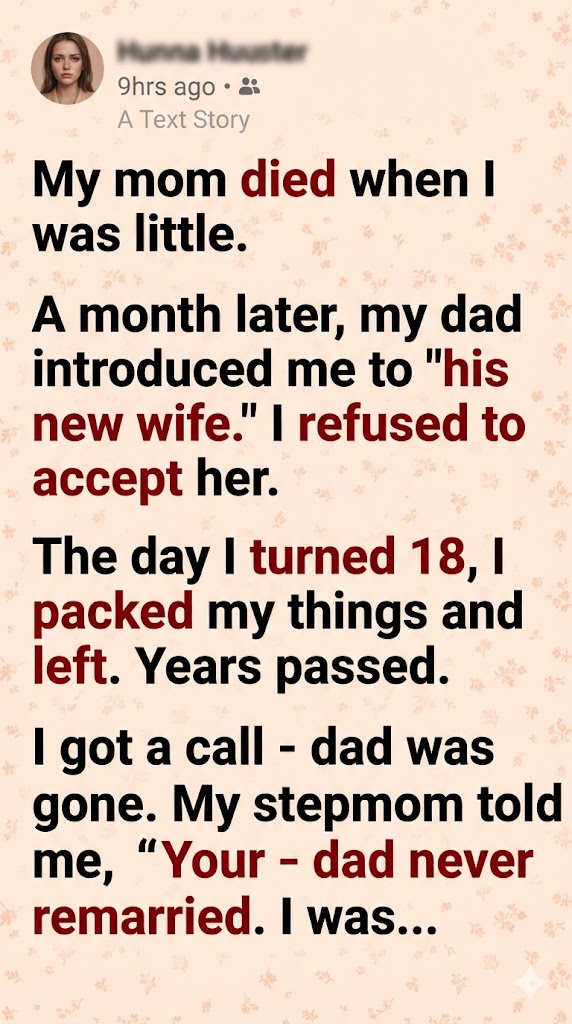
My mother died when I was six, and what stayed with me most was the silence that followed. Overnight, our home felt empty—her laughter replaced by stillness far too big for me to comprehend. Just as I began to understand that she was gone, my father brought someone new into our lives.
“Your new wife,” he said.
It had been only a month.
I didn’t speak to her. I stood behind him, arms crossed, eyes on the floor. In my eyes, she wasn’t a replacement—she was an intruder, someone I wasn’t ready to accept.
She tried, quietly and patiently. She packed my lunches, attended school plays from the back row, left little notes with simple gestures like “Good luck today” or “I made your favorite snack.” But I didn’t see kindness—I saw an attempt I wasn’t willing to acknowledge. Every effort was rejected.
As years passed, the gap between us didn’t shrink; it grew. I built walls so high I forgot what it meant to let anyone in. By eighteen, leaving felt like the only option. I walked away without a word, telling myself I didn’t need them—and that I never had.
Years went by in silence. No calls, no visits, no apologies—just a distance that felt permanent.
Then one day, the phone rang. My father had passed. At first, the words didn’t register; they felt unreal. But they were mine to face.
I drove to the house I hadn’t seen in nearly a decade. Every mile was heavier than the last. Standing at the door, I hesitated—not because I didn’t know how to knock, but because I didn’t know what I would feel when it opened.
When she answered, she was older, quieter—changed, but not a stranger. We didn’t hug or speak at first; we just sat at the kitchen table, the same place where so many unspoken years seemed to gather between us.
Finally, she spoke.
“Your dad never remarried,” she said softly. “We weren’t legally married. He asked me to move in so you wouldn’t grow up without someone caring for you.”
Everything I thought I knew began to shift. All the lunches, the notes, the presence I had labeled as intrusion—it wasn’t what I believed. She stayed, not because she had to, but because she chose to—for him, and in some way, for me too, even when I pushed her away.
She handed me a box of letters, my father’s handwriting carefully capturing his regrets, hopes that I would one day understand, and gratitude for the woman who stayed when it would have been easier to leave.
In that moment, something inside me changed—not fully, not neatly, but enough to see that what I had called betrayal was really sacrifice, patience, and love, expressed in ways I had refused to notice.
I had spent my life guarding my grief, but in doing so, I had shut out the one person who had never stopped trying to care.
For the first time since I was six, I understood: family isn’t defined by how it starts—it’s defined by who chooses to stay, long after they have every reason to walk away.
