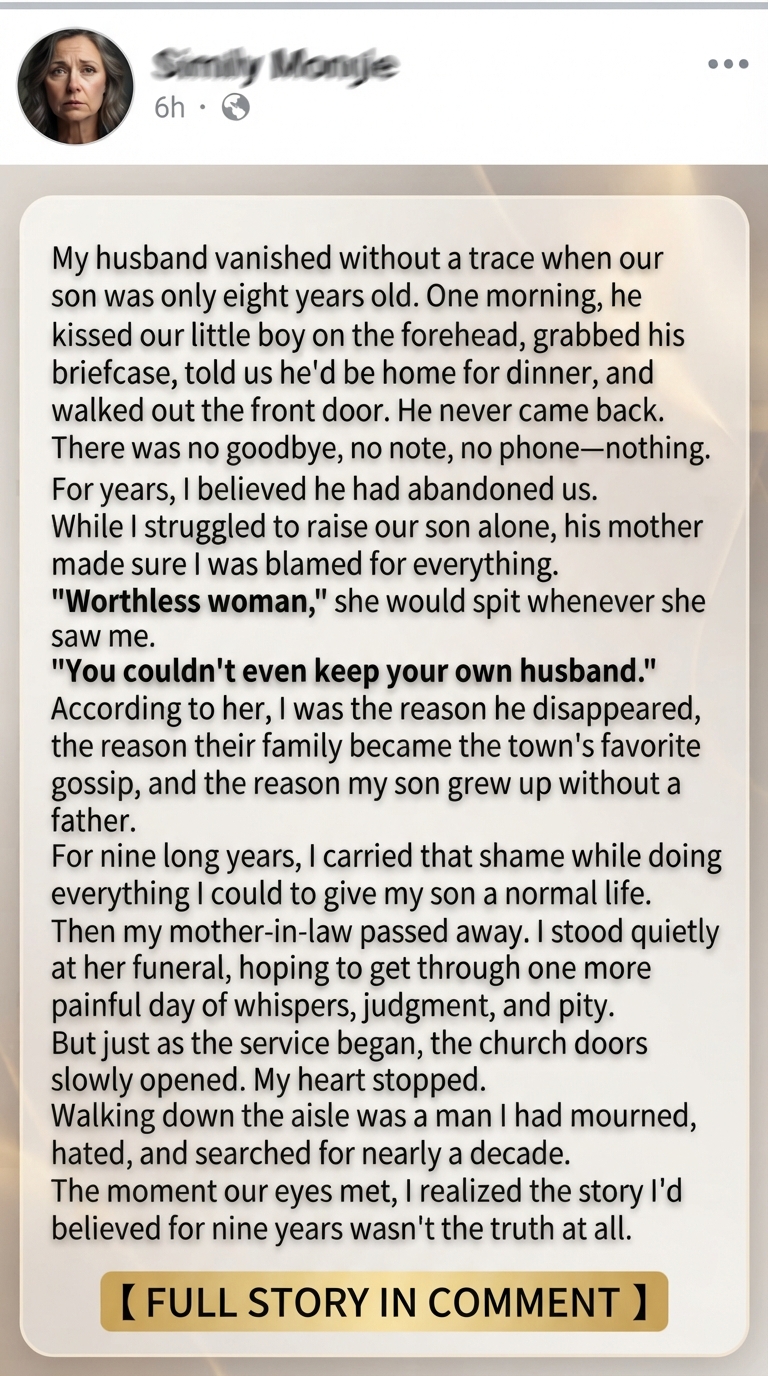
My Husband Disappeared for Nine Years… Then He Walked Into His Mother’s Funeral
The morning my husband disappeared began like every other weekday.
He kissed our eight-year-old son, Noah, on the forehead.
“Be good for your mom,” he said with a smile.
He grabbed his briefcase, adjusted his tie, and paused at the front door.
“I’ll be home for dinner.”
Those were the last words I heard from him.
By seven that evening, dinner sat untouched on the table.
By midnight, I had called every hospital in three counties.
By sunrise, I was filing a missing-person report.
Days turned into weeks.
Weeks became months.
The police searched.
Friends organized volunteer groups.
His coworkers were questioned.
Nothing.
No bank activity.
No passport use.
No confirmed sightings.
It was as though he had simply vanished.
At first, everyone felt sorry for me.
Then sympathy slowly turned into suspicion.
No one fueled those rumors more than my mother-in-law, Evelyn.
Every time she saw me, she had something cruel to say.
“Worthless woman.”
“You couldn’t even keep your own husband.”
“He was miserable with you.”
“If he’d had a better wife, he’d still be here.”
I never answered.
What could I say?
I was grieving too.
Our son heard enough of those comments to start believing them himself.
One afternoon, when he was ten, he quietly asked,
“Mom…”
“Did Dad leave because of us?”
My heart shattered.
I knelt beside him.
“No.”
“Whatever happened to your father…”
“…it was never because of you.”
I wasn’t as certain about myself.
For years I replayed every argument we’d ever had.
Every forgotten anniversary.
Every stressful month.
I searched for the mistake that had driven him away.
There wasn’t one.
But guilt has a way of inventing answers when none exist.
Life slowly moved forward.
I worked two jobs.
Noah grew into a thoughtful, hardworking teenager.
We celebrated birthdays with an empty chair that no one mentioned.
Every Father’s Day hurt a little less—and a little differently.
Nine years passed.
Then Evelyn died.
Despite everything she had said to me, I attended the funeral.
Not for her.
For Noah.
She had still been his grandmother.
The church was quiet.
Family members filled the pews.
People whispered condolences.
The minister had just begun speaking when the heavy wooden doors at the back of the church creaked open.
Everyone turned.
A man stood in the doorway.
Older.
Thinner.
Gray threaded through his dark hair.
His beard hid part of his face.
But I recognized him instantly.
David.
My husband.
The room fell silent.
Noah stared without blinking.
Someone gasped.
David slowly walked down the aisle.
When our eyes met, I felt anger, relief, confusion, and disbelief all at once.
He stopped beside the casket.
Placed one trembling hand on it.
And quietly whispered,
“I’m sorry, Mom.”
Then he turned toward us.
“I know you all deserve answers.”
No one moved.
The minister stepped aside.
David looked directly at me.
“I never abandoned you.”
Those words ignited every ounce of anger I’d buried for nine years.
“You expect me to believe that?”
“You disappeared.”
“You never called.”
“You never wrote.”
“Our son grew up thinking you didn’t want him.”
Tears filled his eyes.
“I know.”
“And I’ll spend the rest of my life regretting that.”
After the service, the family gathered in a small meeting room.
David finally told us what had happened.
Nine years earlier, he had uncovered evidence that the construction company where he worked was laundering money for a criminal organization.
He reported his concerns internally.
A week later, strangers began following him.
One evening, a man approached him in a parking garage.
The message was simple.
*”If you keep talking, your wife and son die first.”*
David immediately contacted federal investigators.
According to him, they believed the threat was credible.
Because he had become a key witness in an ongoing investigation, he was placed into a protected witness program while prosecutors built their case.
He wanted to refuse.
He begged to tell me.
The investigators wouldn’t allow it.
They believed any contact could expose our location and endanger us all.
He signed documents agreeing to complete silence.
For years.
The criminal case involved multiple states, several executives, and organized crime connections.
It took nearly a decade before the final convictions were secured and the remaining threats were considered over.
Only then was he allowed to return.
I stared at him.
Part of me wanted to believe him.
Another part wanted proof.
He quietly handed me a folder.
Inside were official court documents, witness-protection paperwork, newspaper articles, and letters from investigators confirming his role in the case.
Everything matched.
Everything.
My knees nearly gave out.
All those years…
He hadn’t left us because he stopped loving us.
He had disappeared because he believed it was the only way to keep us alive.
Noah hadn’t spoken a word.
Finally, he looked at his father.
“You missed my ninth birthday.”
David nodded.
“I know.”
“My tenth.”
“I know.”
“My high school games.”
“I know.”
“My first broken heart.”
David’s voice cracked.
“I know.”
“You weren’t there.”
“No.”
“I wasn’t.”
Silence filled the room.
Then Noah asked the question that mattered most.
“Did you ever stop thinking about us?”
Without hesitation, David reached into his jacket.
He removed a thick bundle of worn photographs.
Every school picture I’d ever mailed to relatives.
Every newspaper clipping mentioning Noah.
Copies of birthday photos.
Graduation certificates.
Even a photograph of the science fair trophy Noah won at twelve.
“I asked investigators to find every public photo they legally could.”
“I watched you grow up from a distance.”
“I celebrated every milestone alone.”
“I just couldn’t tell you.”
Noah burst into tears.
So did I.
Healing didn’t happen that afternoon.
It couldn’t.
Nine years of absence cannot be erased by one explanation.
David rented a small apartment nearby.
He never expected to move back into our home.
He attended counseling.
So did Noah and I.
For months, our conversations were awkward.
Painful.
Sometimes angry.
Sometimes hopeful.
Trust returned slowly, one honest conversation at a time.
A year later, Noah graduated from high school.
This time, David sat in the audience.
Not as a stranger.
Not yet fully as the father he’d once been.
But as a man trying every day to become part of his son’s life again.
After the ceremony, Noah hugged him.
It wasn’t dramatic.
It wasn’t perfect.
It was enough.
As for me, David and I never remarried.
Too much time had passed.
Too many memories belonged to separate lives.
But we learned to become friends again.
Partners in supporting the son we both loved.
One evening, years later, I finally asked him,
“Was it worth it?”
He looked toward Noah laughing with friends in the backyard.
“If disappearing meant he got to grow up alive…”
“…I’d make the same impossible choice again.”
I understood.
I didn’t like it.
I still mourned everything we had lost.
But for the first time in nine years, I also understood that sometimes the truth is more complicated than the stories grief tells us.
I spent nearly a decade believing my husband had abandoned us.
In reality, he had been carrying the unbearable weight of protecting us from a danger I never even knew existed.
Sometimes the deepest wounds in a family are not caused by a lack of love.
Sometimes they’re caused by impossible choices no one should ever have to make.
