I Gave My Jacket to a Homeless Woman… Two Weeks Later, a Mysterious Box Arrived at My Door
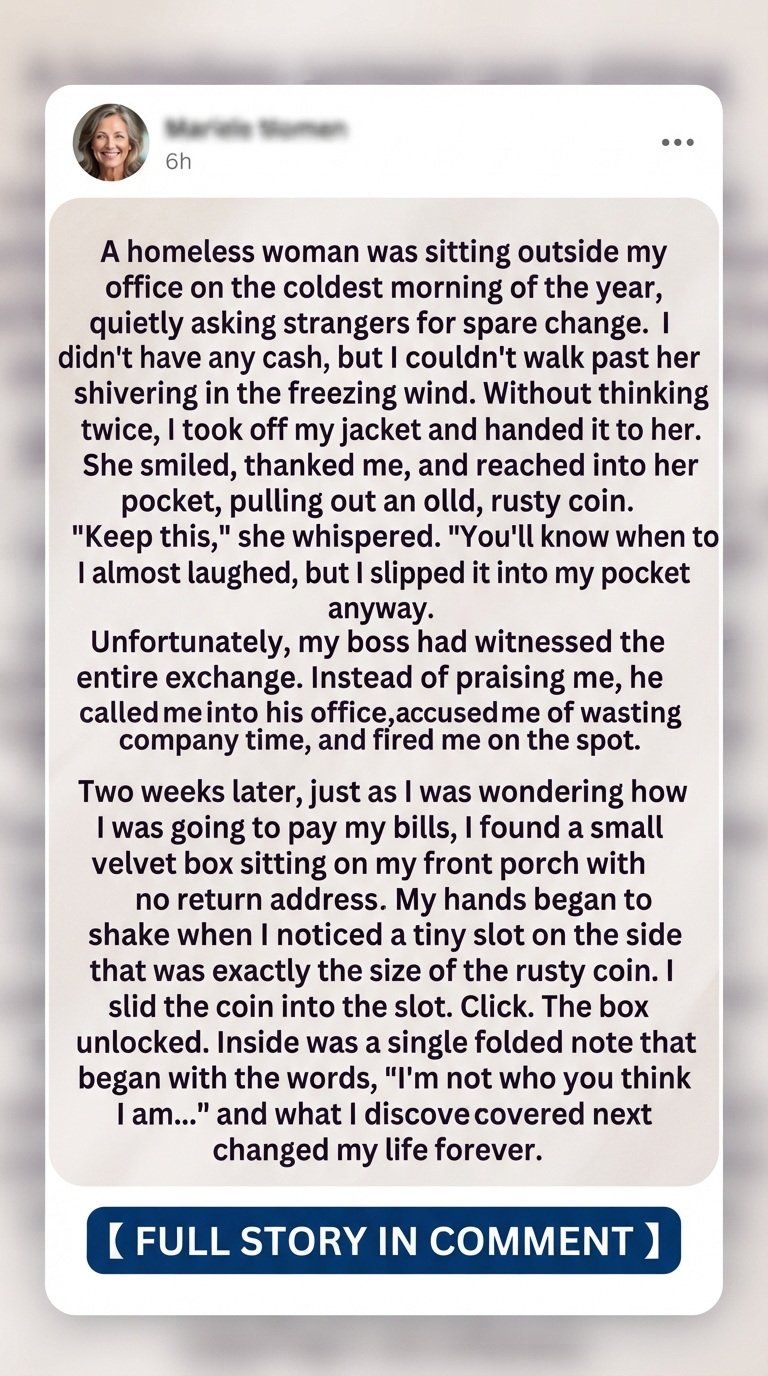
The coldest morning of the year arrived with freezing rain and a wind that seemed determined to cut through every layer of clothing.
I hurried toward my office building with a cup of coffee in one hand and my laptop bag slung over my shoulder.
Just outside the entrance, as she had been for several weeks, sat an elderly homeless woman.
She never shouted.
Never chased people.
She simply sat quietly beside a small cardboard sign that read:
**Anything helps. Thank you.**
Most people walked past without looking at her.
Some pretended to check their phones.
Others crossed the street.
As I approached, I noticed something different.
She was trembling uncontrollably.
Her coat was little more than a thin sweater with torn sleeves.
I reached into my wallet.
Nothing.
Not a single dollar.
I stood there for a moment.
Then, without really thinking, I took off my heavy winter jacket.
“Here,” I said.
“You need this more than I do.”
She looked at me with tired blue eyes.
“You’ll freeze.”
“I’ll survive.”
Slowly, she slipped on the jacket.
It hung loosely over her shoulders.
For the first time since I’d known her, she smiled.
Before I turned to leave, she reached into her pocket and pulled out an old rusty coin.
It was larger than a quarter, with strange markings worn almost smooth by time.
“Keep this,” she whispered.
“You’ll know when to use it.”
I almost laughed.
It sounded like something from a fairy tale.
Still, I didn’t want to offend her.
I slipped the coin into my pocket.
“Thank you.”
As I entered the building, I didn’t realize my boss had watched the entire exchange through the lobby windows.
Ten minutes later, his assistant called me into his office.
He folded his arms.
“You were late.”
“By three minutes.”
“I stopped to help someone.”
“I noticed.”
He leaned back in his chair.
“This company pays you to work.”
“Not to perform public acts of charity during business hours.”
I stared at him.
“I gave someone my coat.”
“You wasted company time.”
“I was three minutes late.”
“Three minutes today.”
“Five tomorrow.”
“That’s how standards disappear.”
Then he slid an envelope across the desk.
“I’m letting you go.”
I couldn’t believe it.
Five years of loyal work.
Excellent reviews.
Gone.
Because I stopped to help someone.
I packed my desk before lunch.
The following two weeks were difficult.
I applied for dozens of jobs.
Attended interviews.
Watched my savings shrink.
Every night I worried about the mortgage.
One rainy afternoon, I returned home to find a small velvet box sitting on my front porch.
There was no return address.
No postage.
Just my name written neatly across the lid.
Curious, I carried it inside.
The box was beautifully made from dark walnut with brass trim.
On one side was a narrow slot.
Oddly familiar.
Then I remembered the coin.
I retrieved it from my kitchen drawer.
It fit perfectly.
The moment I slid it into the slot—
**Click.**
The lid slowly opened.
Inside lay a folded handwritten note.
It began:
> **I’m not who you think I am.**
My pulse quickened.
I kept reading.
> My name is Eleanor Ashford.
>
> Years ago, my husband and I founded the Ashford Foundation, a charitable trust that quietly supports individuals who demonstrate extraordinary compassion.
>
> After he passed away, I wanted to know whether people still helped others when they believed no one important was watching.
>
> So I stopped introducing myself.
>
> I sat outside office buildings, train stations, and parks.
>
> I asked for nothing except kindness.
I frowned.
The Ashford Foundation.
I had heard the name before.
They funded hospitals, scholarships, and community programs across the state.
The note continued.
> Hundreds of people walked past me.
>
> Many stared.
>
> Some insulted me.
>
> You gave away the only coat you had on the coldest day of the year.
>
> Not because someone asked you to.
>
> Not because cameras were recording.
>
> Simply because another human being was cold.
My hands trembled.
Beneath the letter was another envelope.
Inside was not cash.
It was a business card.
Printed on thick cream-colored paper.
**Margaret Chen**
Executive Director
Ashford Foundation
Written on the back:
**Please call me.**
The next morning, I did.
Margaret invited me to the foundation’s offices.
When I arrived, Eleanor was waiting.
Only now she looked entirely different.
Clean clothes.
Styled silver hair.
Warm smile.
She recognized me immediately.
“I told you,” she said.
“You’d know when to use the coin.”
She explained that the coin wasn’t valuable because of what it was made of.
It was simply a key used to identify people who had been personally invited to meet with the foundation.
Then she surprised me.
“We aren’t offering you a reward.”
I blinked.
“I wasn’t expecting one.”
“I know.”
“That’s exactly why you’re here.”
She smiled.
“We’re offering you a job.”
Confused, I asked,
“Doing what?”
“Helping us identify and support small community organizations that are changing lives but struggling to survive.”
The position paid better than my previous job.
It included health insurance, flexible hours, and one responsibility above all else:
Spend your time finding people who quietly help others.
I accepted immediately.
Months later, I learned something else.
Eleanor had never intended to test me specifically.
She hadn’t even known my name that morning.
It was my former boss who changed everything.
The foundation routinely contacted employers to verify basic information before making an offer.
When Margaret asked about me, my former boss proudly explained that he’d fired me for “encouraging unprofessional behavior.”
He expected the story to impress them.
Instead, it convinced them they’d found exactly the kind of person they wanted.
Ironically, several months later, the company where I’d worked applied for a substantial community development grant through the Ashford Foundation.
The application came across my department.
I immediately removed myself from the review process because of the obvious conflict of interest.
Another team evaluated it independently.
The grant was denied—not because of my former boss, but because the proposal didn’t meet the foundation’s standards.
I never celebrated.
Life had already taught me something better than revenge.
One winter morning, nearly a year later, I walked past the same office building where I’d once lost my job.
Outside sat another man wrapped in a thin blanket.
Without thinking, I took off my scarf and handed it to him.
He smiled.
“You don’t even know me.”
I smiled back.
“You don’t have to know someone to know they’re cold.”
The old rusty coin still sits in a small frame on my desk.
People often ask why I’d display something so ordinary.
I tell them it’s a reminder.
Not that kindness is always rewarded.
Because it isn’t.
Sometimes kindness costs you your comfort.
Sometimes it costs you your job.
Sometimes no one notices at all.
But every now and then, the smallest decision you make on an ordinary morning quietly opens a door you never knew existed.
And that kind of reward can never be measured by money alone.
