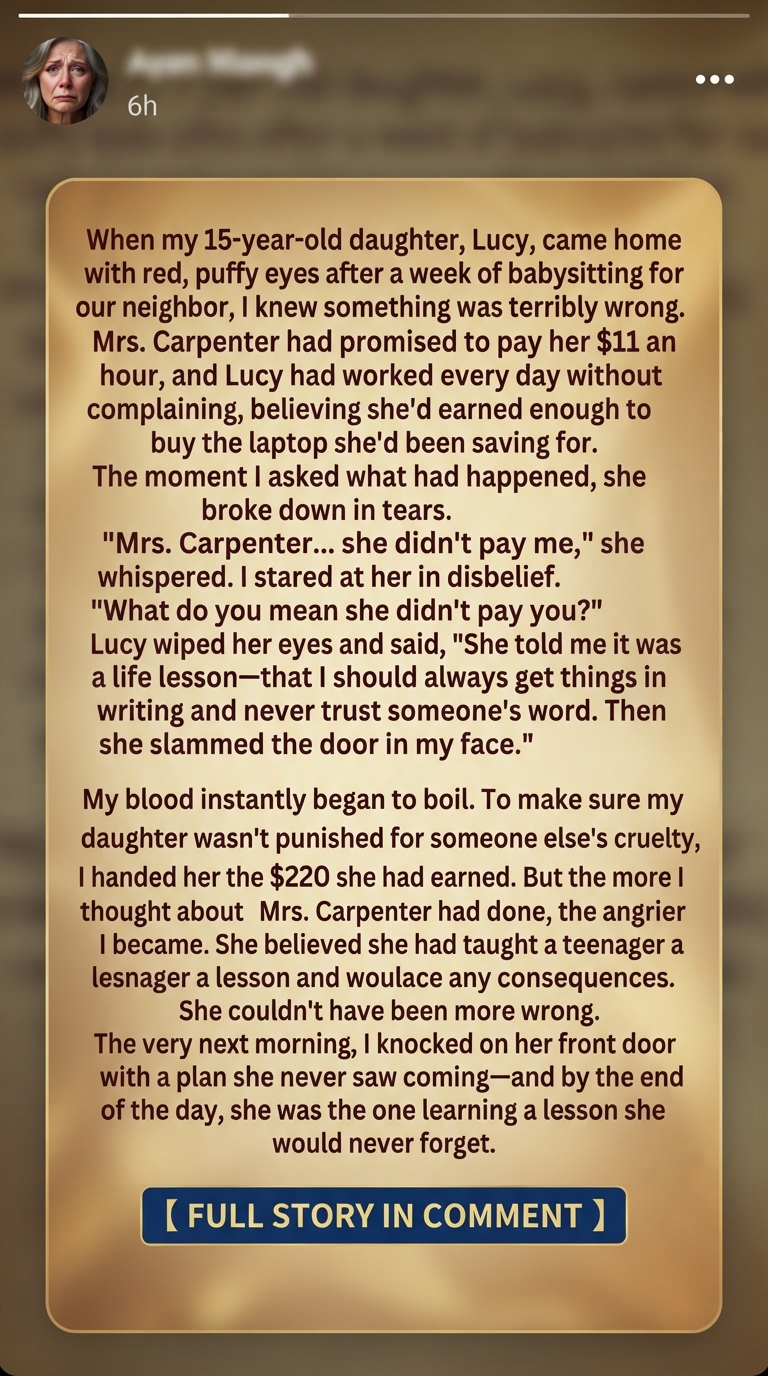
My Neighbor Refused to Pay My 15-Year-Old Daughter for Babysitting… She Said It Was a “Life Lesson.” She Had No Idea One Was Waiting for Her.
When my daughter Lucy walked through the front door that Friday afternoon, I knew something was wrong before she said a single word.
Her eyes were swollen.
Her cheeks were streaked with tears.
She dropped her backpack by the door and stood there, staring at the floor.
“Lucy?” I asked softly.
“What happened?”
She tried to answer.
Instead, she burst into tears.
I wrapped my arms around her until she finally caught her breath.
Between sobs she whispered,
“Mrs. Carpenter didn’t pay me.”
I frowned.
“What do you mean she didn’t pay you?”
Mrs. Carpenter, our neighbor three houses down, had asked Lucy to babysit her two children while she worked extra shifts.
They had agreed on **$11 an hour**.
Lucy had happily accepted.
She’d spent the entire week entertaining two energetic boys, making lunches, helping with homework, and even cleaning up after them.
She had worked twenty hours.
She’d already planned how she’d use the money.
She’d been saving for months toward a laptop for school.
Every dollar mattered.
Lucy wiped her eyes.
“When I asked if she had my money…”
“…she laughed.”
“What did she say?”
Lucy looked at me in disbelief.
“She said it was a life lesson.”
“A lesson?”
“She said I should always get things in writing.”
“And never trust someone’s word.”
“Then she closed the door.”
I felt my stomach tighten.
Not because of the money.
Because a grown adult had deliberately taken advantage of a fifteen-year-old.
I opened my wallet.
Counted out **$220**.
Placed it in Lucy’s hand.
“This is what you earned.”
She immediately shook her head.
“You don’t have to—”
“I know.”
“But you kept your promise.”
“I’m keeping mine.”
She hugged me tightly.
“Thank you.”
That evening I couldn’t stop thinking about Mrs. Carpenter.
She genuinely believed she’d taught my daughter an important lesson.
Maybe she had.
Just not the one she intended.
The next morning, I walked to her house.
She answered the door wearing sunglasses and holding a coffee mug.
When she saw me, she smiled smugly.
“If you’re here about the babysitting…”
“I am.”
She crossed her arms.
“Your daughter learned something valuable.”
“I agree.”
She looked surprised.
“I’m glad you understand.”
“I do.”
“And I’d like to help continue the lesson.”
She frowned.
“What?”
I smiled politely.
“I’d like the names of every family you’ve recommended yourself to.”
Her smile disappeared.
“I don’t know what you mean.”
“I mean the neighborhood parenting group.”
“The church childcare list.”
“The elementary school volunteer directory.”
“I imagine people should know how you define honesty.”
Her confidence faltered.
“You’re threatening me?”
“No.”
“I’m sharing information.”
“The same way you shared a lesson.”
She slammed the door.
I walked home.
Then I sat down at my computer.
I wrote a calm, factual message.
No insults.
No exaggeration.
Just dates, hours worked, the agreed-upon rate, and exactly what Mrs. Carpenter had said to Lucy.
I ended with one sentence.
> **Please make sure your teenagers have payment agreements in writing before accepting babysitting jobs from anyone.**
I posted it to our neighborhood community group.
Then I went about my day.
By lunchtime, dozens of parents had commented.
Many were shocked.
Several shared that their own teenagers had babysat for Mrs. Carpenter before—but had always been paid.
Others thanked me for the reminder to teach young people about clear agreements and fair treatment.
A local attorney in the group even posted a brief explanation that verbal agreements can still be legally enforceable in many situations, depending on the facts.
That afternoon, my doorbell rang.
Mrs. Carpenter stood outside.
She looked furious.
“You embarrassed me.”
I looked at her calmly.
“I described what happened.”
“You turned everyone against me.”
“I told the truth.”
She held out an envelope.
“There.”
Inside was **$220** in cash.
I looked at it.
“Thank you.”
Then I handed it back.
She blinked.
“What?”
“My daughter has already been paid.”
She looked confused.
“You said you wanted the money.”
“I wanted you to do the right thing.”
“The money now belongs to the person you wronged.”
I called Lucy to the door.
Mrs. Carpenter awkwardly held out the envelope.
“I’m sorry.”
Lucy quietly accepted it.
Then surprised both of us.
“I forgive you.”
“But I won’t work for you again.”
Mrs. Carpenter nodded without arguing.
She left looking far less certain than she had the day before.
I thought the matter was over.
A week later, the principal at Lucy’s high school called.
Apparently, word of what had happened had reached the school’s career-readiness teacher.
She wondered whether Lucy would be willing to help create a short workshop for students taking their first jobs.
Lucy loved the idea.
Together, they organized an evening session called **”Your First Paycheck.”**
Local business owners, a banker, and an employment lawyer volunteered their time.
Students learned about:
* Keeping records of hours worked.
* Understanding verbal and written agreements.
* Minimum wage laws and youth employment rules.
* Speaking up respectfully when something feels wrong.
* Asking trusted adults for help before problems grow.
The room was packed.
After the presentation, several parents thanked Lucy for sharing her story.
One freshman quietly admitted she’d been afraid to ask an employer about unpaid hours.
Now she knew she wasn’t alone.
Months later, I ran into Mrs. Carpenter at the grocery store.
She approached me hesitantly.
“I wanted you to know…”
“I’ve paid every teenager I’ve hired since then.”
I nodded.
“I’m glad.”
She sighed.
“I really thought I was teaching responsibility.”
I looked at her for a long moment.
“You were.”
“But responsibility starts with the adult who makes the promise.”
She lowered her eyes.
“I know that now.”
When Lucy finally saved enough to buy her laptop, she paid for it herself.
Not because she had to.
Because she wanted to remember exactly how she’d earned it.
Today she’s studying business at college.
One of the first things she tells younger students is something she learned at fifteen:
“Trust people—but keep good records.”
Whenever someone asks me whether I regret making the situation public, I always answer the same way.
No child should have to believe that honesty belongs only to adults.
If we expect young people to keep their promises, then grown-ups have to keep theirs first.
Because the most important lesson my daughter learned that week wasn’t about contracts.
It was about self-worth.
Never let someone convince you that the work you honestly did deserves nothing in return.
