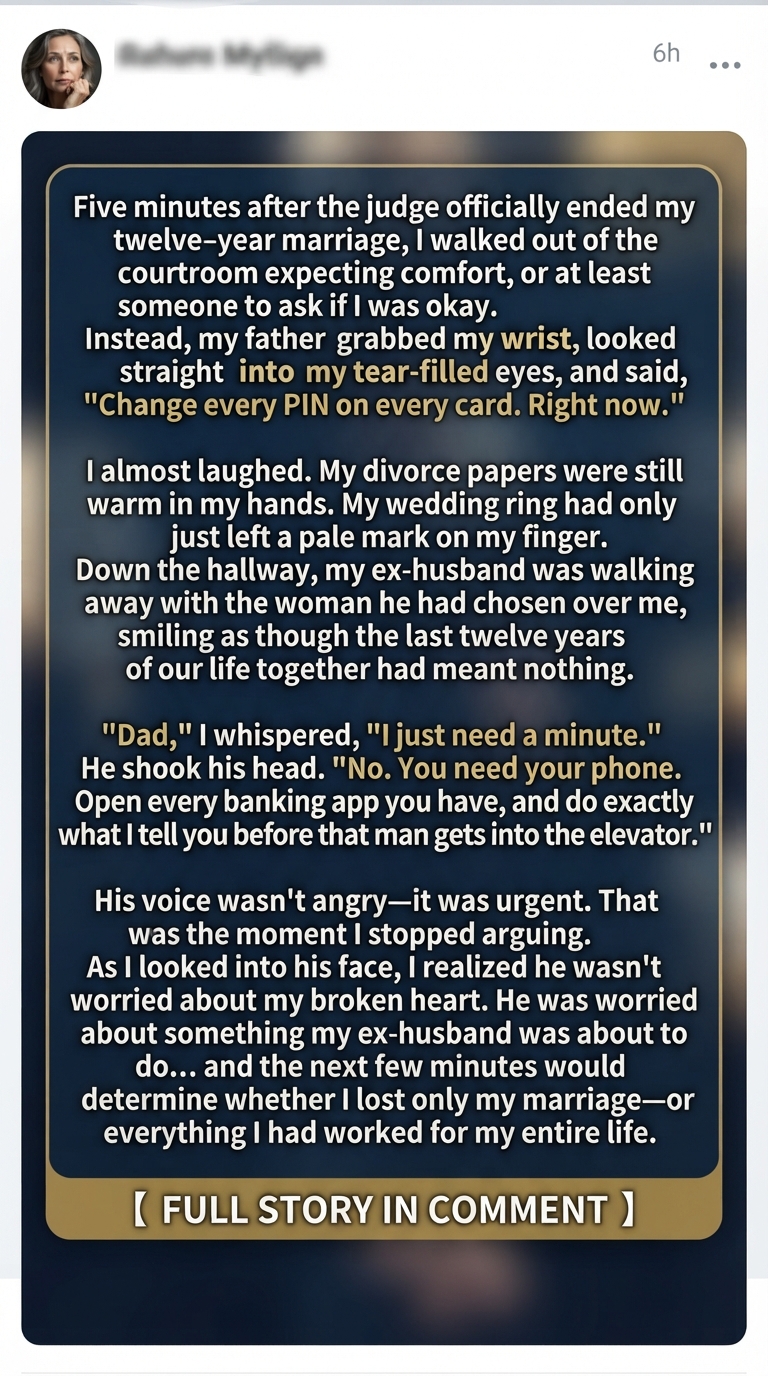
Five Minutes After My Divorce, My Father Didn’t Ask If I Was Okay… He Told Me to Change Every Password I Had
Five minutes after the judge signed the final divorce decree ending my twelve-year marriage, I walked out of the courtroom feeling completely numb.
I expected my father to hug me.
Maybe tell me everything would be okay.
Instead, he caught my wrist before I reached the elevator.
“Change every PIN on every card,” he said.
“Right now.”
I stared at him.
“Dad…”
“I just got divorced.”
“I need a minute.”
He shook his head.
“No.”
“You need your phone.”
“Open every banking app you have before Michael gets into that elevator.”
I looked down the hallway.
My ex-husband was walking away beside the woman he’d left me for.
They were laughing.
As if twelve years together had been nothing more than an inconvenience.
I looked back at my father.
His expression wasn’t angry.
It was urgent.
“Dad…”
“What are you talking about?”
“Do it first.”
“I’ll explain while you work.”
Something in his voice made me listen.
I opened my banking app.
“Now change the password.”
I did.
“Turn on two-factor authentication.”
Done.
“Remove every trusted device.”
Done.
“Now your credit cards.”
Then my investment account.
My retirement account.
My email.
My cloud storage.
My phone carrier.
Every account that mattered.
By the time we reached the parking lot, I’d changed more than twenty passwords.
Finally, I looked at him.
“Will you tell me what’s going on?”
He sighed.
“When you were signing papers inside…”
“I saw Michael using your old passcode.”
My stomach tightened.
“What?”
“He picked up the phone you left on the attorney’s conference table while you were speaking with the judge.”
“He unlocked it without hesitation.”
I felt sick.
“He still knew my code.”
“You hadn’t changed it.”
I hadn’t.
For years we’d used birthdays and anniversaries as passcodes.
I had changed almost nothing after we separated.
Dad continued.
“I also overheard him telling someone…”
“‘She never remembers to change anything.'”
My heart began pounding.
My attorney, who had just caught up with us outside, overheard the conversation.
“He said what?”
Dad repeated it.
Our attorney frowned immediately.
“Let’s check something.”
She asked me to review every account connected to my phone.
As we went through them, we discovered something alarming.
Michael’s laptop was still listed as a trusted device on my cloud account.
His tablet still received password reset approvals.
Our old shared password manager remained active.
Several financial accounts still allowed authentication through an email address he had once used.
Nothing illegal had happened.
Yet.
But if I had walked away assuming the divorce paperwork alone protected me, I could have left dozens of digital doors unlocked.
Over the next two hours, my attorney helped me make a complete checklist.
Shared streaming accounts.
Cloud backups.
Tax software.
Insurance portals.
Medical records.
Utilities.
Our mobile phone plan.
Even the smart thermostat in the house I’d been awarded.
By evening, every account had been updated.
Every device I didn’t recognize had been removed.
The next morning, I received three security alerts.
Someone had tried to log into my email.
Someone had attempted to access my investment account.
Someone had requested a password reset for my cloud storage.
Each request failed.
Because the authentication information had already changed.
I forwarded the alerts to my attorney.
She advised me not to assume who made the attempts, but also to keep copies of everything in case they became relevant later.
A week later, Michael called.
“I can’t get into the tax folder.”
“I know.”
“You changed everything?”
“Yes.”
“You didn’t trust me?”
I looked at the phone for a long moment before answering.
“We’re divorced.”
“It’s not about trust.”
“It’s about boundaries.”
He was silent.
Then he quietly said,
“I guess I didn’t think about all that.”
“I know.”
“That’s why I had to.”
Over the following months, I learned how many people leave marriages without closing those digital doors.
A financial counselor at my bank helped me review every automatic payment.
I froze my credit as a precaution.
Updated beneficiary information.
Created new emergency contacts.
Opened accounts that existed only in my name.
It wasn’t dramatic.
It wasn’t revenge.
It was simply rebuilding a life that no longer depended on someone else’s access.
Six months later, I met my father for lunch.
“I owe you an apology,” I told him.
“For what?”
“I thought you cared more about my bank accounts than my broken heart.”
He smiled sadly.
“I knew your heart would heal.”
“But I also knew grief makes people forget practical things.”
He reached across the table and squeezed my hand.
“I wasn’t trying to protect your money.”
“I was trying to protect your future while you were too overwhelmed to think about it.”
I cried harder than I had in the courtroom.
Because in the moment when I felt like everything was ending, my father had quietly done what he’d spent my whole life doing.
He protected me.
Looking back, people often ask what the first step after divorce should be.
They expect me to say therapy.
Or a vacation.
Or time with friends.
Those things matter.
But there’s another lesson I share too.
When a relationship ends, don’t just divide the furniture.
Secure your digital life.
Change the passwords.
Review shared access.
Update your accounts.
Because healing is hard enough without discovering that yesterday’s trust still has the keys to tomorrow.
And every time I change a password now, I still hear my father’s voice outside that courtroom:
*”Your heart can wait until tonight.”*
*”Protect your future first.”*
