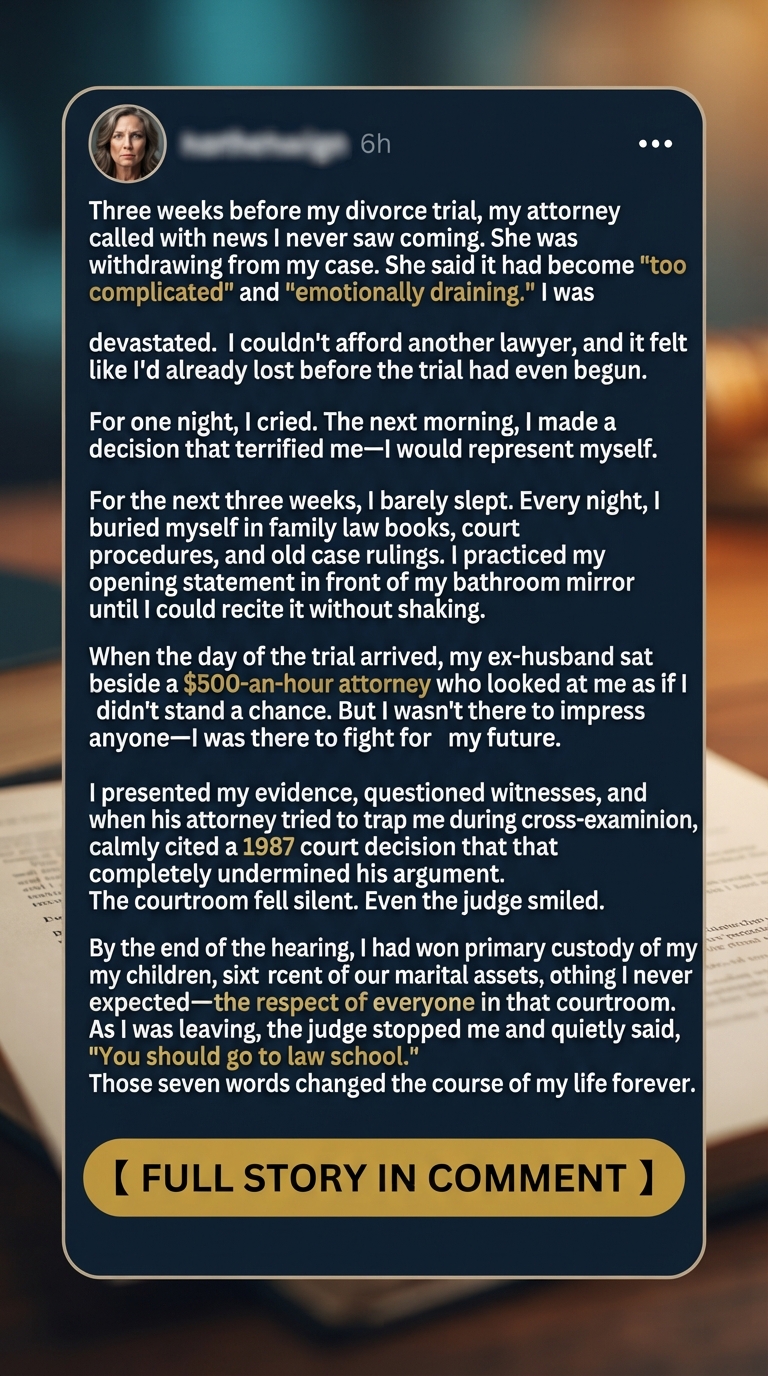
My Attorney Quit Three Weeks Before My Divorce Trial… So I Walked Into Court Alone
Three weeks before my divorce trial, my attorney called and asked if we could meet immediately.
I assumed there had been a new filing or a scheduling change.
Instead, she sat across from me with an expression I’d never seen before.
“I’m withdrawing from your case.”
I stared at her.
“What?”
She sighed.
“I’m sorry.”
“This case has become more complicated than I anticipated.”
“And…”
She hesitated.
“It’s taking a personal toll on me.”
I barely heard the rest.
All I knew was that my trial was three weeks away.
I couldn’t afford another attorney.
The retainers I’d been quoted were more money than I had left after months of legal fees.
When I walked back to my car, I cried harder than I had since my marriage ended.
Not because I believed I was wrong.
Because I believed I was finished.
That night, I let myself fall apart.
The next morning, I made a decision that terrified me.
If I couldn’t afford a lawyer…
I would have to represent myself.
I knew enough to understand how difficult that would be.
Family court isn’t simply about telling your story.
It requires understanding procedures, evidence rules, deadlines, and how to present your case effectively.
So I started learning.
Every evening after work, I sat at my kitchen table surrounded by court rules, statutes, and publicly available legal resources.
I carefully organized every document.
Created timelines.
Prepared exhibits.
Labeled evidence.
Practiced explaining the facts clearly instead of emotionally.
Whenever I didn’t understand a procedure, I researched it until I did.
I wasn’t trying to become a lawyer.
I was trying to avoid making avoidable mistakes.
Some nights I practiced my opening statement in front of the bathroom mirror until I could say it without my voice trembling.
Other nights I doubted myself completely.
More than once, I almost gave up.
Friends encouraged me.
My parents helped with the children so I could prepare.
Court self-help resources answered procedural questions I couldn’t solve alone.
Little by little, fear became preparation.
Trial day arrived.
My ex-husband entered the courtroom with an experienced attorney.
They looked confident.
I looked nervous.
But I was ready.
When the judge asked me to begin, I stood.
I didn’t try to sound like an attorney.
I simply focused on the facts.
I presented my documents one at a time.
Answered questions directly.
Stayed respectful, even when emotions ran high.
During cross-examination, opposing counsel challenged one of my financial claims and argued that my documentation should carry little weight.
Instead of arguing, I calmly directed the judge to the records already admitted into evidence and explained why they supported my position.
The judge asked a few clarifying questions.
After reviewing the documents, the discussion moved on.
That moment reminded me of something important:
Preparation often matters more than confidence.
The trial lasted most of the day.
When it ended, the judge thanked both sides and took the matter under advisement.
Several weeks later, the written decision arrived.
I was awarded primary residential custody, with parenting arrangements designed around the children’s best interests.
The marital property was divided according to the court’s findings and the applicable law.
While not every request I made was granted, the outcome gave me and my children the stability we’d been hoping for.
Relief washed over me.
As people began leaving the courtroom after a later procedural hearing, the judge paused before stepping through the side door.
He looked at me and smiled.
“You were well prepared.”
“Thank you, Your Honor.”
Then he added something I’ll never forget.
“If you ever decide to study law…”
“…I think you’d enjoy it.”
It wasn’t an offer.
It wasn’t legal advice.
It was simply encouragement from someone who had watched an ordinary person work extraordinarily hard to understand a difficult process.
Those few words stayed with me.
The following year, I enrolled in evening classes at my local community college.
Eventually, I transferred to a university.
Then, after years of balancing work, parenting, and studying, I applied to law school.
The first day I walked into class, I felt exactly the way I had on the morning of my divorce trial.
Uncertain.
Overwhelmed.
Determined.
Years later, after earning my law degree and passing the bar exam, I began volunteering at legal aid clinics.
I couldn’t represent everyone.
But I could help people understand the process, organize their documents, and know what questions to ask.
One afternoon, a frightened woman sat across from me.
“My lawyer just withdrew,” she whispered.
“I don’t know what to do.”
I smiled gently.
“I know that feeling.”
Then I handed her a yellow legal pad.
“Let’s start with what you do know.”
Looking back, people sometimes tell me the judge’s words changed my life.
I disagree.
They opened a door.
But I still had to walk through it.
The real turning point came the morning after I thought everything had fallen apart.
It was the moment I decided that being afraid wasn’t the same thing as being defeated.
Sometimes life doesn’t ask whether you’re ready.
It simply asks whether you’re willing to keep learning, keep preparing, and keep moving forward one step at a time.
That decision—not the courtroom, not the verdict, and not the praise—became the foundation of every success that followed.
