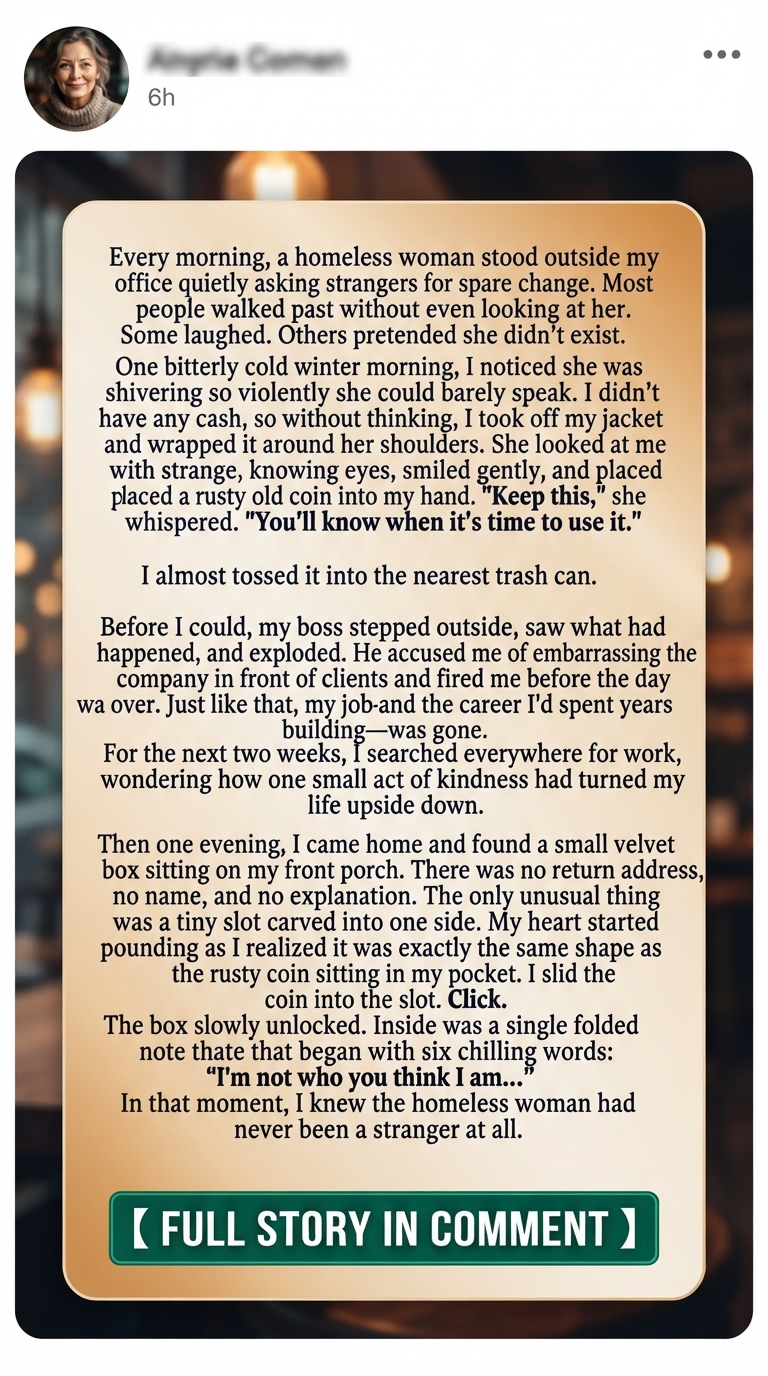
I Gave My Jacket to a Homeless Woman… Two Weeks Later, a Box on My Porch Changed My Life
Every weekday morning, as I walked into my office building, I passed the same elderly woman.
She sat quietly near the entrance with a small cardboard sign that simply read:
**Anything helps. Thank you.**
She never shouted.
Never chased anyone.
Never made anyone uncomfortable.
She simply sat there.
Most people never looked at her.
Some rolled their eyes.
A few laughed.
One bitterly cold January morning, I noticed something different.
She wasn’t asking anyone for money.
She was shaking so hard she could barely hold her paper cup.
I reached into my wallet.
Nothing.
Not a dollar.
For a moment, I hesitated.
Then I took off my winter jacket.
“You need this more than I do.”
She looked surprised.
“No,” she whispered.
“You’ll be cold.”
“I’ll manage.”
I wrapped the coat around her shoulders.
She smiled—a calm, almost knowing smile.
Then she reached into her pocket and placed a rusty old coin in my hand.
“Keep this,” she said softly.
“You’ll know when it’s time to use it.”
I thanked her politely.
Honestly, I assumed it was just an old token she’d carried for luck.
As I walked toward the building, I nearly dropped it into the nearest trash can.
Before I could, my boss called my name.
He had watched everything through the lobby windows.
Inside his office, he folded his arms.
“You stopped outside the building.”
“Yes.”
“You were visible to clients.”
“I gave someone my coat.”
“You embarrassed the company.”
I stared at him.
“I helped someone who was freezing.”
He slid an envelope across his desk.
“Your employment ends today.”
I thought he was joking.
He wasn’t.
Five years of hard work ended before lunch.
The next two weeks were frightening.
I sent out résumé after résumé.
Interview after interview.
Nothing.
Every morning I wondered whether one act of kindness had cost me my career.
Then, fourteen days later, I came home to find a small velvet box sitting on my porch.
There was no return address.
No note.
Just my name.
The box was beautifully crafted from dark wood with brass trim.
On one side was a narrow slot.
The moment I saw it, I remembered the coin.
Curious, I retrieved it from my coat pocket.
It fit perfectly.
**Click.**
The lid slowly opened.
Inside lay a folded letter.
The first line read:
> **I’m not who you think I am.**
I unfolded the rest.
> My name is Eleanor Whitmore.
>
> Ten years ago, after my husband died, I established the Whitmore Family Foundation.
>
> We support organizations that serve people experiencing homelessness, hunger, and poverty.
>
> Before deciding where our grants go, I spend several weeks each year living as anonymously as possible in the communities we hope to help.
I stopped reading for a moment.
Could this really be the same woman?
The letter continued.
> During those weeks, I also learn something else.
>
> How ordinary people respond when they believe no one important is watching.
My hands trembled.
> Hundreds of people walked past me.
>
> A few offered money.
>
> You gave away the warmest thing you had.
Beneath the letter rested another envelope.
Inside was an invitation.
The Whitmore Foundation was launching a new community outreach initiative.
They were looking for someone to coordinate partnerships between local nonprofits and businesses.
At the bottom was a handwritten note.
> You demonstrated the one qualification that cannot be taught.
>
> Compassion.
The following Monday, I met Eleanor.
She looked nothing like the woman on the sidewalk.
She wore a simple navy suit.
Her silver hair was neatly styled.
But her eyes were unmistakable.
The same gentle smile.
The same calm voice.
“You almost threw away the coin,” she said with a laugh.
“I did.”
“It wasn’t valuable.”
“It was only a key.”
“A key?”
“To make sure the invitation reached the right person.”
She explained that the box wasn’t a reward for charity.
It was simply a private way to contact people she’d personally observed.
After several interviews, I accepted the position.
It wasn’t charity work in the traditional sense.
My job was to help local businesses donate surplus food, winter clothing, office equipment, and volunteer hours to organizations that needed them.
For the first time in my career, success wasn’t measured only by quarterly reports.
It was measured by meals served, shelters repaired, and lives made a little easier.
Months later, I learned one final detail.
After my dismissal, Eleanor’s foundation had contacted my former employer while researching my background.
When they learned I had been fired for giving my coat to someone in need, they quietly removed that company from consideration for a major community partnership they had hoped to fund.
Not out of revenge.
Simply because their values no longer aligned.
I never celebrated that decision.
Life had already given me something far better than revenge.
It had given me purpose.
The rusty coin still sits on my desk today.
Visitors often ask why I keep something so ordinary in a small display frame.
I always tell them the same thing.
“It’s not valuable because of what it’s made of.”
“It’s valuable because it reminds me that kindness isn’t an investment with guaranteed returns.”
“Sometimes it costs you.”
“Sometimes no one notices.”
“But every now and then, doing the right thing quietly opens a door you never knew existed.”
Looking back, losing my job felt like the worst day of my life.
It wasn’t.
It was simply the day that pushed me toward the work I was meant to do.
And all because, on one freezing morning, I decided that another human being needed my jacket more than I did.
