My Sister Betrayed Me Ten Years Ago… After Her Death, One Letter Changed Everything I Thought I Knew
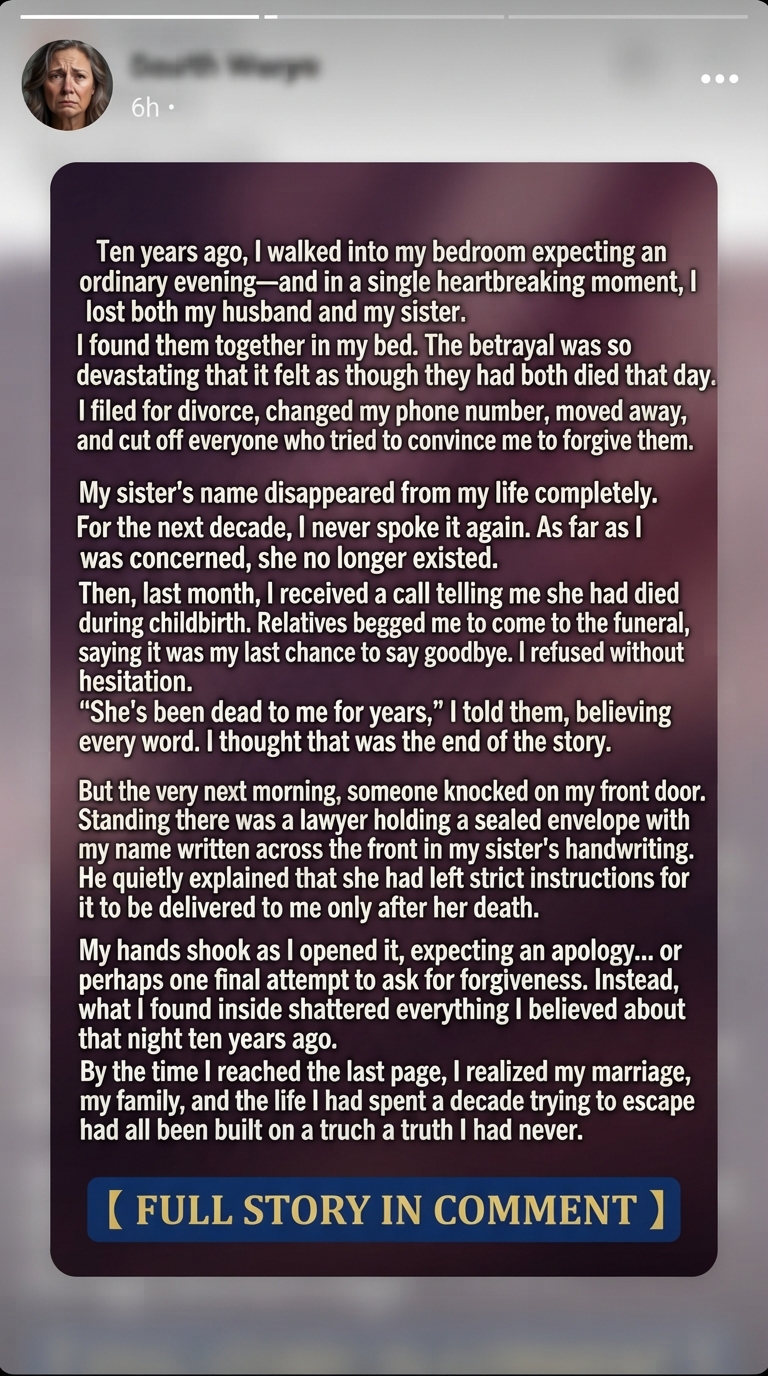
Ten years ago, I walked into my bedroom expecting an ordinary evening.
Instead, I found my husband, Ethan, and my younger sister, Rachel, together in my bed.
Time stopped.
Neither of them spoke.
Rachel burst into tears.
Ethan tried to explain.
I never gave him the chance.
I packed a suitcase that night.
By morning, I’d filed for divorce.
Within weeks, I’d changed my phone number, moved to another city, and cut contact with almost everyone who tried to convince me to “hear them out.”
I didn’t want explanations.
There were some things no explanation could fix.
My parents begged me to speak to Rachel.
I refused.
Friends said people made mistakes.
I refused.
When anyone mentioned her name, I ended the conversation.
As far as I was concerned, my sister had died the night I opened that bedroom door.
Life moved on.
Slowly.
Painfully.
I rebuilt everything.
A new job.
A small house.
New friends who knew almost nothing about my past.
Eventually, I stopped waking up angry.
Then, ten years later, my phone rang.
It was my cousin.
Rachel had died unexpectedly from complications after giving birth to a little girl.
“I’m so sorry,” she whispered.
I felt… nothing.
Or at least that’s what I told myself.
The family begged me to attend the funeral.
“It’s your last chance to say goodbye.”
I answered quietly.
“She’s been dead to me for years.”
I hung up.
The next morning, someone knocked on my front door.
A man in a gray suit stood outside holding a leather briefcase.
“Are you Emily Carter?”
“Yes.”
“I’m sorry for your loss.”
He introduced himself as an attorney handling Rachel’s estate.
“I have something she instructed me to deliver only after her death.”
He handed me a sealed envelope.
My name was written across the front.
In Rachel’s handwriting.
For several minutes, I simply stared at it.
Part of me wanted to throw it away.
Instead, I opened it.
The first page began:
> Emily,
>
> If you’re reading this, then I never found the courage to tell you everything in person.
I sighed.
I expected an apology.
Instead, the next sentence made me stop breathing.
> What you saw that night was real.
>
> But it wasn’t what you believed.
I frowned.
Rachel continued.
> Ethan invited me to your house saying he wanted help planning your surprise tenth wedding anniversary.
>
> I believed him.
I kept reading.
She explained that Ethan had asked her to come over while I was working late.
He said he needed her opinion on a scrapbook and a necklace he’d bought.
She arrived.
They talked.
Then Ethan admitted something shocking.
He had been seeing another woman for nearly a year.
Rachel had immediately told him he had to confess to me.
He refused.
Instead, he begged her not to destroy the family.
She threatened to leave and tell me herself.
Then came the sentence that changed everything.
> Before I could walk out, Ethan kissed me.
I stared at the page.
Rachel wrote that she shoved him away immediately.
He grabbed her arm.
She pulled free.
At that exact moment…
I opened the bedroom door.
From where I stood, all I saw was my husband leaning over my sister on our bed.
The scrapbook, jewelry box, and photo albums they’d been looking through had already fallen onto the floor during the struggle.
I never noticed them.
I never gave either of them time to explain.
Rachel wrote:
> I should have chased after you.
>
> I should have forced you to listen.
>
> Instead, I froze.
>
> And by the time I found my voice, you’d already left.
She admitted that afterward she made terrible choices.
Ashamed and overwhelmed, she stopped trying to contact me directly after my letters and messages were returned unopened.
Eventually, she believed I would never want to hear from her again.
Then I reached the final pages.
Attached were copies of emails.
Text messages.
And, most importantly, a sworn statement Ethan had signed years later during a confidential mediation involving the woman he’d actually been having an affair with.
In it, he admitted that Rachel had never had a romantic relationship with him.
She had been trying to persuade him to tell me the truth when I walked in.
He accepted responsibility for allowing Rachel to take the blame because it made the divorce easier and protected his reputation with his own family.
I sat in stunned silence.
For ten years…
I’d hated the wrong person.
Not because Rachel had been completely blameless—she admitted she should have spoken sooner, louder, and more persistently.
But because I’d believed she’d betrayed me.
The evidence suggested something very different.
She had tried to stop my husband from deceiving me.
And then fear, shame, and terrible timing destroyed us both.
A week later, I drove to the cemetery.
The funeral had already passed.
No crowds remained.
Just fresh flowers and quiet.
I stood beside Rachel’s grave holding her letter.
“I don’t know if you can hear me,” I whispered.
“But I’m sorry.”
“I wish we’d had one conversation.”
“I wish I’d listened.”
Tears finally came.
Not because the pain disappeared.
Because I realized how much time we had lost.
The attorney later contacted me again.
Rachel had left one final request.
If I was willing, she hoped I would meet her daughter someday.
Not to replace anyone.
Not out of obligation.
Simply so her little girl would know that her mother had once had a sister who loved deeply, even when life became unbearably complicated.
Months later, I visited.
My niece was asleep in her crib.
Tiny.
Peaceful.
Completely innocent.
As I held her, my cousin handed me a small photo album.
Inside was a picture of Rachel as a teenager.
Her arm wrapped around my shoulders.
Both of us laughing so hard our eyes were closed.
I smiled through tears.
For years, I had believed that photograph belonged to strangers.
Now I remembered exactly who we had been.
Looking back, people sometimes ask whether I regret refusing to attend Rachel’s funeral.
Every day.
Not because attending would have changed the past.
But because forgiveness is impossible after the final goodbye has already happened.
Her letter didn’t erase what I’d seen.
It didn’t erase the choices everyone made afterward.
But it reminded me of something painfully important.
The worst decisions are often made in the few seconds after we become absolutely certain we already know the whole story.
Sometimes we do.
Sometimes we don’t.
And the difference can shape the rest of a lifetime.
Rachel never got the chance to tell me the truth while she was alive.
The least I can do now is make sure her daughter grows up knowing who her mother really was—not the villain I imagined for ten years, but a flawed, frightened woman who tried too late to make something right.
That became the forgiveness we never had the chance to share together.
