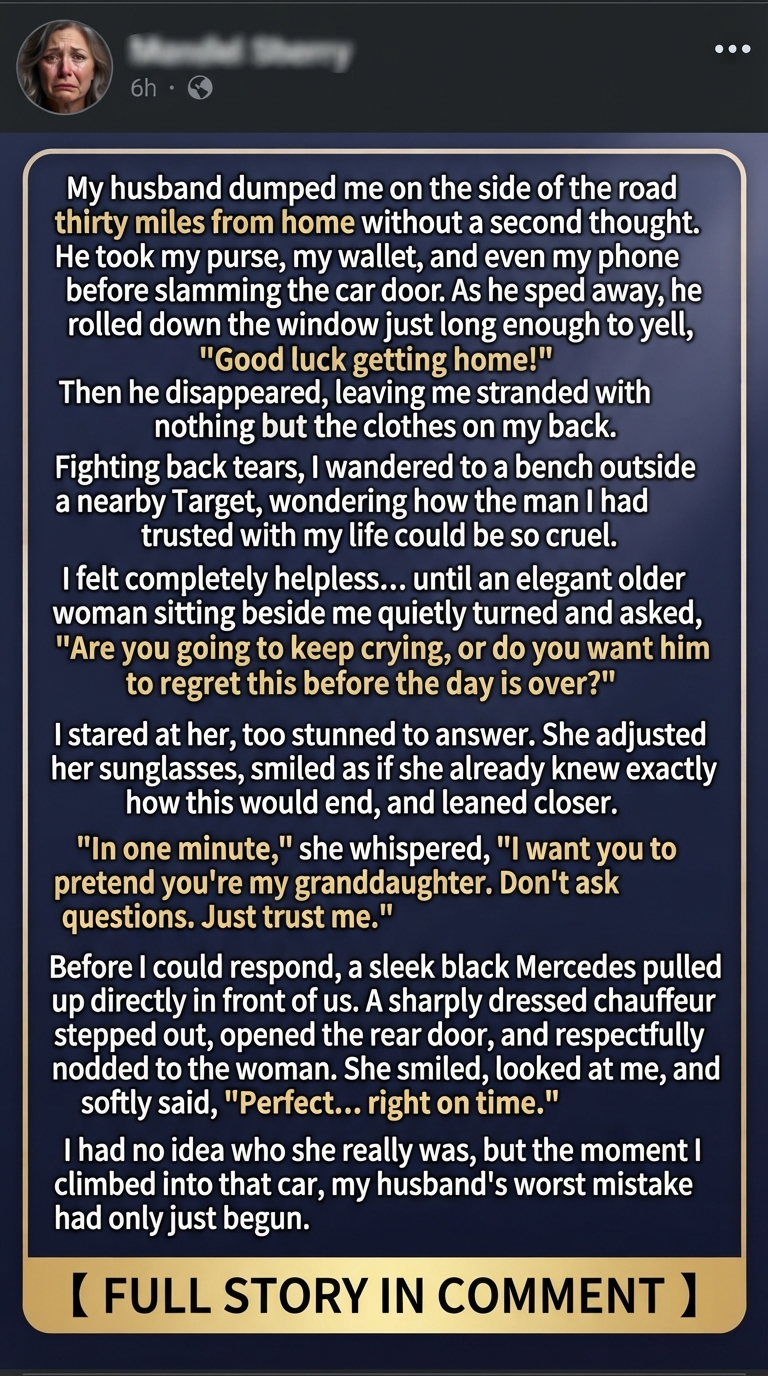
My Husband Left Me Stranded Thirty Miles from Home… The Woman I Met Outside Target Changed My Life Forever
The day my marriage ended didn’t begin with a fight.
It began with silence.
My husband, Eric, had insisted we take a drive to “clear our heads” after weeks of arguing about money.
I agreed, hoping we’d finally have an honest conversation.
Instead, halfway home, he pulled into the parking lot of a Target in a town nearly thirty miles from where we lived.
“I need to run inside for a minute,” he said.
Then he looked at me.
“Actually… get out.”
I laughed.
“What?”
“Get out of the car.”
I thought he was joking.
He wasn’t.
When I refused, he reached across the center console, grabbed my purse, and tossed it onto the driver’s seat.
Before I could stop him, he removed my wallet and my phone.
“I paid for these,” he snapped.
“You can have them back later.”
“Eric, stop.”
He opened my door.
I stepped out, expecting him to calm down.
Instead, he slammed the door, locked it, and drove away.
As he reached the parking lot exit, he rolled down the window.
“Good luck getting home!”
Then he disappeared.
I stood frozen.
No money.
No phone.
No identification.
Just the clothes I was wearing.
For several minutes, I wandered aimlessly before sitting on a bench near the entrance.
I tried not to cry.
I failed.
After a while, I noticed an older woman sitting beside me.
Elegant.
Perfectly tailored navy coat.
Silver hair neatly pinned back.
She watched me quietly for a moment.
Then she asked,
“Are you going to keep crying…”
“…or would you rather he regret this before the day is over?”
I blinked.
“I’m sorry?”
She smiled.
“In one minute, I want you to pretend you’re my granddaughter.”
I stared at her.
“Please don’t ask questions.”
“Just trust me.”
Before I could answer, a black Mercedes stopped in front of us.
A chauffeur stepped out.
“Good afternoon, Mrs. Ashford.”
He opened the rear door.
The woman stood and offered me her hand.
“Come along, dear.”
Every instinct told me this was ridiculous.
But another part of me—the part that had just been abandoned in a parking lot—decided I had nothing left to lose.
I climbed into the car.
As we drove away, she handed me a bottle of water.
“My name is Eleanor Ashford.”
“I’m Margaret.”
“I know.”
I frowned.
“You know me?”
She smiled.
“No.”
“I know your name because you still have your employee badge clipped to your jacket.”
I looked down.
She was right.
For the first time that day, I laughed.
When we reached her home, I expected a mansion.
Instead, it was a beautiful but modest historic house.
She invited me inside.
“First things first.”
She pointed toward the guest bathroom.
“Freshen up.”
“Then we’ll call someone you trust.”
She had no interest in plotting revenge.
She wanted to make sure I was safe.
Using her phone, I called my sister.
Within an hour, she arrived.
Before I left, Eleanor handed me a business card.
“I don’t usually interfere in strangers’ lives.”
“But I have a feeling this isn’t the last time we’ll meet.”
The next few weeks were difficult.
I reported the incident to the police, documenting that my husband had taken my belongings and left me stranded.
I met with a divorce attorney.
I moved in temporarily with my sister.
One afternoon, I received an unexpected call.
It was Eleanor.
“I hope you don’t mind.”
“I looked you up.”
She explained that she chaired the board of a nonprofit that helped women rebuilding their lives after domestic and financial abuse.
“We need someone to manage community outreach.”
“You seem remarkably calm under pressure.”
I almost laughed.
“You should’ve seen me in that parking lot.”
“I did,” she replied.
“I also saw that even after what happened, you thanked the store employee who brought you a tissue.”
“Character shows itself in small moments.”
I accepted the interview.
A month later, I started the job.
It paid less than my previous position.
But it gave me something I’d been missing for years.
Purpose.
Meanwhile, the divorce moved forward.
During the financial disclosures, it became clear that Eric had quietly accumulated significant personal debt without telling me.
His decision to seize my wallet and phone wasn’t about anger.
He’d been trying to prevent me from immediately discovering several accounts and transactions.
The records eventually surfaced anyway through the legal process.
His actions in abandoning me also became part of the evidence considered during the proceedings.
He later admitted his behavior had been reckless and deeply wrong.
The court addressed the financial issues according to the law.
I didn’t need revenge.
I needed freedom.
Nearly two years later, our nonprofit hosted its annual fundraising dinner.
As guests arrived, Eleanor quietly slipped her arm through mine.
“You know,” she said.
“I never told you why I stopped at that Target that day.”
I smiled.
“I’ve wondered.”
“I was on my way to lunch.”
She laughed softly.
“Then I saw a woman sitting alone on a bench trying very hard not to cry.”
“I remembered being that woman.”
Her husband had left her decades earlier under very different circumstances.
A stranger had helped her rebuild.
She had spent the rest of her life trying to repay that kindness.
That evening, during my speech, I looked across the room at Eleanor.
I realized something.
The worst mistake my husband made wasn’t leaving me thirty miles from home.
It was assuming that taking away my purse, my wallet, and my phone meant he had taken away my future.
He hadn’t.
All he’d really done was leave me on the exact bench where the person who would change my life happened to be sitting.
Sometimes the people who hurt us think they’ve reached the final chapter of our story.
They rarely realize they’re only writing the page that introduces someone who will help us begin again.
And that’s exactly what Eleanor did for me.
