Twelve Years After My Ex-Husband Died, His Widow Handed Me a Letter That Changed Everything I Believed
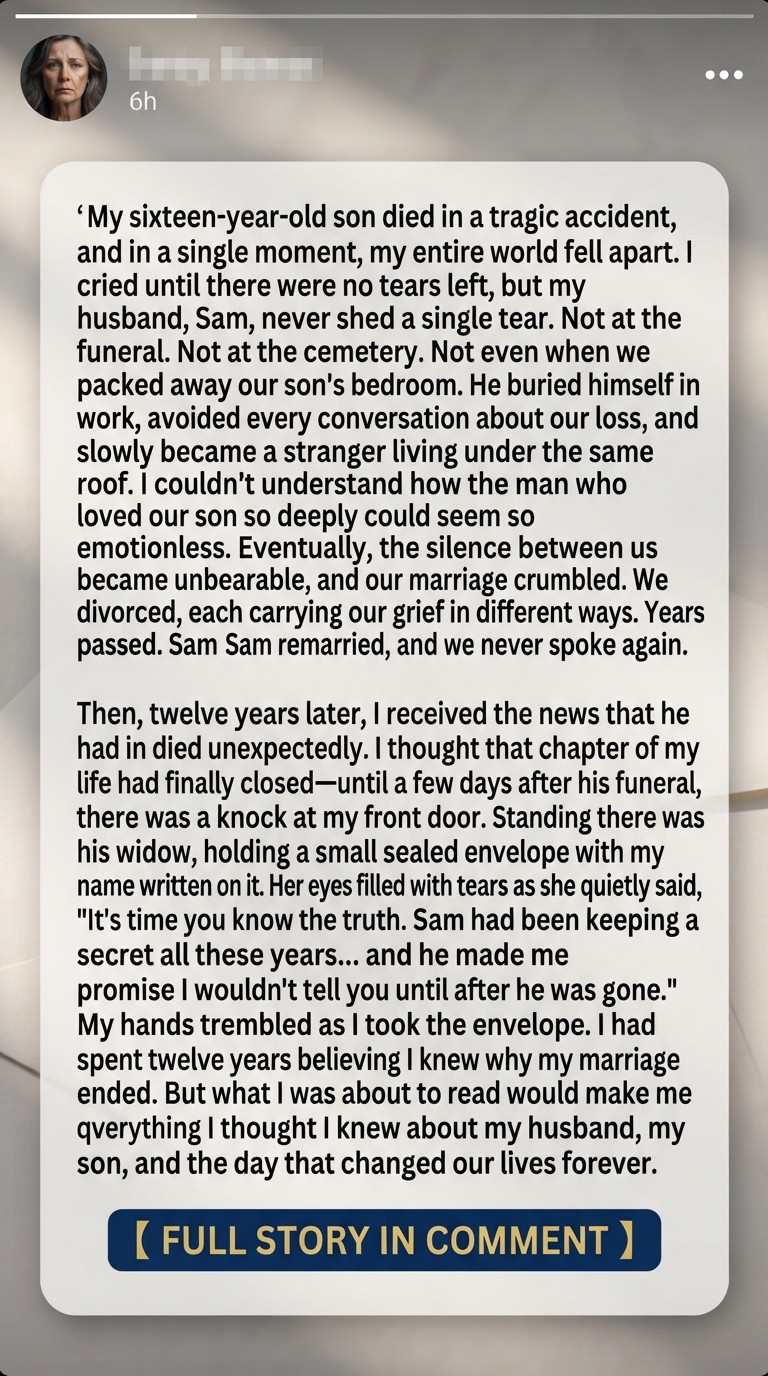
When our sixteen-year-old son, Ethan, died in a car accident, time stopped.
One phone call divided my life into two parts:
Before Ethan.
After Ethan.
For weeks, I barely functioned. I cried until my eyes burned. Friends brought casseroles that went untouched. I wandered into Ethan’s room every morning, breathing in the faint scent of his cologne because I was terrified it would disappear.
Sam, my husband, grieved differently.
Or at least, that’s what I believed.
He never cried.
Not at the hospital.
Not at the funeral.
Not when we chose the headstone.
Not when we packed Ethan’s baseball glove into a box.
People whispered about how “strong” he was.
I didn’t see strength.
I saw distance.
If I tried to talk about Ethan, Sam would quietly leave the room.
If I cried, he’d place a hand on my shoulder for a moment, then bury himself in work.
His silence hurt more than any argument ever could.
One night I finally exploded.
“Did losing him mean anything to you?”
His face turned pale.
“It meant everything.”
“Then why won’t you cry?”
He looked at me for a long time.
“I can’t.”
That was all he said.
I took it as indifference.
Looking back, I wish I’d asked one more question.
Instead, our marriage slowly unraveled.
Grief became two separate islands with no bridge between them.
Two years later, we divorced.
I convinced myself that losing Ethan had revealed who Sam really was.
A man incapable of feeling.
Life moved forward because it had to.
I eventually built a quieter life.
Sam remarried.
We never spoke again.
Then, twelve years later, I learned he had died unexpectedly from a heart attack.
The news saddened me more than I expected.
Not because I still loved him as a husband.
But because he had once been the father of my child.
A few days after his funeral, someone knocked on my door.
Standing there was a woman I recognized immediately from the obituary.
His wife.
Emily.
She held a small sealed envelope.
My name was written across the front in Sam’s familiar handwriting.
She looked exhausted.
“He asked me to give you this.”
“When?”
“Years ago.”
“He made me promise I wouldn’t deliver it unless he died first.”
My hands began shaking.
“Why?”
She swallowed.
“He said… if he told you while he was alive, you would never believe him.”
After she left, I stared at the envelope for almost an hour before opening it.
Inside was a handwritten letter.
And a small folded medical report.
The letter began simply.
> Dear Anna,
> If you’re reading this, it means I never found the courage to tell you in person.
> I’m sorry.
As I continued reading, tears blurred the ink.
Sam wrote that the day Ethan died, something inside him had broken in a way he couldn’t explain.
He wanted to scream.
He wanted to collapse.
But every time he looked at me, he believed one of us had to stay standing.
> You lost our son.
> I believed I couldn’t let you lose your husband too.
He thought if he fell apart, we’d both drown.
So he forced himself to stay composed.
One hour became one day.
One day became one week.
Eventually, he no longer knew how to stop pretending.
Then I reached the medical report.
Twelve months after Ethan’s death, Sam had been evaluated by a neurologist and a psychiatrist after suffering panic attacks, nightmares, and emotional numbness.
His diagnosis included severe post-traumatic stress disorder and complicated grief.
One sentence struck me hardest.
> Patient demonstrates profound emotional suppression and reports inability to cry despite overwhelming sadness.
Unable to cry.
Not unwilling.
Unable.
The letter continued.
> Every night after you went to sleep, I sat in Ethan’s room.
> I held his baseball glove.
> I talked to him.
> I begged him to forgive me for surviving.
My chest tightened.
Sam enclosed photocopies of journal pages.
Dozens of them.
Every entry addressed to Ethan.
Some were only a few lines.
Others stretched for pages.
One read:
> Today your mom smiled for almost five minutes.
> I pretended not to notice because I didn’t want her to feel guilty for smiling.
Another simply said:
> I finally cried today.
> It happened while folding one of your sweatshirts.
> No one saw.
Another:
> Your mom thinks I don’t miss you.
> I don’t know how to convince her that every breath hurts.
By the end of the letter, I could barely see through my tears.
The final paragraph read:
> I don’t expect forgiveness.
> I only hope that one day you’ll know I never stopped loving Ethan.
> And I never stopped loving the woman who gave him life.
> I just forgot how to show either of you.
Weeks later, Emily called and asked if I would like to keep the rest of Sam’s journals.
There were twenty-three notebooks.
He had written to Ethan every Sunday for twelve years.
Never missing one.
Sometimes about baseball.
Sometimes about birthdays.
Sometimes about the life Ethan never got to live.
I spent months reading them.
Not all at once.
A few pages at a time.
Each notebook revealed a man I thought I’d known.
A man who had carried unimaginable grief in complete silence.
Eventually, I met Emily for coffee.
I thanked her for keeping her promise.
She smiled sadly.
“He talked about you often.”
“He did?”
“He hoped you’d someday understand.”
I looked down at my cup.
“I wish we’d understood each other while we still had the chance.”
“So did he.”
Today, Ethan’s journals and Sam’s letters sit together on the same bookshelf.
Every year on Ethan’s birthday, I read one entry from each.
One from a mother.
One from a father.
Both grieving the same child.
In different languages of sorrow.
Losing Ethan was the greatest heartbreak of my life.
Losing my marriage was the second.
But discovering the truth taught me something I wish no family ever has to learn the hard way:
Grief doesn’t always sound like sobbing.
Sometimes it sounds like silence.
Sometimes it looks like work.
Sometimes it hides behind the desperate belief that staying strong is the only way to protect the person you love.
If I could speak to Sam one last time, I wouldn’t ask him why he never cried.
I’d simply tell him what I wish I’d said all those years ago:
“You didn’t have to carry it alone.”
And maybe, just maybe, we both could have survived our grief together.
