I Managed Our Family’s Money for Thirty-Six Years… Then I Discovered My Husband’s Secret Account
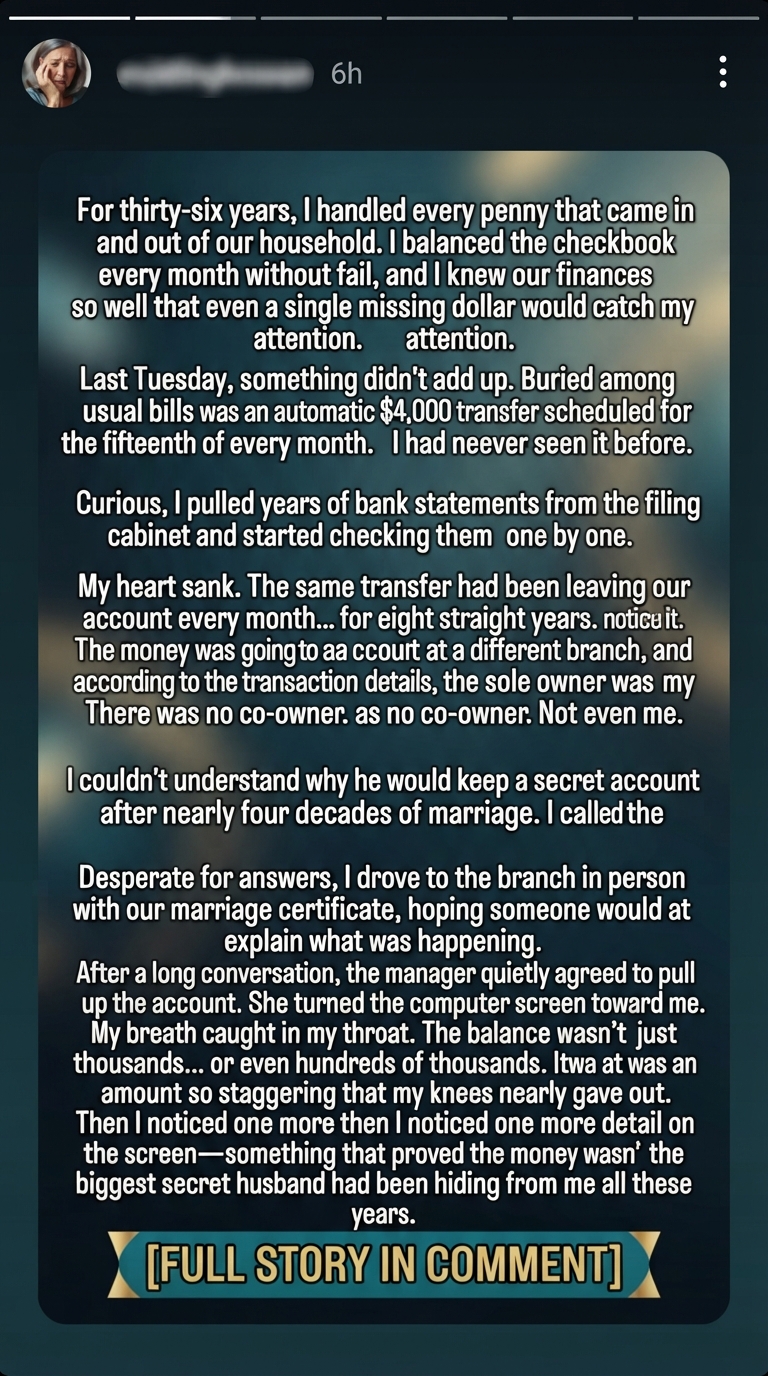
For thirty-six years, I handled every bill in our household.
Mortgage.
Utilities.
Insurance.
Taxes.
College tuition.
Retirement contributions.
If a single dollar was missing, I noticed.
Or at least, I thought I did.
Last Tuesday, while reconciling our checking account, I saw something unfamiliar.
**Automatic Transfer – $4,000.**
Date: The fifteenth of every month.
Destination: Another branch of the same bank.
At first, I assumed it was a typo.
Then I searched the previous month’s statement.
There it was again.
The month before.
And the month before that.
Soon, I had eight years of statements spread across the dining room table.
Every fifteenth.
Exactly four thousand dollars.
Month after month.
Ninety-six transfers.
Nearly **$384,000** had quietly left our household account.
I felt sick.
How had I missed it?
I called the bank.
The representative politely explained that because the receiving account belonged solely to my husband, she couldn’t discuss it.
So I drove to the branch.
The manager listened patiently as I explained that we’d been married almost four decades and that I managed every family account.
She couldn’t disclose private information.
But after confirming my identity and reviewing the circumstances, she agreed to contact my husband while I waited.
He didn’t answer.
She sighed.
“I can only show you information related to the transfers from your jointly owned account.”
She turned the monitor slightly toward me.
I saw the receiving account number.
The current balance.
My knees nearly buckled.
It wasn’t just the monthly deposits.
The account had grown through investments over the years.
The balance exceeded **$1.8 million**.
I barely heard the manager speaking.
Then my eyes drifted to another field on the screen.
**Payable-on-death beneficiary.**
My name.
I blinked.
Surely I’d read it wrong.
I leaned closer.
There it was again.
My name.
Not anyone else’s.
Just mine.
I drove home more confused than angry.
That evening, I placed one of the statements on the kitchen table.
When my husband, Richard, walked in, he froze.
For a long moment, neither of us spoke.
Finally, he asked quietly,
“You found it?”
I nodded.
“What is it?”
He pulled out a chair.
“I’ve been hoping you never would.”
“That’s not an answer.”
He rubbed his face with both hands.
Then he disappeared into the study.
When he returned, he carried a weathered leather binder I’d never seen before.
He set it in front of me.
Inside were dozens of neatly organized documents.
Investment statements.
Certificates of deposit.
Letters.
Legal paperwork.
And one handwritten note.
Richard took a deep breath.
“Eight years ago, after your surgery…”
I looked up.
The surgery.
The one that had turned out well.
The one we rarely talked about anymore.
“I was terrified,” he continued.
“The doctors believed you’d recover.”
“But they couldn’t promise.”
“I realized something that day.”
“If anything ever happened to me first, you’d be financially secure because you understood every account we owned.”
“But if something happened to you first…”
His voice broke.
“I wouldn’t know how to manage any of it.”
He smiled sadly.
“So I started learning.”
At first, he’d opened the separate account simply to teach himself investing without risking our retirement savings.
He transferred four thousand dollars each month from discretionary income we’d already budgeted.
He read books.
Took evening classes.
Met with financial advisers.
Made mistakes.
Learned.
Over time, the investments grew far beyond what he’d imagined.
“So why keep it secret?”
He looked down.
“Because after the first year, I wanted to surprise you.”
“What kind of surprise lasts eight years?”
“The kind where I kept waiting for the balance to become enough.”
“Enough for what?”
He opened the final section of the binder.
Inside was architectural artwork.
Photographs.
Letters.
Plans.
It wasn’t just an investment account.
He had been quietly planning a retirement community scholarship fund in my parents’ names.
Both of them had spent decades volunteering to teach financial literacy after retiring.
Richard wanted to honor them.
The account wasn’t only for us.
It was intended to provide financial education grants and emergency assistance for widows and widowers learning to manage finances after losing a spouse.
“I wanted to announce it on our fortieth anniversary.”
“I thought we’d create it together.”
I stared at him.
“So why was I the beneficiary?”
He smiled gently.
“Because every dollar in that account came from money that belonged to both of us.”
“If I died before surprising you, it should all become yours.”
I turned another page.
There was one more surprise.
Every investment journal Richard kept began with the same sentence.
> Today I tried to become as good with money as my wife has always been.
I laughed through tears.
“You’ve been competing with me?”
He grinned.
“Not competing.”
“Trying to catch up.”
We spent the next several hours going through every document together.
For the first time in nearly forty years, he showed me a part of his life he’d quietly built on his own.
Not because he wanted secrets.
Because he wanted confidence.
And because he wanted to give me something meaningful.
The following year, on our fortieth anniversary, we announced the Richard and Evelyn Carter Financial Confidence Fund.
Instead of helping only widows and widowers, we expanded the mission to teach budgeting, investing, and financial planning to anyone facing a major life transition.
People often ask me what I thought when I first saw that account.
I always tell them the truth.
The money shocked me.
But it wasn’t the biggest surprise.
The biggest surprise was discovering that after thirty-six years of marriage, my husband still believed he could delight me with a secret years in the making.
Looking back, I don’t recommend keeping financial accounts hidden from your spouse.
Transparency matters.
We talked openly about that afterward, and Richard admitted he should have trusted me with the plan much sooner.
But I also learned something important.
Not every hidden account conceals betrayal.
Sometimes it conceals hope.
Sometimes it conceals gratitude.
And sometimes, if you’re very fortunate, it conceals a dream your partner has been quietly building for both of you all along.
