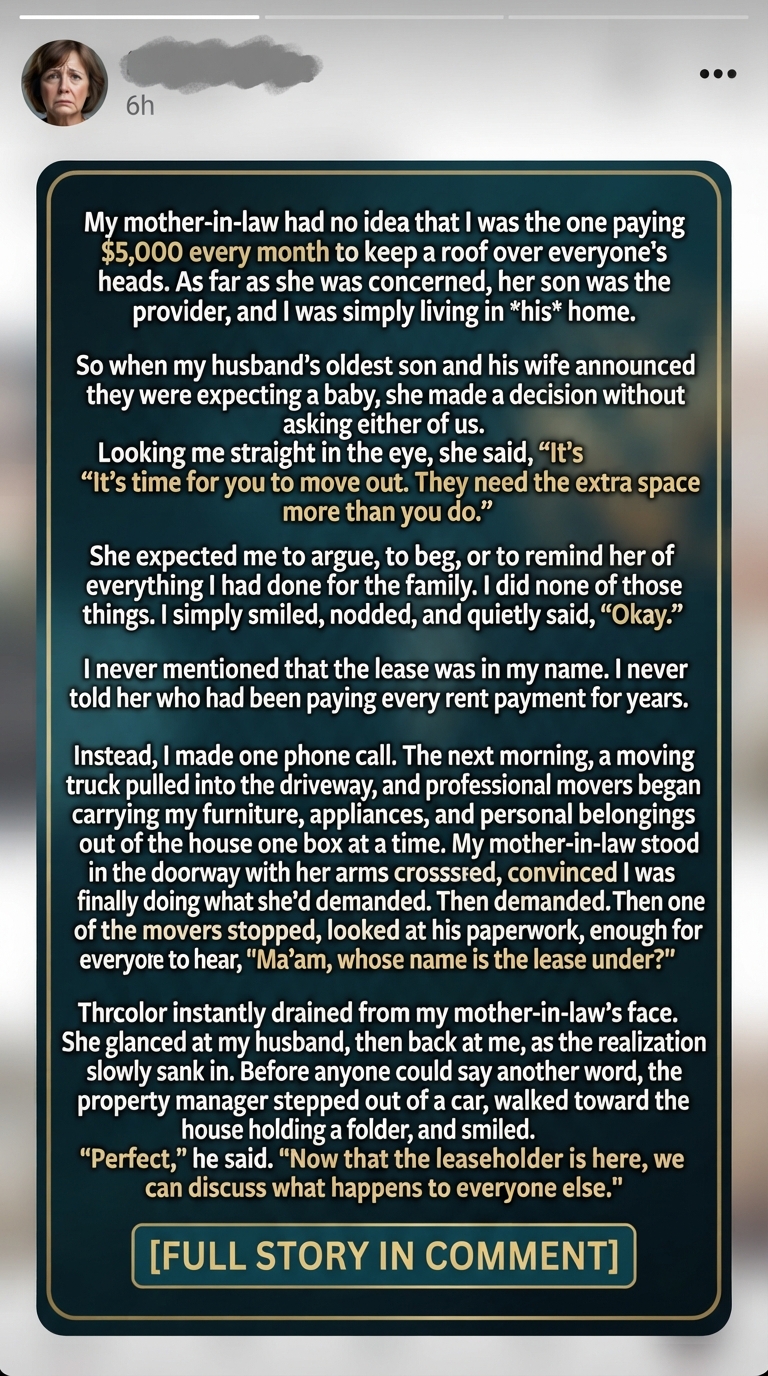
My Mother-in-Law Told Me to Move Out… She Didn’t Know I Was the One Paying $5,000 a Month in Rent
When people looked at our family, they assumed my husband, David, paid the bills.
He had a successful career.
He spoke confidently about finances.
And he never corrected anyone when they called him “the provider.”
I didn’t mind.
For years, I worked as a senior software consultant, and my income fluctuated with contract work. When David decided to leave a higher-paying job to start a small business, we agreed that I would cover the rent until things stabilized.
The rent wasn’t cheap.
Five thousand dollars every month.
The lease was in my name because my income qualified us.
We made the decision together.
Neither of us imagined it would ever matter.
Then David’s oldest son, Ryan, and his wife announced they were expecting a baby.
Everyone was thrilled.
A few weeks later, David’s mother, Lorraine, moved in temporarily after knee surgery.
“Temporarily” quietly stretched into nearly a year.
Lorraine had very traditional ideas.
She believed the man should own the house, pay the bills, and make every important decision.
She also believed daughters-in-law should never question elders.
Whenever anyone complimented the house, she’d smile proudly and say,
“My son works so hard for all of this.”
David usually changed the subject.
I never corrected her.
One Saturday afternoon, Lorraine called a “family meeting.”
Everyone gathered in the living room.
She cleared her throat.
“Ryan and Emily need more room now that the baby’s coming.”
Everyone nodded.
Then she turned to me.
“So I’ve decided it’s time for you to move out.”
The room became perfectly still.
She continued,
“They’re starting a family.”
“You’ll manage.”
I waited for David to respond.
He looked stunned.
“Mom…”
She raised a hand.
“No.”
“This is already decided.”
She expected me to argue.
Instead, I smiled.
“Okay.”
Her eyebrows lifted.
“That’s it?”
“That’s it.”
I stood.
“I’ll start making arrangements.”
The next morning, I called a moving company.
Not because I wanted revenge.
Because I had accepted her request exactly as she’d stated it.
If I was moving out, I intended to do it properly.
By ten o’clock, professional movers filled the driveway.
They carefully wrapped furniture I’d purchased before my marriage.
My office equipment.
Kitchen appliances I’d paid for.
Artwork.
Books.
Boxes.
Even the washer and dryer I’d bought when we first rented the house.
Lorraine watched from the doorway with folded arms.
“I knew she’d come to her senses.”
Halfway through the morning, one of the movers approached me with a clipboard.
“Excuse me.”
“Before we continue, I need to verify one thing.”
He looked at the paperwork.
“Are you the leaseholder for the property?”
“Yes.”
He checked a box.
“Thank you.”
His voice carried farther than any of us expected.
Lorraine frowned.
“The what?”
Before anyone answered, another car pulled into the driveway.
It was the property manager, Mr. Collins.
I’d asked him to stop by because I needed to discuss ending my tenancy.
He greeted me warmly.
“Good morning.”
He glanced at the moving truck.
“Looks like you’re making progress.”
Then he looked around.
“I’ll need a few minutes with the leaseholder to discuss the next steps.”
Lorraine interrupted.
“She’s leaving.”
“So we’ll just stay.”
Mr. Collins smiled politely.
“I’m afraid that’s not quite how this works.”
He opened the folder he carried.
“The current lease is solely in her name.”
“If she terminates it, everyone occupying the property will either need to qualify for a new lease or vacate according to the terms of the agreement.”
Silence.
Lorraine slowly turned toward David.
“What does he mean?”
David sighed.
“When we rented this house, your income wasn’t enough to qualify,” he said gently.
“Mine wasn’t either after I started the business.”
He looked at me.
“Her income qualified.”
“So the lease has always been hers.”
Lorraine stared at me as though she’d never seen me before.
“You’ve been paying the rent?”
“For almost four years,” I answered quietly.
David nodded.
“We agreed she’d carry us while I built the company.”
“I’ve been paying other household expenses as the business improved, but the lease has always been under her name.”
No one spoke.
Mr. Collins excused himself while the family absorbed what they’d learned.
After a long silence, Lorraine finally whispered,
“I didn’t know.”
“I know.”
She looked down.
“I should have asked instead of assuming.”
Those words mattered.
Not because they erased the hurt.
Because they were the first honest acknowledgment I’d heard.
That evening, David and I had the conversation we’d been avoiding.
Not about his mother.
About us.
He admitted that by allowing people to believe he alone supported the household, he’d unintentionally created the misunderstanding.
“I thought I was protecting your privacy.”
I shook my head.
“You were protecting your pride.”
He didn’t argue.
Because he knew it was true.
Over the next month, we made a decision together.
We found a smaller home that better suited the two of us.
Ryan and Emily rented a place closer to his work.
Mr. Collins approved their application independently.
Lorraine eventually moved into a nearby senior apartment community where she could be closer to friends and medical care.
Before we left the old house for the last time, Lorraine asked if we could talk.
She handed me a handwritten letter.
Inside, she apologized—not only for asking me to leave, but for years of overlooking my contributions because they didn’t fit the picture she’d built in her mind.
One sentence stayed with me.
> I confused being quiet with having nothing to contribute.
I framed that sentence.
Not because it made me feel victorious.
Because it reminded me how easily assumptions can replace curiosity.
People often ask whether I enjoyed watching everyone discover the truth.
Honestly?
No.
I would have preferred they’d known it all along.
Recognition feels much better when it comes from appreciation instead of surprise.
The biggest lesson wasn’t that my name happened to be on the lease.
It was that respect should never depend on who signs the checks.
Every family works differently.
Some partners earn more.
Some earn less.
Some contribute through income.
Others through caregiving, homemaking, or supporting a spouse’s career.
Healthy families don’t keep score.
They recognize that every meaningful contribution deserves respect.
And that’s the home I wanted to build—one where no one’s worth could ever be measured by someone else’s assumptions.
