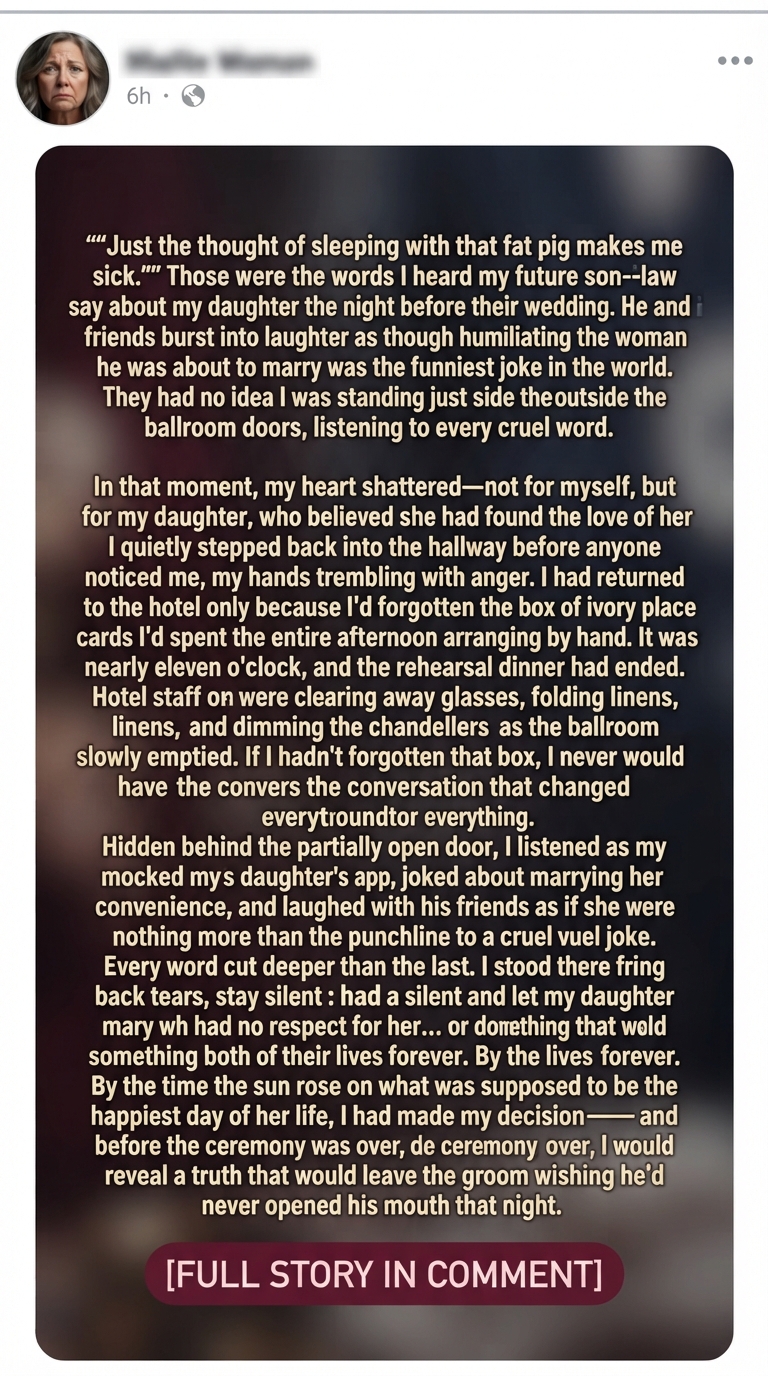
I Overheard My Future Son-in-Law Mocking My Daughter the Night Before Their Wedding… So I Made Sure She Knew the Truth Before It Was Too Late
The night before my daughter’s wedding was supposed to be filled with happy memories.
Instead, it became the longest night of my life.
I’d returned to the hotel ballroom because I’d forgotten a small box of ivory place cards I’d spent hours lettering by hand.
The rehearsal dinner had ended.
Staff members were folding tablecloths, stacking chairs, and dimming the chandeliers.
The ballroom doors were nearly closed.
As I reached for the handle, I heard laughter.
At first, I smiled.
I assumed it was the groom and his friends celebrating.
Then I heard his voice.
Clear.
Confident.
Cruel.
> “Just the thought of sleeping with that fat pig makes me sick.”
The room erupted with laughter.
I froze.
For a second, I honestly wondered if I’d misunderstood.
Then someone asked,
“So why are you marrying her?”
He answered without hesitation.
“Because she’s easy.”
“And her family has connections.”
“Besides…”
“Once we’re married, she’ll never leave.”
More laughter.
Another friend joked that he’d at least be “financially comfortable.”
My future son-in-law laughed the loudest.
I felt physically ill.
My daughter, Emma, adored this man.
She believed every compliment he’d ever given her.
She had spent months planning a wedding with someone who, behind closed doors, treated her with complete contempt.
I quietly stepped away before anyone saw me.
I sat alone in the empty hotel lobby for nearly an hour.
I kept asking myself the same question.
Do I tell her?
Part of me feared she’d think I’d misunderstood.
Another part feared she’d go through with the wedding anyway.
But one thing became painfully clear.
If I stayed silent, I would spend the rest of my life wondering whether I could have protected her.
Just after sunrise, I knocked on her hotel room door.
She answered in pajamas, smiling sleepily.
“Mom?”
“You’re up early.”
I asked if we could talk.
Something in my voice made her step aside immediately.
We sat together on the edge of the bed.
For several moments, I couldn’t speak.
Finally, I told her exactly what I’d heard.
Word for word.
I didn’t exaggerate.
I didn’t soften it.
When I finished, she stared at the floor.
“I don’t believe you.”
Those words hurt.
Not because she doubted me.
Because I knew how desperately she wanted the story to be untrue.
“I understand,” I said quietly.
“So let’s not make this about trusting me.”
“Let’s find out together.”
She frowned.
“What do you mean?”
I suggested we ask the hotel’s event manager whether the ballroom security cameras recorded audio.
The manager explained that the security cameras did not capture conversations, but another employee quietly approached us afterward.
He had been clearing tables during the conversation.
He had heard much of it himself.
He was visibly uncomfortable.
“I’ve been debating whether to say anything,” he admitted.
“I didn’t think it was my place.”
“But your mother is telling the truth.”
Emma’s face went pale.
Still, she wanted certainty.
So she called one of the bridesmaids whose husband had stayed behind helping clean up after the rehearsal dinner.
He reluctantly confirmed hearing similar comments.
Not every word.
Enough to know the conversation had happened.
Emma thanked him and ended the call.
She sat silently for a long time.
Then she whispered,
“I can’t marry someone who talks about me like that.”
There were no dramatic speeches.
No screaming.
No revenge.
She simply removed her engagement ring and placed it on the bedside table.
“I deserve better.”
By midmorning, she asked me to accompany her to meet the groom in a private conference room at the hotel.
Only the two of them—and, at Emma’s request, me as a quiet witness.
When he arrived, he smiled.
Until he saw the ring.
“What’s going on?”
Emma looked him in the eyes.
“I know what you said last night.”
For the first time since I’d met him, he looked genuinely frightened.
“I was joking.”
She shook her head.
“No.”
“You were honest.”
“That’s different.”
He insisted his friends had encouraged him.
That he hadn’t meant it.
That it was “locker-room talk.”
Emma listened without interrupting.
Then she asked one simple question.
“If I’d heard you say those things about another woman… would you think she should still marry you?”
He had no answer.
She placed the ring on the table.
“I’m canceling the wedding.”
He reached for her hand.
She stood.
“I’m grateful I learned who you are before making vows I couldn’t take back.”
Then we walked away.
Canceling the wedding wasn’t easy.
There were disappointed relatives.
Nonrefundable deposits.
Awkward phone calls.
More than one person suggested she was “overreacting.”
Emma answered every one of them the same way.
“I didn’t cancel the wedding because of one sentence.”
“I canceled it because one sentence revealed years of disrespect I simply hadn’t seen.”
Two years later, Emma met Michael.
Their relationship looked very different from the beginning.
There were no grand promises.
No love bombing.
No cruel jokes disguised as humor.
He celebrated her achievements.
Encouraged her when she doubted herself.
And every time he spoke about her—whether she was in the room or not—his words matched the respect he showed her every day.
On the morning of their wedding, I happened to pass a room where Michael was getting ready with his friends.
I paused outside the door.
For just a second, my heart remembered the fear from years earlier.
Then I heard him laughing.
Not at Emma.
About how lucky he felt.
One of his friends teased him about becoming emotional.
Michael smiled and replied,
“I’d rather spend my life making her feel loved than spend one minute trying to impress you guys.”
I quietly walked away before anyone noticed me.
This time, I was crying for an entirely different reason.
People sometimes ask whether I regret telling my daughter what I overheard.
Never.
A canceled wedding is painful.
A marriage built on hidden contempt is far worse.
Love isn’t measured by beautiful vows spoken in front of hundreds of guests.
It’s measured by the words someone chooses when they believe the person they love will never hear them.
That’s where character lives.
And that’s the truth every parent hopes their child discovers before it’s too late.
