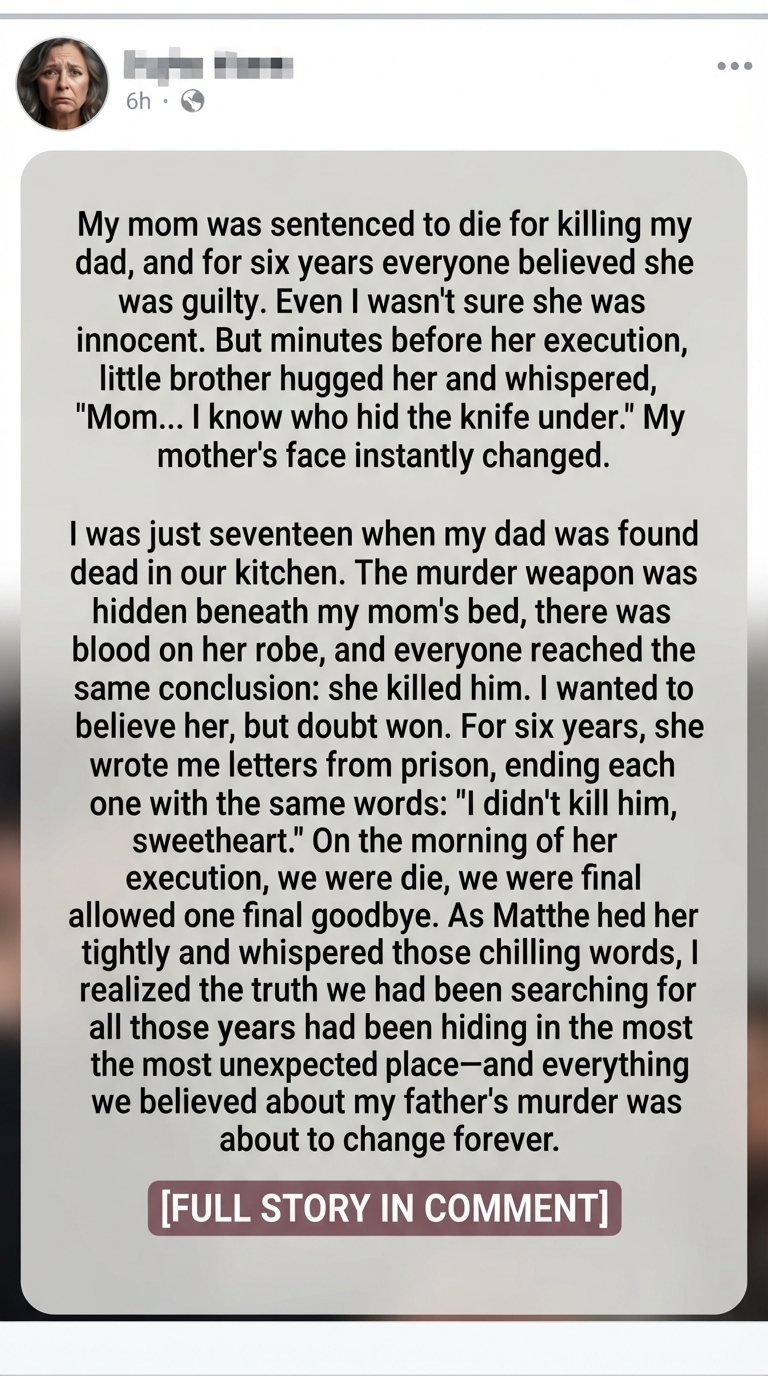
My Mom Was Sentenced to Die for My Father’s Murder. Six Years Later, My Little Brother Whispered One Sentence That Changed Everything.
I was seventeen when my father was murdered.
He was found on the kitchen floor just after midnight.
The knife was discovered hidden beneath my mother’s bed.
There was blood on her robe.
My parents had argued earlier that evening.
To the police, the case looked painfully simple.
My mother insisted she was innocent.
No one believed her.
Not the detectives.
Not the jury.
Not even me.
I hated myself for doubting her, but every piece of evidence pointed in the same direction.
She was convicted of murdering my father.
For the next six years, she wrote me a letter every month from prison.
Every letter ended exactly the same way.
> *I didn’t kill him, sweetheart.*
At first, I read them.
Eventually, I stopped believing them.
I still visited because she was my mother.
But hope had quietly disappeared.
The morning of her execution, my younger brother Matthew and I were allowed one final visit.
Matthew had been only eleven when Dad died.
He remembered less than I did.
As our time came to an end, he hugged Mom tightly.
Then he whispered something I almost didn’t hear.
“Mom…”
“…I know who hid the knife under your bed.”
She pulled back immediately.
For the first time in six years, I saw real shock on her face.
“What did you say?”
Matthew looked at both of us.
“I remembered.”
He began crying.
“I thought it was a dream.”
The correctional officer, realizing something serious was happening, called the prison warden.
Within minutes, our attorney—who had never stopped working on Mom’s case—was brought into the room.
Matthew explained that, in the weeks leading up to Dad’s death, he often hid in the hallway outside my parents’ bedroom when they argued.
One night, after everyone thought he was asleep, he had seen our Uncle Steven—Dad’s younger brother—leave our house carrying a small toolbox.
A few minutes later, Steven quietly returned through the back door.
Matthew watched him kneel beside Mom’s bed before slipping something underneath it.
He had been too frightened to tell anyone.
Later, after police found the knife there, his childhood memory blended with everything adults kept saying.
Over the years, he convinced himself it had only been a nightmare.
But the memory returned when he saw Mom one last time.
Our attorney listened carefully.
Then he asked Matthew one question.
“How do you remember it so clearly now?”
Matthew reached into his backpack.
“I found this.”
It was an old disposable camera we’d discovered while cleaning our grandparents’ attic.
Most of the film had already been developed years earlier.
One roll hadn’t.
Inside were photographs taken by Matthew as a child.
He loved taking pictures of everything.
Birthday cakes.
Pets.
Trees.
Random corners of the house.
One photograph stopped everyone cold.
It showed our dog lying in the hallway.
In the background, barely visible through our parents’ partially open bedroom door, Uncle Steven was kneeling beside Mom’s bed.
The date printed on the developed photograph was two days before Dad’s murder.
The prison attorney immediately contacted the state appeals office.
The execution was stayed while the evidence was reviewed.
Over the following months, investigators reopened the case.
Modern forensic testing was performed on the knife using techniques unavailable during the original investigation.
DNA belonging to Uncle Steven was discovered in places that couldn’t be explained by innocent contact.
Financial investigators uncovered another motive.
Dad had recently changed his will.
Steven, who had expected to inherit part of the family business, had been removed entirely after a serious falling-out.
Phone records, bank transactions, and newly interviewed witnesses painted a picture that the original investigation had missed.
The evidence against my mother had always been circumstantial.
The evidence against Steven kept growing.
When detectives questioned him again, his story changed repeatedly.
Eventually, confronted with the forensic evidence and financial records, he confessed.
He admitted killing my father during an argument over money.
Terrified of being caught, he planted the knife beneath my mother’s bed while everyone else slept, believing the police would focus on the most obvious suspect.
He was right.
For six years, they did.
The conviction against my mother was overturned.
Months later, every charge against her was formally dismissed.
The state publicly acknowledged that she had been wrongfully convicted.
No apology could return the years she lost.
No court order could erase what our family had endured.
One evening, after she finally came home, I found the box containing every letter she’d ever sent me.
I confessed something I’d carried for years.
“I stopped believing you.”
She smiled sadly.
“I know.”
“I’m sorry.”
She hugged me.
“You were a frightened teenager.”
“You believed what everyone else believed.”
Then she handed me the last letter she’d written before the execution date.
It had never been mailed.
At the bottom, beneath her familiar closing sentence, she’d added one more line.
> *If the truth ever finds its way home, don’t waste your life feeling guilty. Spend it living freely.*
Today that letter sits framed on my bookshelf.
People sometimes ask me how an entire justice system could get it so wrong.
I tell them the truth.
Sometimes the loudest evidence isn’t the strongest evidence.
Sometimes assumptions become stronger than facts.
And sometimes the smallest voice in the room—the frightened little brother everyone assumed was too young to remember—holds the one piece of truth that changes everything.
The greatest miracle wasn’t that my mother survived.
It was that, after six years of being called a murderer, she finally heard the words she’d been waiting for all along.
“You were telling the truth.”
