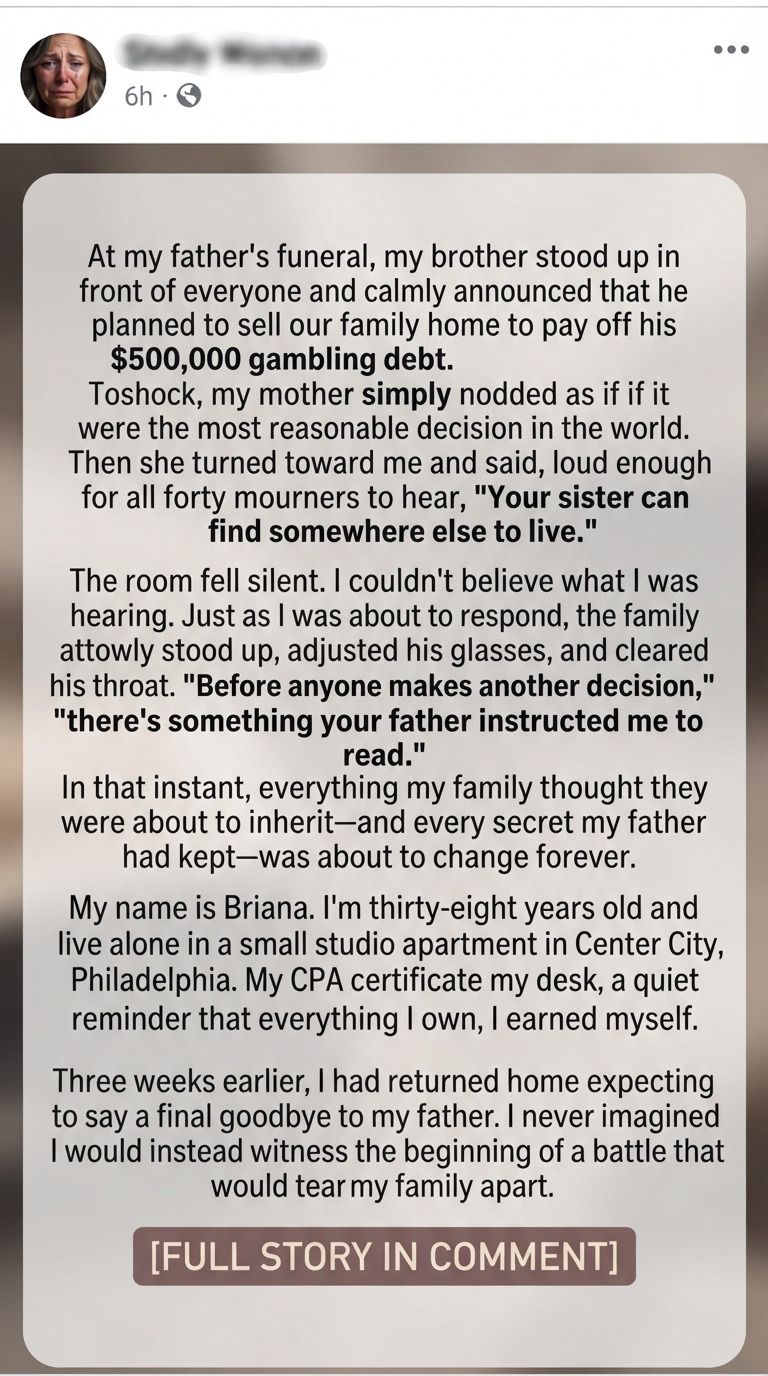
At My Father’s Funeral, My Brother Tried to Sell Our Family Home. Then My Father’s Attorney Read One Final Letter.
My name is Briana.
I’m thirty-eight years old, a certified public accountant, and I live in a small apartment in Center City, Philadelphia.
People often assume that because I work with numbers, I don’t get emotional.
The truth is, numbers have always been easier than family.
Three weeks before my father’s funeral, I received the call I’d been dreading.
He had suffered a massive stroke.
I drove to my hometown immediately.
He never regained consciousness.
Growing up, my father built a successful plumbing company from nothing.
He believed in hard work, paying your bills, and keeping your promises.
My older brother, Eric, inherited his charm.
Unfortunately, he also inherited our grandfather’s gambling addiction.
For years, my parents quietly bailed him out.
A few thousand dollars became twenty thousand.
Twenty became one hundred.
Every rescue convinced him there would always be another.
Dad hated that cycle.
Mom couldn’t stop it.
By the time Dad passed away, Eric owed nearly **$500,000** to casinos, online betting sites, and private lenders.
The funeral was held on a gray Thursday morning.
Nearly forty people gathered to remember my father.
Former employees.
Neighbors.
Church friends.
Family.
The service had barely ended when Eric stood.
“I’ve been talking with Mom,” he announced.
“The easiest solution is to sell the family house.”
He spoke as though he were discussing repainting a fence.
“We’ll pay off my debts and split whatever’s left.”
I felt my stomach tighten.
Before I could respond, my mother nodded.
“I agree.”
Then she looked directly at me.
“Your sister can find somewhere else to live.”
Everyone turned toward my younger sister, Hannah.
She had lived with our parents while caring for Dad during his illness.
She had reduced her nursing hours to become his primary caregiver.
Now she was being told she no longer had a home.
Before anyone could speak, Mr. Lawson—our family’s attorney for over twenty years—rose slowly from his chair.
He adjusted his glasses.
“Before anyone makes another decision,” he said, “your father left specific written instructions for today.”
He removed a sealed envelope from his briefcase.
Across the front, in my father’s unmistakable handwriting, were the words:
**Read only after my funeral.**
Mr. Lawson unfolded the letter.
My father’s voice seemed to fill the room.
> *If you’re hearing this, then my family is together. I hope you’re comforting one another instead of arguing about money.*
He paused before continuing.
> *I know Eric may still be struggling with gambling. If he asks to sell the house to pay debts, my answer is no.*
Eric’s face lost all color.
The room remained silent.
> *This house is not an asset to rescue bad decisions. It is a home.*
Dad continued by explaining that months before his stroke, he had transferred the house into a living trust.
The trust had one clear purpose.
Hannah could live there rent-free as long as she wished, provided she maintained the property and paid the routine expenses associated with living there.
If she ever chose to move, the house would be sold, and the proceeds divided equally among all three siblings.
Until then…
No one could force a sale.
Not Eric.
Not my mother.
Not even me.
Eric stood abruptly.
“That’s ridiculous!”
Mr. Lawson calmly slid another document across the table.
The trust agreement.
Signed.
Witnessed.
Recorded.
Perfectly valid.
Eric looked toward Mom.
“You knew?”
She slowly shook her head.
“No.”
Dad had deliberately kept the trust private.
Not because he wanted secrets.
Because he knew pressure would follow if anyone found out before his death.
Then Mr. Lawson reached into his briefcase one final time.
“There’s another letter.”
This one was addressed specifically to Eric.
He hesitated before opening it.
His hands trembled.
He read silently at first.
Then stopped.
His eyes filled with tears.
Mr. Lawson asked whether Eric wanted the letter read aloud.
After a long pause, he nodded.
Dad had written:
> *Son, I love you more than you’ll ever know.*
> *But love is not the same as rescuing someone from every consequence.*
> *Every time I paid your gambling debts, I told myself I was helping you.*
> *I wasn’t.*
> *I was helping the addiction stay alive.*
Then came the sentence that changed the atmosphere in the room.
> *If you truly want your inheritance, earn it.*
Dad explained that he had placed a separate portion of his estate into a trust for Eric.
The money wasn’t gone.
It wasn’t withheld forever.
It would be released only after Eric completed treatment for gambling addiction, remained free from gambling for a sustained period verified through the trust’s conditions, and worked with a financial counselor.
“If you do that,” Dad wrote, “you’ll receive every dollar I intended to leave you.”
“If you don’t…”
“The money will instead fund college scholarships for apprentices entering the skilled trades.”
Eric lowered the letter.
For the first time in years, nobody rushed to comfort him.
Nobody offered another loan.
Nobody suggested an easier way.
There was only silence.
A week later, Eric called me.
I expected another argument.
Instead, he said,
“I think Dad finally figured out how to help me.”
Two months later, he entered a residential treatment program.
Recovery wasn’t quick.
There were setbacks.
Hard conversations.
More than one difficult apology.
But something had changed.
For the first time, he wasn’t trying to escape the consequences.
He was learning to face them.
Mom struggled the most.
She admitted she had confused protecting Eric with loving him.
Watching him finally accept responsibility forced her to confront years of choices she’d rather not examine.
As for Hannah, she remained in the family home.
She planted flowers Dad had always wanted near the front porch.
Every spring, they bloom just as the weather begins to warm.
Three years later, Eric invited us all to dinner.
He had completed treatment, rebuilt his finances, and begun mentoring others recovering from gambling addiction.
When the trust conditions were met, the inheritance Dad had set aside for him was released exactly as promised.
That evening, Eric raised a glass.
“To Dad.”
“I hated him for saying no.”
“I realize now…”
“…it was the first time anyone truly loved me enough to stop rescuing me.”
Looking back, I understand why Dad trusted an attorney instead of emotions.
Grief can cloud judgment.
Fear can make people agree to terrible ideas.
But clear planning, written with love and wisdom, can protect a family long after someone is gone.
My father didn’t leave us a fortune that day.
He left us something far more valuable.
A final lesson.
Real love isn’t measured by how often you save someone from the consequences of their choices.
Sometimes it’s measured by having the courage to stop.
