I lived in his house for ten years, but I was never really part of it.
To his children, I was just “the nurse.” The help. The woman who changed his sheets, measured his pills, and stayed awake through the nights when he couldn’t sleep. They came and went with polite smiles that never reached their eyes, always in a hurry, always too busy to notice the small things.
But he noticed.
Mr. Whitaker was not an easy man. He was sharp-tongued, stubborn, and fiercely independent—even when his body had long betrayed him. The first year I worked for him, he barely spoke to me unless it was to complain.
“The tea’s too cold.”
“You’re late.” (I never was.)
“Don’t hover.”
But somewhere between the long nights and the quiet mornings, something softened.
Maybe it was the way I sat with him when the pain got bad, even when he insisted I didn’t have to. Or how I learned exactly how he liked his coffee—strong, no sugar, a splash of milk only when he was in a good mood. Or maybe it was simply that I stayed.
For illustrative purposes only
Ten years is a long time to stay.
In the end, he didn’t go peacefully. It was slow. Hard. The kind of ending that strips away pride and leaves only truth behind. One night, when the house was quiet and the rain tapped softly against the windows, he looked at me—not as his nurse, but as something else.
“You didn’t have to do all this,” he said, his voice thin but steady.
“I know,” I replied.
He nodded, as if that answer meant more than anything else I could’ve said.
He passed away three days later.
His children arrived within hours.
The house that had once felt quiet and heavy suddenly filled with noise—voices, footsteps, arguments whispered behind closed doors. Papers were shuffled, drawers opened, decisions made quickly and without me.
On the second day, his eldest son approached me in the hallway.
“You’ve done your job,” he said, not unkindly, but not kindly either. “We won’t be needing you anymore.”
I waited for him to say something else—about my final salary, about the years I’d given—but he didn’t.
Instead, he handed me a small envelope.
“Your things are already packed.”
That was it.
Ten years, reduced to a single sentence.
I left quietly, the way I had lived there.
For five days, I tried not to think about it. Tried to convince myself that kindness didn’t come with guarantees. That I hadn’t done it for recognition, or money, or gratitude.
Still, it hurt.
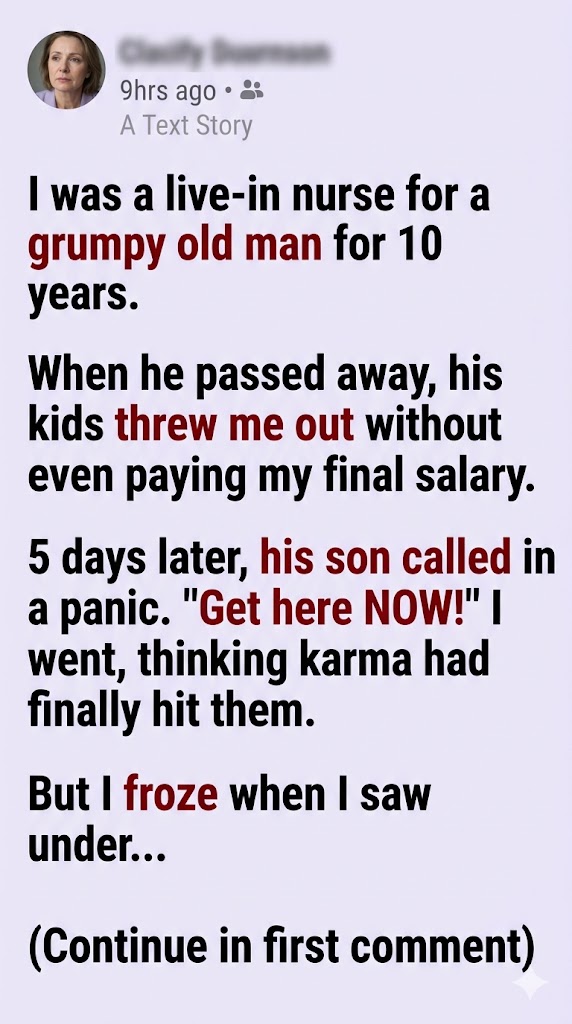
Then the phone rang.
I almost didn’t answer when I saw his son’s name.
“Hello?”
“Get here. Now.”
His voice was tight. Urgent. Not angry—something else. Something close to panic.
For a moment, I thought: this is it. Karma.
I didn’t rush, but I went.
When I arrived, the house felt different. Tense. Heavy in a new way. His son met me at the door, pale, his usual confidence completely gone.
“Come upstairs,” he said.
No explanation.
Just that.
I followed him down the hallway I knew so well, into the room I had spent countless nights in. The bed was still there, neatly made, as if he might walk back in at any moment.
But it was what was underneath it that made me stop.
“There,” his son said, pointing.
For illustrative purposes only
Taped carefully to the wooden frame was a sealed envelope. My name was written across the front in handwriting I knew instantly—uneven, slightly shaky, but unmistakably his.
Attached to it was a small set of keys.
And on top, another note. This one addressed to his children.
“Open this only with her present. The lawyer has a copy of everything inside.”
The room went silent.
His son swallowed hard before peeling the envelope free. For a moment, he hesitated—like opening it might change something he wasn’t ready to face.
Then he handed it to me.
“Go on,” he said quietly.
My hands trembled as I opened it.
Inside was a folded letter, and another key.
I read his words slowly, each one landing deeper than the last.
“You never made me feel like a burden. You sat with me when the nights got long. You stayed when others wouldn’t. The cabin is yours. It’s already in your name. They can’t touch it.”
I looked up, unable to speak.
“The lawyer confirmed it,” his son said, his voice hollow. “He transferred the deed months ago. It’s legally yours.”
A small lake cabin.
I remembered it. He used to talk about it sometimes, on the rare days he felt like reminiscing. Said it was the only place he ever truly felt at peace.
And he had given it to me.
Not his children.
Not anyone else.
Me.
There was nothing they could do. The paperwork was airtight. Every detail handled quietly, carefully, long before his condition worsened.
For the first time since I’d known him, his son had nothing to say.
For illustrative purposes only
I folded the letter gently, pressing it to my chest for just a second before slipping it into my pocket. Then I picked up the key.
It felt heavier than it should have.
I turned toward the door.
“Wait,” his son said, but his voice lacked conviction.
I paused, just briefly.
Then I walked out.
No anger. No triumph.
Just… understanding.
Some people show their love loudly, with grand gestures and public words.
But he hadn’t been that kind of man.
He had been quiet. Difficult. Guarded.
And yet, in the end, he found his own way to say thank you.
It turned out, quiet kindness doesn’t disappear.
It waits.
And sometimes… it comes back when you least expect it.
