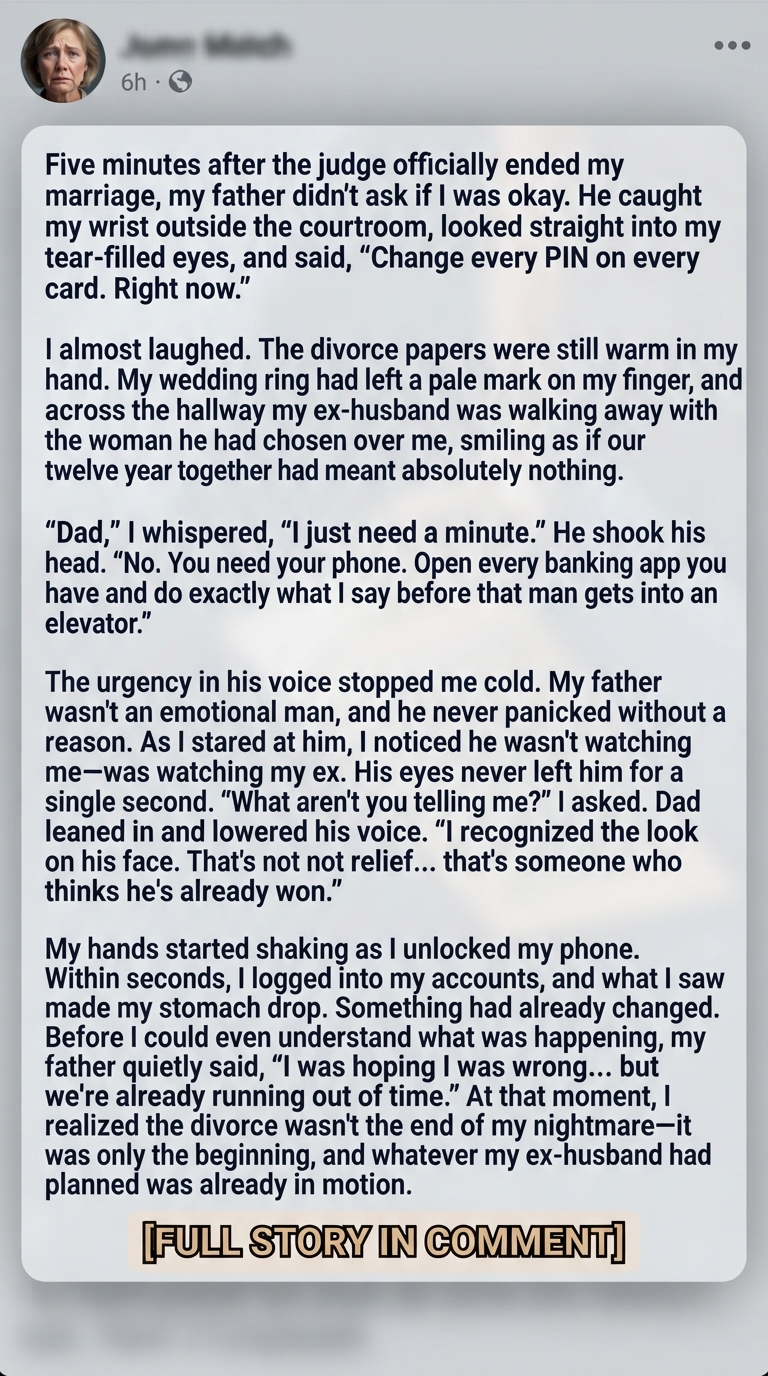
Five Minutes After My Divorce, My Father Told Me to Change Every PIN I Had. I Thought He Was Overreacting—Until I Logged Into My Bank.
Five minutes after the judge finalized my divorce, I could barely breathe.
Twelve years of marriage had ended in less than twenty minutes.
I was still holding the court papers when my father caught my wrist outside the courtroom.
He didn’t ask if I was okay.
He didn’t hug me.
He looked me straight in the eyes and said,
“Change every PIN on every card. Right now.”
I stared at him.
“Dad…”
“I just need a minute.”
He shook his head.
“No.”
“You need your phone.”
“Open every banking app you have before your ex gets into that elevator.”
The urgency in his voice startled me.
My father wasn’t dramatic.
He had spent thirty-five years investigating financial crimes before retiring.
He trusted evidence—not instinct.
As he spoke, I noticed he wasn’t looking at me.
His eyes never left my ex-husband, Ryan, who was laughing with the woman he’d left me for.
“What aren’t you telling me?” I whispered.
Dad leaned closer.
“I recognize that expression.”
“What expression?”
“Someone who believes he’s already won.”
A chill ran through me.
With trembling hands, I unlocked my phone.
I opened my primary checking account.
Nothing unusual.
Savings.
Also normal.
Then I opened the joint credit card account that, under our divorce agreement, Ryan was responsible for closing after paying the remaining balance.
Instead of a zero balance, I saw several large pending transactions.
Luxury electronics.
Designer watches.
A furniture store.
More than **$18,000** in purchases made less than an hour earlier.
My stomach dropped.
“Those weren’t there this morning.”
Dad nodded.
“I figured.”
“How?”
“He kept checking his watch during the hearing.”
“He wasn’t nervous.”
“He was waiting.”
Waiting for the divorce decree.
Our settlement required each of us to assume responsibility for specific accounts.
The joint credit card was supposed to be paid off and closed immediately after the judgment became final.
Instead, Ryan had apparently used it before anyone could begin the closing process.
I looked up.
“He planned this.”
Dad’s voice stayed calm.
“Maybe.”
“But planning doesn’t make it legal.”
“What do I do?”
“The same thing you always do.”
“Document everything.”
Instead of chasing Ryan down the hallway, Dad walked me back into the courthouse.
My attorney was still gathering files.
Within minutes, she was reviewing the account activity with us.
She immediately contacted the card issuer.
Because the account was still technically open, they couldn’t simply erase the charges.
But they could place a temporary hold on additional spending while ownership and responsibility were reviewed.
She also sent Ryan’s attorney a formal notice documenting the unexpected activity and requesting that no further transactions occur until the issue was resolved.
By the time Ryan reached the parking garage, everyone who needed to know already knew.
Over the following week, more facts emerged.
The purchases hadn’t been random.
Several items had been delivered to an apartment Ryan had leased with his new partner weeks before the divorce became final.
He had scheduled deliveries assuming the debt would somehow become my responsibility.
Unfortunately for him, the settlement agreement—and the transaction records—told a different story.
The court retained jurisdiction to enforce the divorce decree, and my attorney filed a motion asking the judge to address the disputed charges.
At the hearing, Ryan insisted he believed he was “allowed” to use the account because it hadn’t yet been closed.
The judge asked one simple question.
“Were these purchases for ordinary joint expenses?”
Ryan hesitated.
“No.”
“Were they discussed with your former spouse?”
“No.”
My attorney then presented the timeline.
Receipts.
Delivery confirmations.
Text messages discussing furniture for Ryan’s new apartment before the divorce was finalized.
The judge wasn’t interested in excuses.
The court ordered Ryan to reimburse the account for the unauthorized personal purchases, pay additional attorney’s fees related to enforcing the decree, and cooperate in closing every remaining joint financial account.
When we left the courthouse that day, Dad finally smiled.
“I owe you an apology,” I said.
“For what?”
“I thought you were overreacting.”
He laughed softly.
“No.”
“I’ve just seen this before.”
On the drive home, I asked him how he’d known.
“I didn’t know,” he admitted.
“I suspected.”
“When people spend months negotiating a divorce fairly, relief usually looks… quiet.”
“But your ex looked excited.”
“Not because the marriage was over.”
“Because he expected to leave with one last advantage.”
Dad paused before adding,
“People reveal their plans long before they reveal their actions.”
Over the next month, I changed every password.
Every PIN.
Every security question.
I froze my credit with the major reporting agencies, updated beneficiary information where appropriate, and closed every remaining shared financial connection.
It wasn’t about revenge.
It was about peace.
Several months later, I received a handwritten note from my father.
Inside was a single sentence.
> **I’m proud that you protected your future instead of chasing your past.**
I keep that note in my desk.
Not because it reminds me of my divorce.
But because it reminds me of something far more important.
Heartbreak can make us believe the worst is already behind us.
Sometimes, though, the wisest thing we can do is pause, take one careful look around, and protect ourselves before turning the page.
My marriage ended in a courtroom.
My new life began the moment I listened to the quiet voice of someone who loved me enough to notice what I couldn’t.
Looking back, the divorce wasn’t the end of my story.
It was simply the day I learned that healing starts with hope—but recovery begins with protecting yourself.
