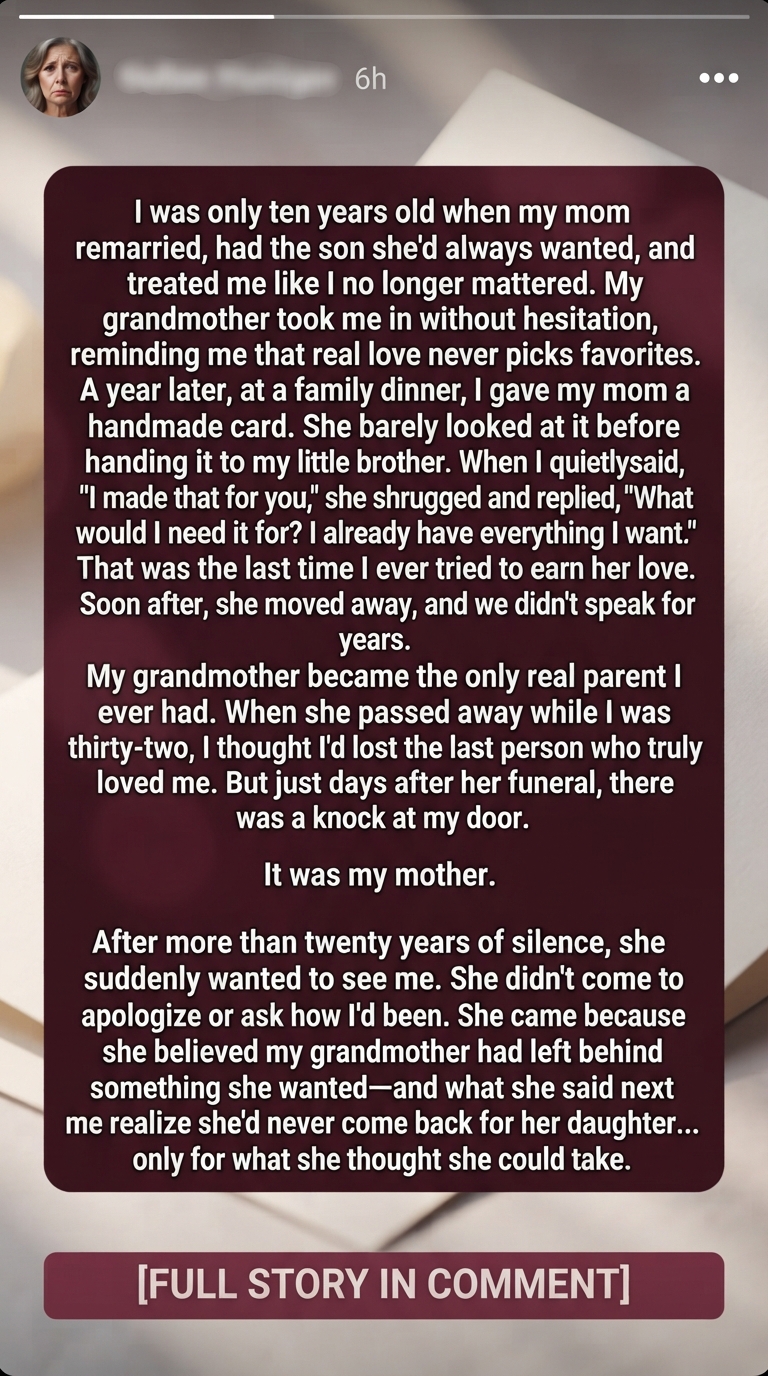
My Mother Chose Her New Family Over Me. Twenty-Two Years Later, She Came Back for My Grandmother’s Inheritance.
I was ten years old when my mother remarried.
Within a year, she had the son she’d always dreamed of.
From that moment on, it felt as though I had become a reminder of the life she wanted to leave behind.
My grandmother noticed long before I did.
One evening, after another argument between my mother and me, Grandma quietly packed a small suitcase and said, “You’re coming home with me.”
No court battle.
No dramatic confrontation.
My mother simply agreed.
Looking back, I think that hurt more than if she had fought to keep me.
Grandma never tried to replace my mother.
She simply loved me.
She helped with homework.
Cheered at every school concert.
Stayed awake when I was sick.
And every night before bed she reminded me,
“Real love never picks favorites.”
A year after moving in with Grandma, we attended a family dinner.
I’d spent hours making my mother a birthday card.
Construction paper.
Markers.
Little pressed flowers glued around the edges.
When I handed it to her, she barely glanced at it before passing it to my younger half-brother.
He laughed and colored on it with a crayon.
I quietly said,
“I made that for you.”
Without even looking at me, she shrugged.
“What would I need it for?”
“I already have everything I want.”
I was eleven years old.
That was the day I stopped trying to earn my mother’s love.
A few months later, she and her new family moved several states away.
Years passed.
Birthdays came and went.
Graduations.
College.
My wedding.
She attended none of them.
Grandma never spoke badly about her.
Whenever I asked why my mother never called, she’d simply squeeze my hand.
“Some people don’t know how to love the way they should.”
“That isn’t your fault.”
Those words carried me through adulthood.
When Grandma died, I was thirty-two.
The grief was unlike anything I’d ever known.
She had been my safe place.
My parent.
My best friend.
After the funeral, I sat alone in her living room surrounded by photo albums and quiet memories.
Three days later, someone knocked on my front door.
When I opened it, I froze.
My mother stood there.
Older.
Perfectly dressed.
Looking strangely uncomfortable.
It had been more than twenty years.
For one impossible second, I wondered if she’d finally come because she’d missed me.
She didn’t hug me.
She didn’t ask how I was.
Instead, she cleared her throat.
“I assume your grandmother left you the house.”
I stared at her.
“I’m sorry?”
She folded her arms.
“She always favored you.”
“I’d like to discuss dividing her estate fairly.”
There it was.
Not an apology.
Not regret.
Money.
I quietly asked,
“What makes you think any of it belongs to you?”
“I’m her daughter.”
I nodded.
“And I was the child she raised.”
She looked irritated.
“That’s exactly why this isn’t fair.”
Before I could answer, my grandmother’s attorney, Mr. Lawson, pulled into the driveway.
He had arranged to meet me that afternoon to review the remaining estate paperwork.
Seeing my mother, he sighed softly.
“I thought this might happen.”
He invited us both inside.
After everyone sat down, he placed a sealed envelope on the table.
“This letter was written by your mother,” he said, looking at me.
“She instructed me to give it to you only after the estate was settled.”
My hands shook as I opened it.
Grandma’s familiar handwriting filled the page.
> My sweet girl,
> If your mother is reading this with you, then I’m afraid I’ve guessed correctly why she came.
I glanced up.
My mother’s expression tightened.
The letter continued.
> I loved my daughter from the day she was born.
> I never stopped loving her.
> But loving someone does not mean pretending they never caused harm.
Grandma explained that she had revised her will years earlier after speaking with an attorney.
The house, her savings, and her personal belongings had all been left to me.
Not because she wanted to punish my mother.
But because she wanted to provide for the child she had actually raised.
Then came the sentence that broke me.
> Parenting isn’t biology.
> It’s showing up.
Mr. Lawson quietly handed me another folder.
Inside were years of records.
School tuition Grandma had paid.
Medical bills.
Dance lessons.
College expenses.
Everything she’d willingly covered after my mother stopped contributing.
My mother stared silently at the paperwork.
Finally, she whispered,
“I didn’t know she kept all of this.”
Grandma had.
Not to embarrass anyone.
Simply to document the life she’d chosen to build with me.
Then Mr. Lawson handed my mother a smaller envelope.
“This one is addressed to you.”
She hesitated before opening it.
No one spoke while she read.
Halfway through, tears rolled down her face.
She looked at me for the first time that day—not as someone standing between her and an inheritance, but as her daughter.
“I didn’t realize…” she whispered.
Mr. Lawson gently replied,
“She hoped someday you would.”
Later, my mother asked if she could tell me something.
“I kept convincing myself there would be time.”
“Time to call.”
“Time to explain.”
“Time to fix everything.”
She looked around Grandma’s empty house.
“But your grandmother ran out of time before I did.”
I didn’t know what to say.
Some wounds are too old for quick answers.
Weeks passed.
She called occasionally.
Not to ask about money.
Just to talk.
Sometimes the conversations lasted five minutes.
Sometimes an hour.
She apologized more than once.
I believed she was sincere.
But sincerity doesn’t erase decades.
Trust had to be rebuilt one conversation at a time.
A year later, she asked if we could visit Grandma’s grave together.
We stood in silence for several minutes.
Finally, my mother whispered,
“I spent so much of my life chasing the family I wanted…”
“…that I forgot to love the daughter I already had.”
I cried.
So did she.
Our relationship never became perfect.
It never could.
Too many birthdays had passed.
Too many empty seats at graduations.
Too many years without phone calls.
But something changed that afternoon.
For the first time, we stopped pretending the past hadn’t happened.
Healing didn’t begin with forgiveness.
It began with honesty.
People sometimes ask whether my grandmother left me a valuable inheritance.
She did.
The house helped me build financial security.
Her savings gave me peace of mind.
But those weren’t the greatest gifts she left behind.
The greatest inheritance was every ordinary day she chose me.
Every packed lunch.
Every bedtime story.
Every reassuring hug.
Every reminder that love is measured by presence, not promises.
My mother gave me life.
My grandmother taught me how to live it.
And in the end, that was the inheritance no one could ever take away.
