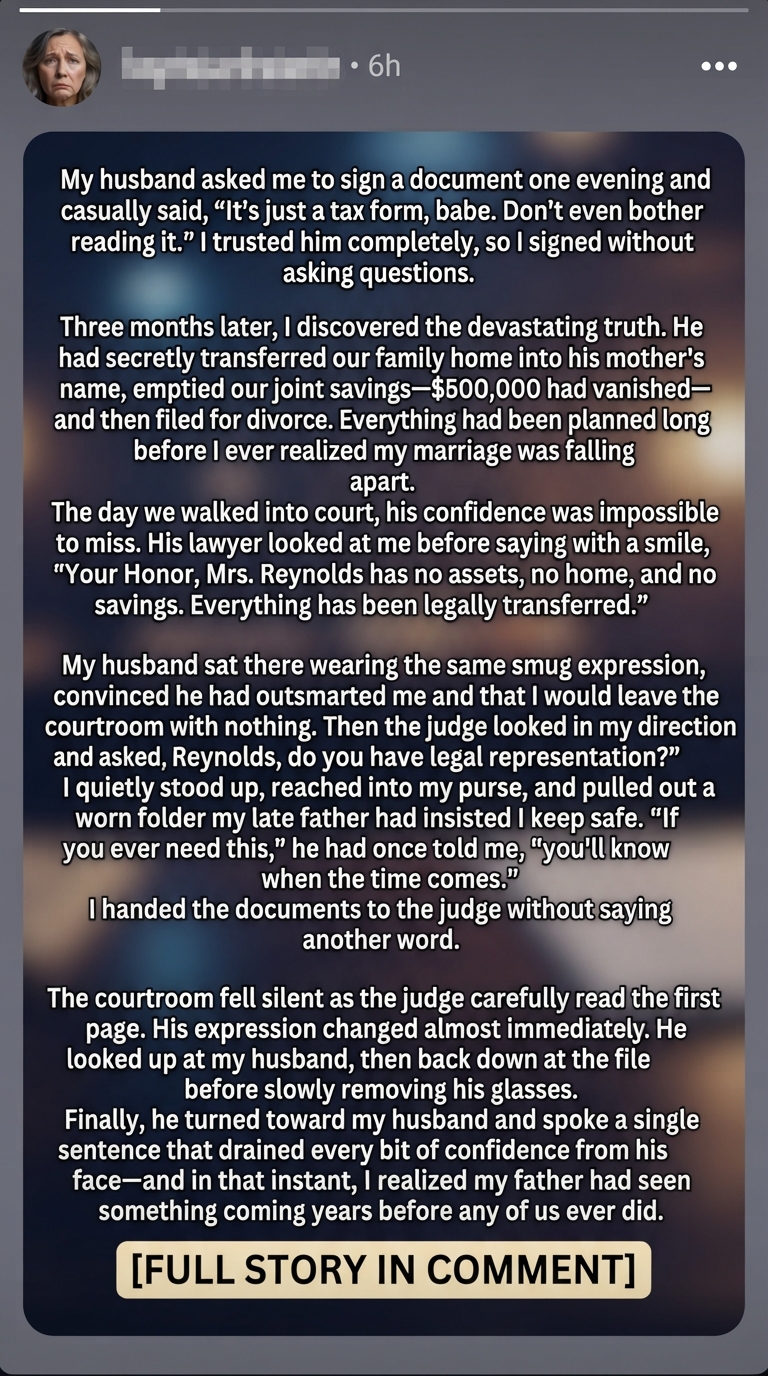
My Husband Told Me to Sign “Just a Tax Form.” Three Months Later, I Learned I’d Signed Away Our Home—or So He Thought.
When my husband handed me the papers, I didn’t hesitate.
“It’s just a tax form, babe,” he said with a tired smile.
“Don’t even bother reading it.”
We’d been married for fourteen years.
We owned a beautiful home.
Shared retirement accounts.
Nearly **$500,000** in savings we’d built together over more than a decade.
I trusted him.
So I signed.
I didn’t know that trust would become the most expensive mistake of my life.
Three months later, I came home from work to find half the closets empty.
His clothes were gone.
His office was cleared out.
On the kitchen counter sat an envelope.
Inside were divorce papers.
At first, I thought it had to be some kind of misunderstanding.
Then my attorney began reviewing our financial records.
The home had been transferred into my mother-in-law’s name.
Large withdrawals had emptied our joint investment and savings accounts.
Property records showed documents bearing what appeared to be my signature.
The paper I’d believed was a tax form had been included in a stack of legal documents.
My attorney looked at me carefully.
“Did you know you were signing a property transfer?”
“No.”
“Did anyone explain those documents?”
“No.”
“Did you have independent legal advice?”
“No.”
She nodded slowly.
“Then we have serious questions to investigate.”
The weeks before court were miserable.
Friends told me to prepare for the worst.
My husband refused every request to negotiate.
He acted as though everything had already been decided.
The morning of the first major hearing, he arrived wearing the confident smile I’d once loved.
His attorney addressed the court.
“Your Honor, the marital residence has already been transferred.”
“The funds at issue have likewise been distributed.”
“My client believes the remaining matters can now be resolved efficiently.”
It sounded as though the case were already over.
Then the judge looked toward my attorney.
“Counsel?”
She stood.
“Your Honor, before addressing property division, we’d ask the Court to review several exhibits concerning the circumstances surrounding those transfers.”
She nodded toward me.
I reached into my purse and removed a worn folder.
My late father had given it to me years earlier.
He’d been a meticulous accountant who believed every important document deserved a secure place.
“If life ever becomes complicated,” he’d once said, “keep records. Facts outlast arguments.”
Inside the folder weren’t magical papers that solved everything.
They were copies.
Emails.
Financial statements.
Property records.
A notebook where I’d written the dates and purposes of documents my husband had asked me to sign over the years.
There was even an email from him sent the same evening I’d signed the paperwork.
Its subject line read:
**Tax Documents Before Friday**
Attached to the email was a message reminding me to “sign the tax packet tonight.”
There was no mention of transferring our home.
No explanation.
No disclosure.
My attorney also produced testimony from the notary who had witnessed the signatures.
The notary acknowledged that several documents had been presented together in a single stack and could not specifically recall whether each page had been individually explained.
The judge read quietly for several minutes.
He removed his glasses.
Then he looked directly at my husband.
“Mr. Reynolds…”
“…these allegations, if supported by the evidence presented at trial, raise serious questions about whether your spouse gave informed consent to these transactions.”
The confidence disappeared from my husband’s face.
It wasn’t a final victory.
But it was the first time he realized the court wasn’t simply going to accept the paperwork at face value.
Over the next several months, the case became far more detailed.
Financial experts traced the movement of the money.
Property records were examined.
Emails, text messages, and electronic metadata established when documents had been created and how they had been presented.
My mother-in-law testified that her son had assured her “everything had been handled.”
She admitted she never paid for the house.
She believed it had been a gift.
That testimony mattered.
The court wasn’t deciding whether gifts between family members were allowed.
It was deciding whether those transfers were legitimate or part of an effort to defeat the equitable division of marital property.
At trial, the judge found that multiple transfers had occurred while the marriage was already breaking down and that the evidence showed I had not been adequately informed about the nature of the documents I signed.
The court concluded that the disputed transfers should not determine the final division of the marital estate.
The value of the house and the missing funds were brought back into the court’s overall property analysis.
Because some assets could no longer be returned exactly as they had been, the judge awarded me an offset through other marital property and a monetary judgment reflecting my share under the applicable law.
The judge also ordered my husband to reimburse a substantial portion of my attorney’s fees after finding that his conduct had unnecessarily increased the cost and complexity of the litigation.
When the hearing ended, my husband didn’t look at me.
He quietly gathered his papers and walked out.
Outside the courthouse, I sat on a bench holding the worn folder my father had given me years before.
For a long time, I simply stared at it.
People often ask whether my father somehow predicted this would happen.
He didn’t.
He simply understood something many people learn too late.
Documents matter.
Keeping copies matters.
Reading before signing matters.
And if someone you love tells you not to read something before signing it, that’s exactly when you should slow down.
I eventually bought a smaller house.
Not as grand as the one I’d lost.
But every room inside it belonged to a life built on honesty instead of appearances.
The folder still sits in my desk drawer.
Not because I expect another betrayal.
But because it reminds me of the greatest lesson my father ever taught me.
Trust is a beautiful thing.
But trust should never replace understanding.
The strongest protection isn’t suspicion.
It’s taking the time to know exactly what you’re signing before you place your name on the page.
