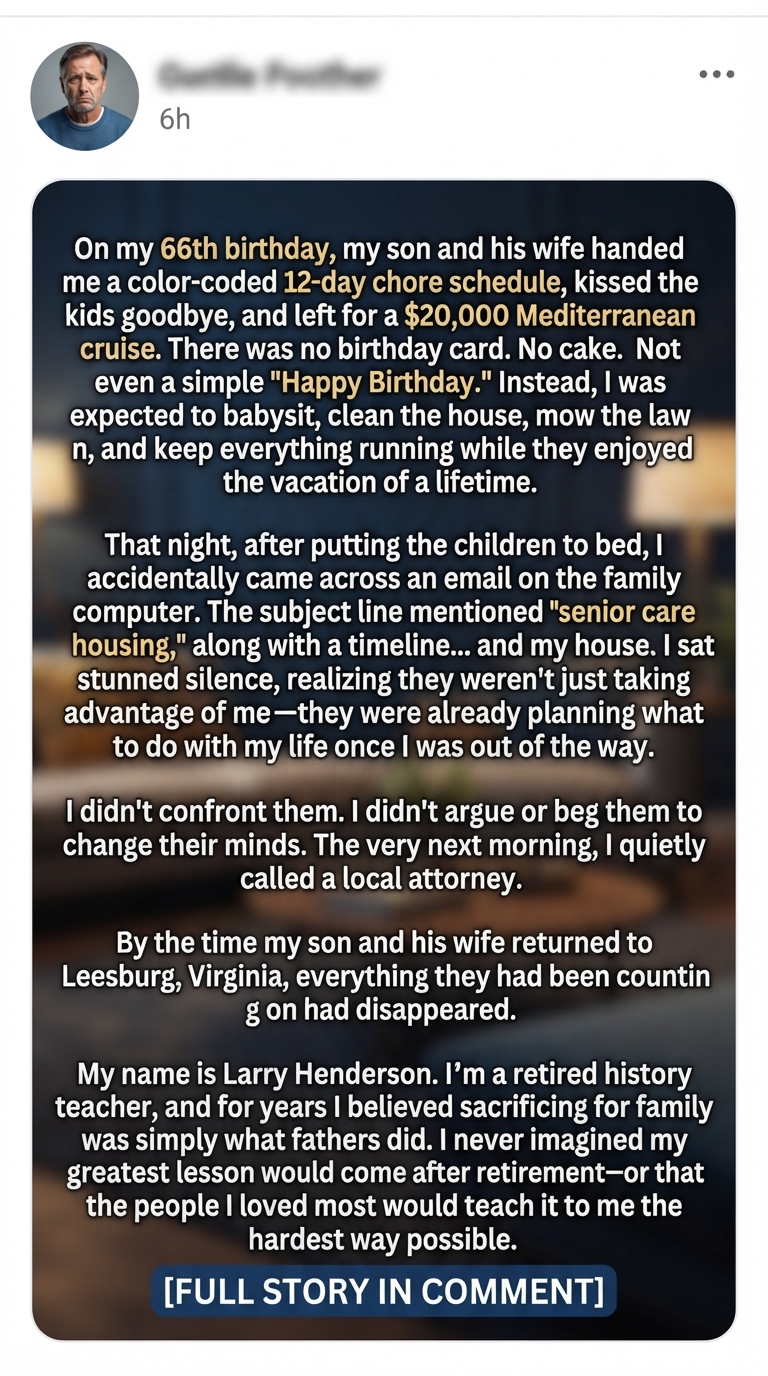
On My Sixty-Sixth Birthday, My Son Left Me a Twelve-Day Chore Schedule Instead of a Birthday Card. It Changed the Rest of My Retirement.
My name is Larry Henderson.
I taught American history at a public high school for thirty-eight years.
I spent my career telling students that the choices people make often become history long before anyone realizes it.
I never imagined the most important lesson of my own life would begin on my sixty-sixth birthday.
That morning, my son, Michael, handed me a laminated sheet.
At first, I smiled.
I thought it might be a birthday message from the grandchildren.
Instead, it was titled:
**Grandpa’s Schedule**
Every day was color-coded.
Breakfast.
School drop-offs.
Laundry.
Vacuuming.
Lawn care.
Homework.
Bath time.
Bedtime.
Every hour of the next twelve days had already been planned.
His wife looked at her watch.
“We’ve got to leave for the airport.”
Michael hugged me quickly.
“Thanks again, Dad.”
“We couldn’t have taken this trip without you.”
The grandchildren hugged my legs.
Then everyone climbed into the car.
No birthday card.
No cake.
No “Happy Birthday.”
Just a reminder taped to the refrigerator:
**Trash goes out Thursday.**
As the car disappeared down the street, I stood quietly in the driveway holding the schedule.
The children were wonderful.
None of this was their fault.
For the next several days, I did what I’d always done.
Made pancakes.
Helped with homework.
Read bedtime stories.
Built blanket forts.
The house echoed with laughter.
But late one evening, after the children were asleep, I sat down at the family computer to print permission forms for my granddaughter’s school project.
An email window had been left open.
I wasn’t searching through anyone’s messages.
It was simply there on the screen.
The subject line caught my eye.
**Senior Housing Timeline**
Below it were words that made my stomach tighten.
> If Dad moves within the next year, selling his house should make everything much easier.
There were discussions about assisted living communities.
Estimated home values.
Moving timelines.
Financial projections.
I read the screen twice.
Then I quietly closed the email.
I didn’t wake the children.
I didn’t call my son.
I didn’t send an angry message.
The next morning, after school drop-off, I called an attorney.
Not because I wanted revenge.
Because I wanted clarity.
The attorney asked careful questions.
“Who owns your house?”
“I do.”
“Have you promised anyone the property?”
“No.”
“Do you currently have an estate plan?”
“It’s about fifteen years old.”
He nodded.
“Then let’s update it so it reflects your wishes today.”
Over the next week, we reviewed everything.
My will.
My powers of attorney.
Health care directives.
Beneficiary designations.
Most importantly, we talked about something I’d avoided for years.
Boundaries.
The attorney said something I still remember.
“Planning your future doesn’t mean distrusting your family.”
“It means making your own decisions while you’re able to.”
I also met with a financial advisor.
Together we created a plan that ensured my retirement savings would support me for the rest of my life.
If I ever needed assisted living, the decision would be mine—not someone else’s.
When Michael and his wife returned from their cruise, the grandchildren ran into the house full of stories.
I hugged them tightly.
Later that evening, after the children went to bed, I asked my son if we could talk.
He smiled.
“Everything okay?”
I nodded.
“I saw the email.”
His face turned pale.
For a long moment, neither of us spoke.
Finally, he sighed.
“It isn’t what you think.”
“Then tell me what it is.”
He admitted they had been discussing possibilities for the future.
They worried about what might happen if my health declined.
But they also admitted they had talked about my house as though it were already part of their financial plans.
That hurt more than anything else.
I looked at him quietly.
“You planned my future.”
“You never asked me what I wanted.”
He lowered his eyes.
“I know.”
“I’ve updated my estate documents.”
His head snapped up.
“I haven’t disinherited you.”
“But I’ve made something very clear.”
“My house is not anyone’s retirement plan.”
“If I ever choose to move, I’ll make that decision.”
“If I stay, that’s my decision too.”
“And if I someday need help…”
“…I’ll ask.”
The room was silent.
Then he asked the question I wasn’t expecting.
“Were you really that hurt about your birthday?”
I laughed softly.
“It wasn’t the missing cake.”
“It was realizing I had become part of the household schedule instead of part of the family.”
He cried.
So did I.
Healing wasn’t immediate.
Trust rarely is.
Over the following months, things slowly changed.
When they needed childcare, they asked instead of assuming.
Sometimes I said yes.
Sometimes I said no.
Both answers were respected.
The grandchildren still spent weekends with me.
But now they came because we wanted to be together—not because someone had filled in a calendar.
The following year, on my sixty-seventh birthday, there was another knock at my door.
When I opened it, my grandchildren stood there holding a homemade cake.
Michael stood behind them.
“I know this doesn’t erase last year,” he said quietly.
“But I’d like to spend today celebrating you.”
We ate cake on my back porch.
The youngest grandchild asked why everyone seemed so emotional.
I smiled.
“Because birthdays aren’t about getting older.”
“They’re about remembering the people who helped us get here.”
People sometimes assume this story is about inheritance.
It isn’t.
It’s about something much more valuable.
Respect.
Growing older doesn’t mean giving up the right to make your own choices.
Helping family should always be an act of love.
Never an expectation.
And the greatest gift I gave myself in retirement wasn’t rewriting my will.
It was remembering that my life still belonged to me.
After spending decades teaching history, I finally learned one last lesson.
The future shouldn’t be written by people who are planning your life without inviting you into the conversation.
It should be written by you.
