I Almost Sent My Late Uncle’s Old Pickup to the Junkyard. Then I Found a Hidden Compartment Beneath the Truck Bed.
My uncle Raymond died two winters ago.
He never married.
He had three grown children, but none of them wanted his old pickup.
“It’s nothing but scrap,” my cousin said while tossing me the keys.
“If you can get anything for it, it’s yours.”
The truck was a faded blue 1994 Chevrolet that had hauled firewood, fencing supplies, feed sacks, and just about everything else imaginable.
Every dent had a story.
Every squeak seemed older than I was.
Raymond had driven it for nearly thirty years.
He lived alone beyond the county line in a small farmhouse surrounded by oak trees.
He wasn’t unfriendly.
Just quiet.
He believed conversations should have a purpose.
When he spoke, people listened.
When he didn’t, no one expected him to.
After the funeral, the truck sat in my barn for several months.
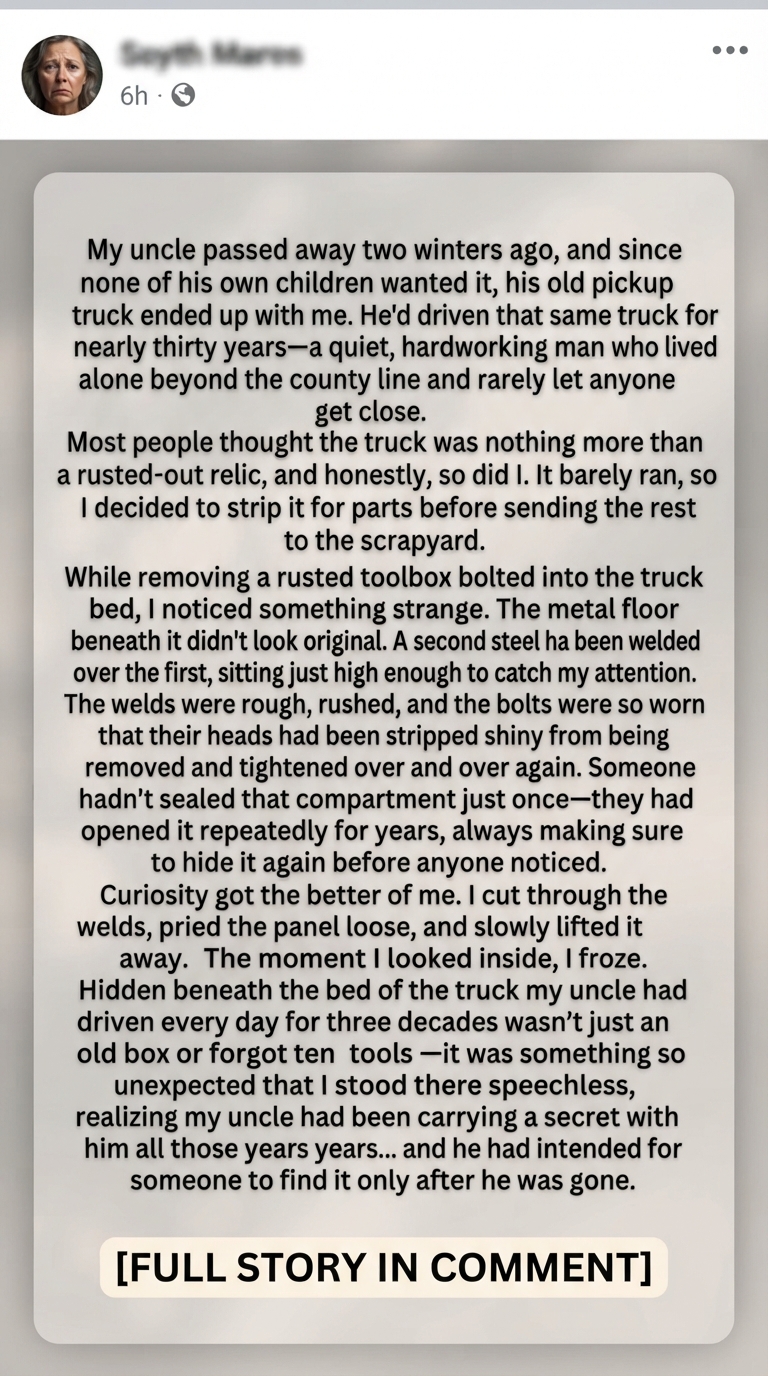
One Saturday, I finally decided to dismantle it for usable parts before sending the frame to a scrapyard.
As I removed the rusted steel toolbox bolted into the truck bed, something caught my attention.
The metal underneath looked different.
The truck bed should have been a single stamped sheet of steel.
Instead, one section had a second panel welded over it.
The welds weren’t factory work.
They were rough.
Practical.
The bolts holding the toolbox in place had another detail that didn’t make sense.
Their heads were polished almost smooth.
Not from age.
From repeated removal.
Someone had opened that section over and over again.
Always closing it again before anyone noticed.
Curiosity took over.
I carefully ground away the welds.
Removed the remaining bolts.
Then pried the steel panel upward.
Beneath it sat a weatherproof aluminum box.
Not very large.
Just long enough to fit snugly between the truck bed supports.
My heart pounded as I lifted it out.
Inside wasn’t cash.
Or gold.
Or anything dramatic.
It contained carefully organized folders.
Cassette tapes.
A handful of old photographs.
A small key.
And one sealed envelope with my name written across the front.
I sat down right there on the concrete floor.
The letter began:
> If you’re reading this, then you’re probably the only person curious enough to keep taking things apart until they make sense.
I laughed through tears.
That sounded exactly like Uncle Raymond.
He explained that the compartment wasn’t built to hide valuables.
It was built to protect memories.
For years, he’d used the truck while volunteering with a regional historical society.
He traveled through rural counties recording interviews with elderly farmers, veterans, teachers, and local business owners whose stories had never been written down.
Whenever he visited someone, he’d ask one question.
“What do you wish people remembered?”
Many of those conversations had been recorded on the cassette tapes now sitting in my lap.
There were nearly two hundred of them.
The folders contained handwritten transcripts, photographs of old family farms, church gatherings, one-room schoolhouses, and community events stretching back decades.
Many of the buildings no longer existed.
Neither did most of the people in the photographs.
At the bottom of the box lay another note.
> I never trusted leaving these in the farmhouse.
> Fire.
> Flood.
> Thieves.
> Trucks travel.
> Trucks survive.
> So the truck became my filing cabinet.
The small key opened a safety deposit box at a nearby bank.
Inside, with the help of the executor, I found neatly labeled external hard drives containing digital copies of many recordings he’d made in his later years.
There was also a letter addressed to the county historical society.
He’d planned to donate everything eventually.
He simply hadn’t lived long enough to finish organizing it.
Over the next several months, I contacted the historical society.
Archivists carefully preserved every recording.
Volunteers digitized the remaining cassette tapes.
Families began hearing the voices of grandparents they hadn’t heard in decades.
One woman cried while listening to her father’s stories about serving in the Korean War.
A local elementary school created a history project using excerpts from the interviews.
The county library hosted an exhibit called **Voices of Our Valley**, built almost entirely from my uncle’s collection.
At the opening ceremony, the museum director smiled at me.
“Your uncle quietly saved a piece of this community.”
“He just never told anyone.”
Months later, while organizing the final photographs, I found one more envelope tucked inside a folder labeled **Truck**.
Inside was a faded picture of Uncle Raymond standing beside that old pickup on the day he bought it.
On the back he’d written:
> Everybody thinks the truck carried lumber.
> Feed.
> Tools.
> It did.
> But mostly…
> It carried stories.
I framed that photograph.
The pickup never went to the scrapyard.
Instead, several local mechanics volunteered to help restore it.
Today it sits outside the county museum during community history events.
Children climb inside the cab.
Older visitors smile when they recognize it.
Sometimes someone will point toward the truck and say,
“I remember Raymond.”
“He came by one afternoon with a tape recorder.”
Then another person begins telling a story.
And another.
Looking back, I realize the hidden compartment didn’t contain treasure.
At least not the kind people usually imagine.
It held voices.
Memories.
Ordinary lives that would have disappeared forever if one quiet man hadn’t believed they were worth preserving.
People often ask why my uncle hid everything beneath the truck bed.
I think I finally understand.
He wasn’t hiding history.
He was protecting it until someone cared enough to uncover it.
Sometimes the greatest inheritance isn’t measured in dollars.
Sometimes it’s measured in stories that would have been lost if one person hadn’t taken the time to save them.
And every time I see that old blue pickup, I remember one simple truth.
Some treasures aren’t buried because they’re valuable.
They’re buried because they’re waiting for the right person to ask one more question before throwing them away.
