My Family Threw My Five-Year-Old Daughter and Me Out of Thanksgiving Dinner. Walking Away Was the Best Decision I Ever Made.
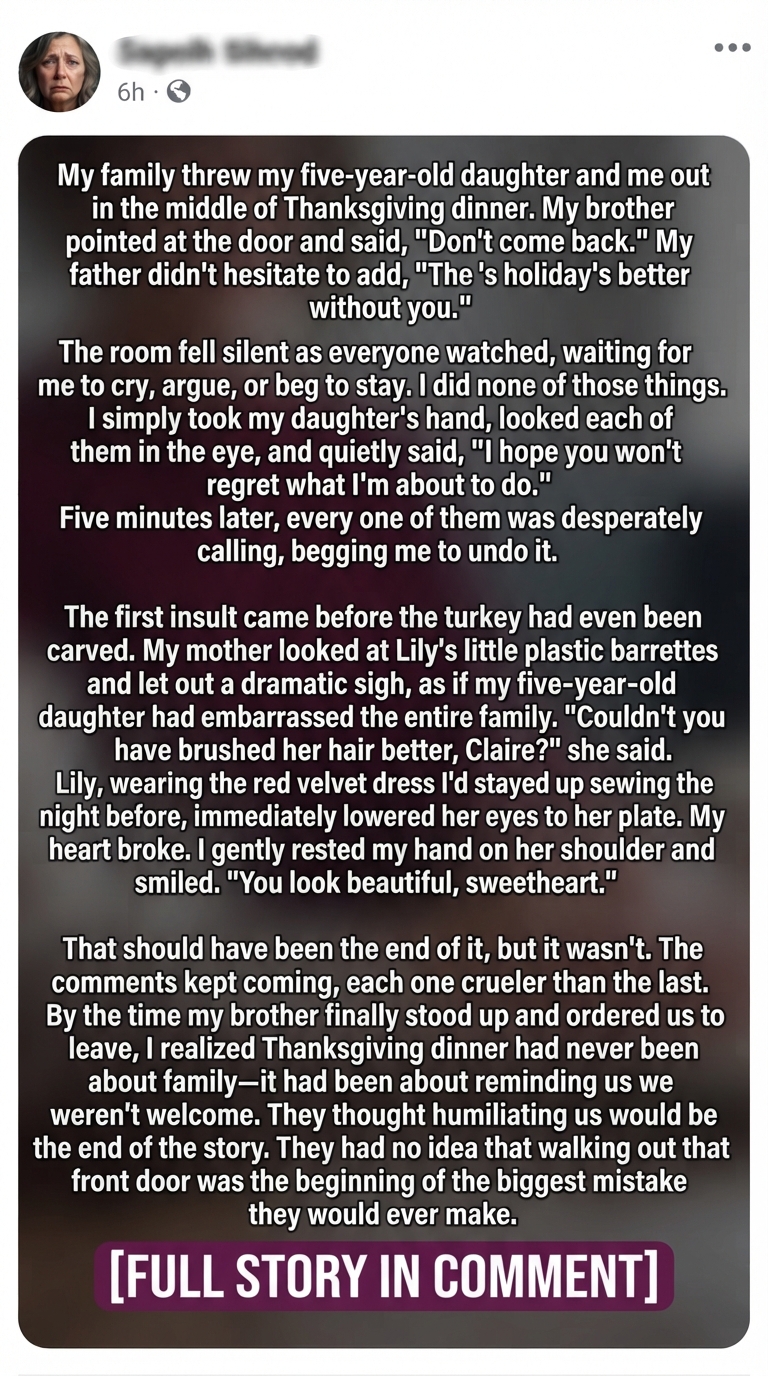
The first insult came before the turkey had even been carved.
My mother looked at my five-year-old daughter, Lily, adjusted her glasses, and sighed dramatically.
“Couldn’t you have brushed her hair better, Claire?”
Lily instinctively reached up and touched the little red plastic barrettes I’d clipped into her hair that morning.
The night before, I’d stayed up until nearly midnight sewing a loose hem on her favorite velvet dress because buying a new one wasn’t in my budget.
She looked beautiful.
I smiled and squeezed her shoulder.
“You look perfect, sweetheart.”
She smiled back, but only for a second.
Then my sister-in-law laughed.
“Well… at least she tried.”
The room filled with uncomfortable chuckles.
No one defended us.
Dinner hadn’t even started.
I should have left then.
Instead, I stayed because I wanted my daughter to have Thanksgiving with her grandparents.
For years, I’d convinced myself things would eventually change.
Ever since my divorce three years earlier, family gatherings had become exercises in quiet humiliation.
If I worked too much, I was neglecting Lily.
If I worked less, I was irresponsible.
If Lily spoke excitedly, she was “too loud.”
If she sat quietly, she was “antisocial.”
Nothing we did was ever enough.
That afternoon, the comments continued.
My father criticized the pie I’d brought because it was store-bought.
My brother joked that I should “find another husband before it was too late.”
Even Lily wasn’t spared.
When she accidentally spilled a little cranberry sauce while reaching for her roll, my brother rolled his eyes.
“That’s exactly why kids shouldn’t eat at the grown-up table.”
Lily whispered, “I’m sorry.”
I cleaned the tablecloth.
“No harm done.”
But I could see her shrinking into herself.
Children believe the way adults treat them says something about who they are.
I refused to let her believe she deserved this.
Then my brother stood up.
“If you’re so unhappy here,” he snapped,
“there’s the door.”
Nobody said a word.
He pointed toward the front entrance.
“Don’t come back.”
My father looked directly at me.
“The holiday’s better without you.”
Silence.
Every face at the table turned toward me.
Waiting.
Waiting for tears.
For an argument.
For me to plead my case.
Instead, I calmly folded Lily’s little napkin.
Helped her into her coat.
Picked up the untouched pie.
Then I looked around the room.
“I hope you won’t regret what I’m about to do.”
We walked out.
Lily climbed quietly into the car.
As I buckled her seatbelt, she asked the question that shattered my heart.
“Mom…”
“Are Grandma and Grandpa mad because I’m bad?”
I pulled the car over before answering.
“No.”
“Absolutely not.”
“They made a bad choice.”
“You didn’t.”
She nodded slowly.
Then asked,
“Can we still have Thanksgiving?”
I smiled.
“Yes.”
“We absolutely can.”
Instead of driving home, we stopped at a grocery store.
We bought frozen pizzas.
Hot chocolate.
Whipped cream.
And a pumpkin pie.
Back at our little house, we spread a blanket across the living room floor.
We watched holiday movies.
Made paper turkeys out of construction paper.
Lily declared it “the best Thanksgiving ever.”
That evening, while she slept, I made one difficult decision.
I stopped trying to earn a place at tables where we clearly weren’t welcome.
Over the following weeks, I quietly declined every invitation from my family.
No angry messages.
No dramatic speeches.
Just polite refusals.
Christmas.
Birthday dinners.
Sunday lunches.
Every answer was the same.
“We already have plans.”
Eventually, the phone calls became more frequent.
My mother left messages asking why I was “holding a grudge.”
My brother insisted everyone should “move on.”
I didn’t respond immediately.
Several months later, my father called.
“I don’t understand why you’re keeping Lily away.”
I answered calmly.
“I’m not keeping her away from people who love her.”
“I’m protecting her from people who repeatedly hurt her.”
There was a long silence.
Then he quietly said,
“I didn’t think she understood.”
I closed my eyes.
“She understood enough to ask whether she was a bad little girl.”
He didn’t have an answer.
Time passed.
Lily started first grade.
She made wonderful friends.
Our holidays slowly filled with new traditions.
We invited neighbors who had nowhere else to go.
Single parents.
An elderly widower down the street.
A college student whose family lived overseas.
Our Thanksgiving table grew larger every year.
Not because we had a bigger family.
Because we built one.
Nearly three years after that Thanksgiving, my mother asked if she could meet me for coffee.
She looked older.
Quieter.
“I’ve been thinking about that day,” she said.
“So have I.”
She took a deep breath.
“When Lily asked me if I liked her dress…”
“…I never answered.”
I remembered.
She hadn’t.
My mother looked down at her coffee.
“I should have.”
“I’m sorry.”
It wasn’t a perfect apology.
It didn’t erase the past.
But it was honest.
I thanked her.
Forgiveness came slowly.
Trust even more slowly.
Some relationships improved.
Others never did.
And that was okay.
The following Thanksgiving, Lily—now eight years old—helped me set our dining room table.
She carefully placed one extra plate beside mine.
“Who’s coming?”
I asked.
She grinned.
“Mrs. Alvarez from next door.”
“She said she’s spending Thanksgiving alone.”
I smiled.
“Then she’s definitely coming.”
As our guests arrived, laughter filled the house.
Before dinner, Lily looked around the table and whispered,
“Mom…”
“I like our family.”
“So do I.”
Because family isn’t measured by who shares your last name.
It’s measured by who makes a little girl feel beautiful in the dress her mother stayed up sewing.
Who notices when someone feels left out.
Who chooses kindness over cruelty.
People sometimes ask whether my relatives regretted asking us to leave that Thanksgiving.
Maybe they did.
Maybe they didn’t.
But that’s no longer the question that matters.
The important question is this:
What kind of home did Lily grow up believing she deserved?
I’m grateful the answer became one where love never had to be earned, respect wasn’t conditional, and no child ever wondered whether she belonged at the table.
Sometimes walking away isn’t giving up.
Sometimes it’s finally walking toward the life your child deserves.
