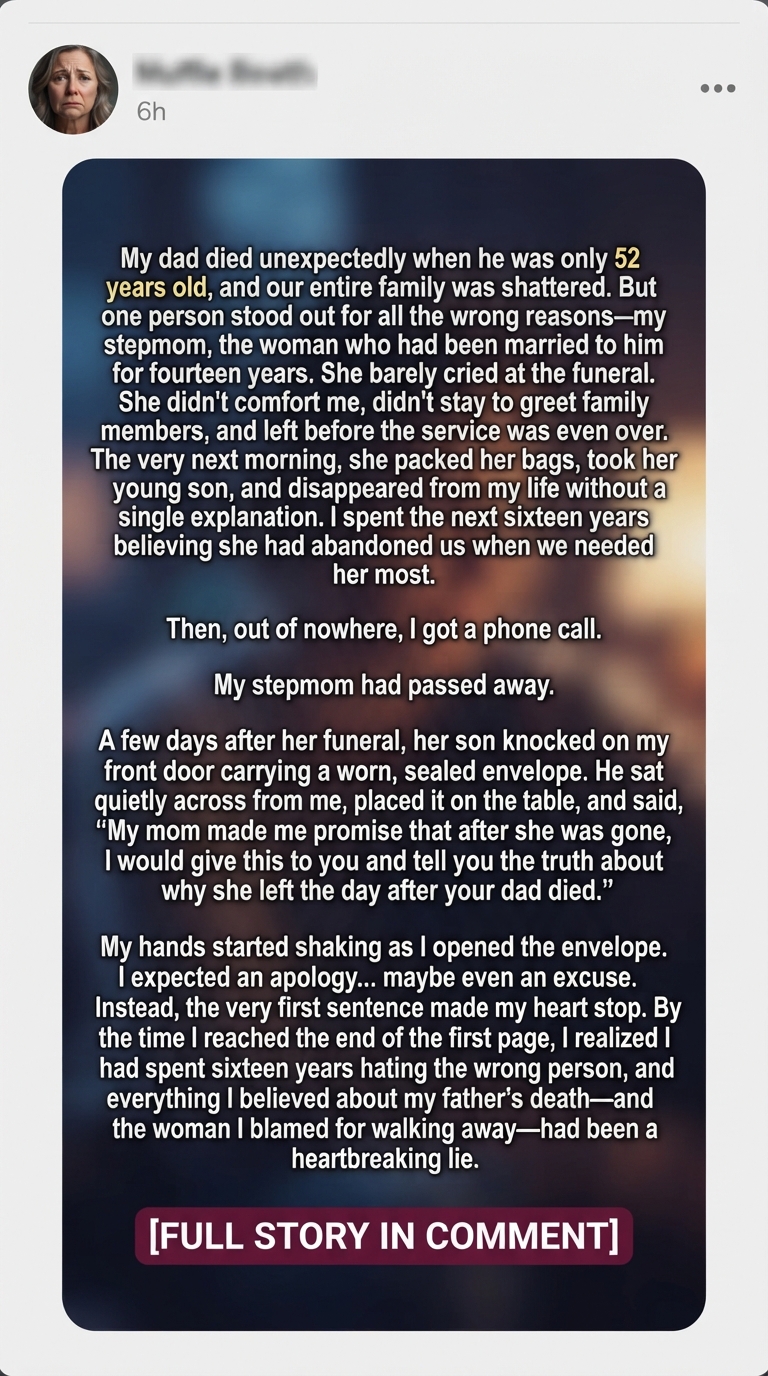
I Spent Sixteen Years Believing My Stepmother Abandoned Us. After She Died, One Letter Changed Everything.
My father died when he was only fifty-two years old.
One ordinary Tuesday morning, he kissed everyone goodbye, drove to work, and never came home.
A sudden heart attack.
The phone call came just after noon.
Nothing prepares you for hearing those words.
I was twenty-three.
My entire world collapsed in a single afternoon.
But as painful as losing my father was, another memory haunted me for years.
My stepmother.
Karen.
She had been married to Dad for fourteen years.
She had helped raise me through high school.
She packed school lunches.
Sat through parent-teacher conferences.
Cheered at my college graduation.
She wasn’t my biological mother.
But until that week, she’d always felt like family.
Then everything changed.
At the funeral, she barely cried.
She left before most of the relatives had even finished speaking.
The next morning, she packed a few suitcases, took her young son, Daniel, and disappeared.
No goodbye.
No explanation.
No phone calls.
Nothing.
I felt abandoned twice.
First by death.
Then by someone I’d trusted.
For sixteen years, I carried that resentment.
Whenever anyone mentioned Karen, I simply changed the subject.
As far as I was concerned, she’d walked away when our family needed each other most.
Then one rainy Thursday afternoon, my phone rang.
A quiet voice introduced himself.
“Hi.”
“This is Daniel.”
My stepbrother.
We hadn’t spoken in over a decade.
“I’m sorry to call like this.”
“My mom passed away last week.”
I didn’t know what to say.
He hesitated.
“She left something for you.”
Three days later, he knocked on my front door carrying a worn envelope.
He looked so much like our father that it took my breath away.
We sat at my kitchen table in silence.
Finally, he slid the envelope toward me.
“Mom made me promise I’d only give this to you after she was gone.”
“She said you’d finally be ready.”
My hands trembled as I opened it.
The first line made me stop breathing.
> You deserved the truth years ago.
> I wasn’t protecting myself.
> I was protecting your father’s final wish.
I read on.
Karen explained that my father’s heart attack hadn’t been entirely unexpected.
Several months before his death, he’d quietly undergone medical testing after experiencing chest pain.
His doctors had urged him to slow down.
Instead, he worried constantly about what would happen to both families if his health declined.
According to the letter, Dad had made Karen promise something.
If he died unexpectedly, she was to move away with Daniel rather than remain in the middle of growing conflict between the extended families.
At first, I frowned.
That didn’t make sense.
Then I turned the page.
Karen described what happened immediately after the funeral.
Before most guests had left the cemetery, disagreements had already begun over insurance proceeds, personal belongings, and the house.
Some relatives blamed Karen simply because she was the surviving spouse.
Others insisted she shouldn’t remain in the home.
She wrote that the arguments became so heated she feared Daniel would grow up surrounded by constant hostility.
She included copies of letters she’d received during those first weeks.
Some were heartbreaking.
One accused her of “stealing a husband who wasn’t hers.”
Another demanded she leave town.
Reading them made my stomach turn.
Then came the paragraph that shattered me.
> I wanted to stay.
> Every part of me wanted to stay.
> But your father held my hand in the hospital after his first warning from the doctors.
> He asked me to promise that if he died, I wouldn’t spend years fighting people who were grieving.
> He said grief makes good people say terrible things.
> He hoped time would heal everyone.
I had no memory of Dad ever being ill.
Karen explained why.
He hadn’t wanted his children to live in fear.
He believed he’d have many more years.
She enclosed copies of appointment cards and medical correspondence showing he had, in fact, been under treatment months before his death.
Then I reached the final page.
> You probably believed I stopped loving you.
> I never did.
> Every birthday, I wondered if I should call.
> Every Christmas, I wrote your name on a card I never mailed.
> I thought contacting you would reopen wounds your father hoped time would close.
> If I’ve made the wrong choice, I’m deeply sorry.
By then I couldn’t see through my tears.
Daniel quietly reached into his backpack.
“I have something else.”
He placed sixteen birthday cards on the table.
Every one addressed to me.
Every one unopened.
She had written one every year.
None had ever been sent.
“I found them after she died,” Daniel whispered.
“She couldn’t bring herself to throw them away.”
We spent hours talking.
For the first time, I heard about Karen’s life after she left.
She became a school librarian.
Volunteered at a literacy program.
Kept a framed photograph of Dad beside her desk until the day she died.
She never remarried.
A month later, Daniel and I visited Dad’s grave together.
Then we drove to Karen’s.
I placed fresh flowers beside her headstone.
“I spent sixteen years blaming you,” I whispered.
“I’m sorry.”
The wind moved softly through the trees.
For the first time since Dad died, I felt something I hadn’t expected.
Peace.
People often ask whether I regret those lost years.
Of course I do.
I wish we’d talked sooner.
I wish I’d asked questions instead of filling the silence with assumptions.
But grief rarely gives us perfect choices.
It gives us incomplete stories.
We fill the missing pages ourselves.
Sometimes correctly.
Sometimes tragically wrong.
Today, Daniel and I speak every week.
My children call him Uncle Daniel.
The family I thought I’d lost forever slowly found its way back together.
Not because the past changed.
Because the truth finally did.
Looking back, I don’t think the greatest tragedy was that my stepmother left.
The greatest tragedy was that two people who loved the same man spent sixteen years believing they had stopped loving each other.
All because grief is loud…
…and the truth sometimes whispers too softly to be heard until much later.
Dad always said that love should leave people closer, not farther apart.
It took sixteen years.
But in the end, it finally did.
