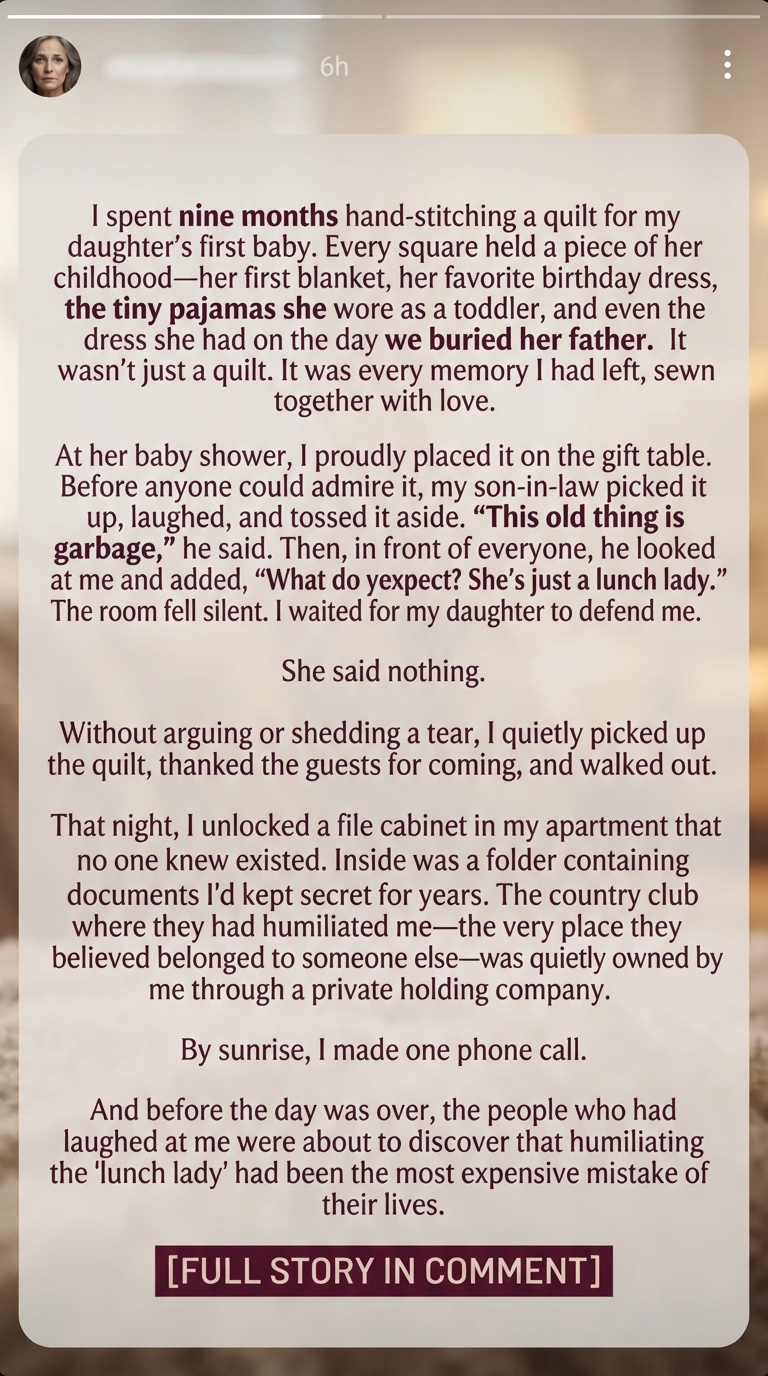
They Called Me “Just a Lunch Lady.” They Never Knew the Woman They Were Laughing At.
For nine months, I stitched one square at a time.
Every evening after work, I sat beside my apartment window with a needle, thread, and a box of carefully folded fabric.
Each piece meant something.
A corner of my daughter’s first baby blanket.
The tiny yellow dress she wore on her third birthday.
The flannel pajamas she insisted on wearing long after she’d outgrown them.
Even a small piece of the navy-blue dress she wore the day we buried her father.
That one was the hardest to sew.
Every stitch felt like saying goodbye all over again.
By the time I finished, it wasn’t simply a quilt.
It was thirty years of memories sewn together by hand.
My daughter was expecting her first child.
I imagined wrapping my grandbaby in the same love that had carried us through so many difficult years.
I couldn’t afford an expensive stroller or designer nursery furniture.
But I could give my grandchild something no store could ever sell.
On the morning of the baby shower, I carefully folded the quilt into tissue paper and tied it with a simple cream ribbon.
When I arrived at the country club, guests admired elaborate floral arrangements, towers of wrapped gifts, and elegant decorations.
I quietly placed my quilt on the gift table.
For a moment, I simply smiled.
Then my son-in-law, Brandon, walked over.
“What’s this?”
“It’s for the baby,” I answered.
He pulled away the ribbon and unfolded the quilt.
For a second, I thought he might appreciate it.
Instead, he laughed.
Loudly.
He held it up for everyone to see.
“What is this?”
“A rag blanket?”
Before I could answer, he tossed it carelessly onto another table.
“This old thing is garbage.”
Then he looked directly at me.
“What do you expect?”
“She’s just a lunch lady.”
The room became painfully quiet.
Every conversation stopped.
I looked at my daughter.
She opened her mouth.
Then closed it again.
She looked down at the floor.
She never said a word.
That silence hurt far more than Brandon’s insult.
I walked across the room.
Picked up the quilt.
Folded it carefully.
Turned toward the guests.
“Thank you for inviting me.”
Then I left.
I cried all the way home.
Not because someone mocked my job.
I’d spent twenty-seven years serving meals to children.
There was nothing shameful about honest work.
I cried because my daughter had watched someone insult both me and a gift made from her own childhood memories…
…and chose silence.
That evening, I unlocked a filing cabinet I’d owned for years.
Inside were records for a small investment company I’d built quietly after my husband’s death.
For decades, I’d lived carefully.
Worked every shift I could.
Saved consistently.
Invested patiently.
One of those investments happened to be a minority ownership interest in the company that operated the country club where the shower had been held.
It wasn’t controlling ownership.
I couldn’t fire anyone or shut the place down.
But I did have the right to communicate concerns to management as an owner.
The next morning, I called the general manager.
“I’d like to schedule a meeting.”
He welcomed me warmly.
During our conversation, I never demanded anyone lose their job.
I never threatened legal action.
I simply explained what had happened.
“The staff treated me with kindness.”
“My concern isn’t with your employees.”
“My concern is that a guest publicly humiliated another guest while using your event space.”
The manager listened quietly.
“I appreciate you bringing this to our attention,” he said.
“We expect respectful conduct at events held here.”
A few days later, Brandon received a letter from the country club reminding the event organizer that abusive behavior toward guests violated the club’s standards and that future reservations could be reviewed if similar incidents occurred.
That wasn’t revenge.
It was accountability.
But something else happened that mattered far more.
A week later, my daughter knocked on my apartment door.
She looked exhausted.
She was holding the quilt.
“I found it in Brandon’s trunk.”
My heart sank.
She burst into tears.
“I’m sorry.”
“I should have said something.”
“You shouldn’t have had to.”
She handed me the quilt.
“I’ve been thinking about what was inside it.”
“I remembered every piece.”
“The blanket.”
“The birthday dress.”
“Dad’s funeral.”
“I didn’t realize…”
Her voice broke.
“…I didn’t realize what you’d given us.”
I looked at her for a long time.
Then I asked the only question that mattered.
“Why didn’t you speak?”
She wiped her eyes.
“I was afraid of embarrassing my husband.”
“And instead?”
“I embarrassed my mother.”
Neither of us spoke for several minutes.
Finally, she whispered,
“I don’t want my child growing up thinking silence is the right response when someone is being treated cruelly.”
Months passed.
She began counseling.
Brandon eventually apologized.
Whether his apology came from genuine regret or embarrassment, I honestly don’t know.
Forgiveness didn’t happen overnight.
Trust rarely does.
When my granddaughter was finally born, my daughter came to the hospital carrying the quilt.
She wrapped her baby inside it before anyone else held her.
Looking at the tiny face nestled among those familiar pieces of fabric, she smiled through tears.
“I finally understand.”
That quilt was never about sewing.
It was about remembering.
Remembering where we came from.
Who loved us before life became complicated.
Who stayed.
Who sacrificed.
Who quietly gave everything without asking for recognition.
People sometimes apologize for calling me “just a lunch lady.”
I always smile.
Because there has never been anything “just” about feeding children.
Or comforting frightened first-graders.
Or remembering which student needed an extra apple because there wasn’t enough food at home.
Or going to work every morning knowing your kindness might be the warmest part of someone’s day.
My career never made me wealthy.
But it taught me something far more valuable.
The measure of a person’s worth has never been printed on a business card.
It’s found in the lives they touch when nobody is watching.
And every stitch in that quilt still reminds me of that truth.
Not because someone finally respected it.
But because love was always valuable—even when the people receiving it failed to recognize it.
