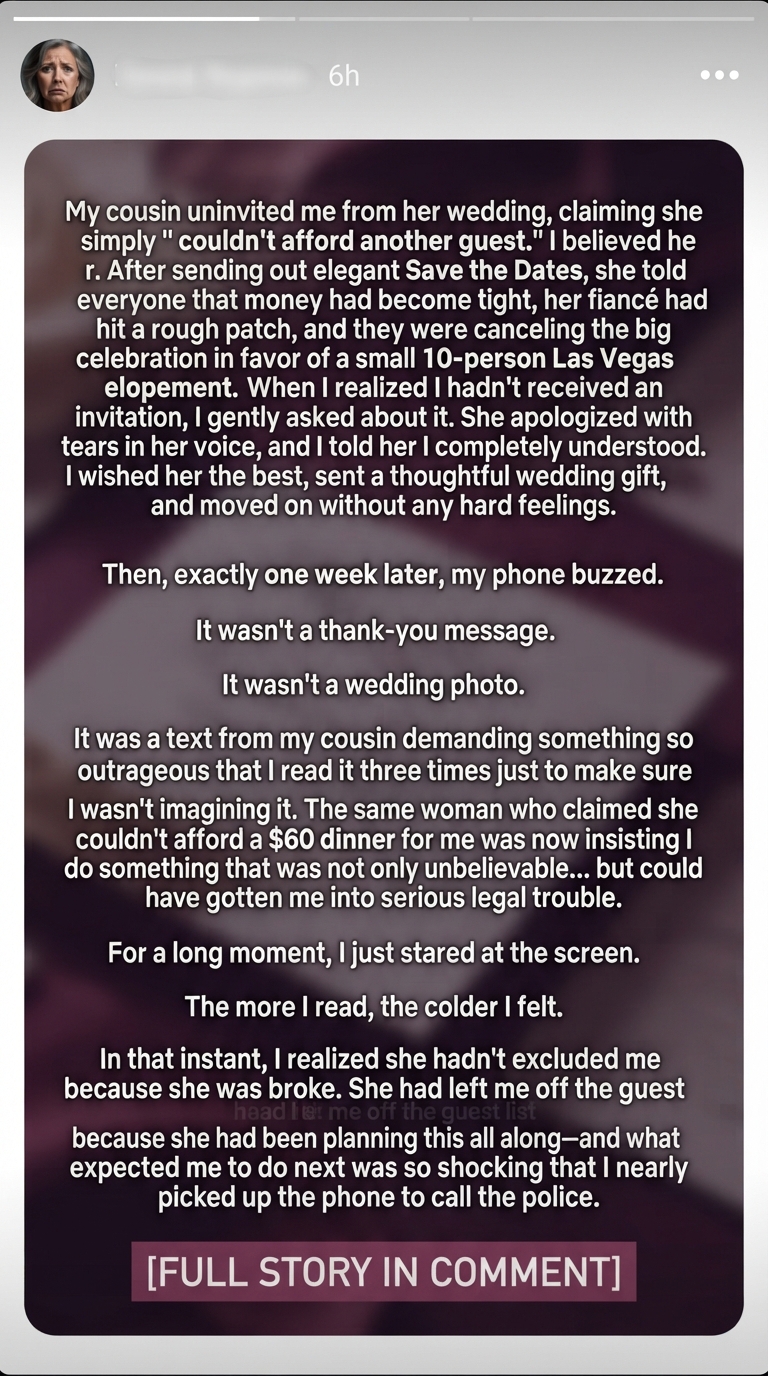
My Cousin Said She Couldn’t Afford to Invite Me to Her Wedding. A Week Later, She Asked Me to Commit a Crime for Her.
When my cousin Emily called to explain why I hadn’t received a wedding invitation, I honestly felt sorry for her.
Months earlier, she’d mailed beautiful save-the-date cards with embossed lettering and elegant gold trim.
Everyone expected a large celebration.
Then life happened.
Or so she said.
“My fiancé lost a major client,” she explained through tears.
“We just can’t afford the wedding anymore.”
She told me they had canceled the reception, reduced the guest list to only immediate family, and planned a simple ceremony in Las Vegas with about ten people.
“I’m so embarrassed,” she whispered.
“I completely understand,” I replied.
“Please don’t apologize.”
I meant every word.
Weddings are expensive.
Life is unpredictable.
I mailed a thoughtful gift, wished them happiness, and never mentioned the guest list again.
A week later, my phone buzzed.
I smiled, expecting a thank-you message.
Instead, I read something that made me stop breathing.
> Hey! I need a huge favor.
> Can you say you were at our wedding and sign a statement for the venue?
I frowned.
Before I could respond, another message arrived.
> They say we violated the occupancy rules and brought in more guests than we paid for.
> We just need a couple people to say they were part of the original reservation.
Then came the sentence that changed everything.
> Nobody will ever know.
I stared at my phone.
I hadn’t attended the wedding.
I hadn’t even been invited.
I typed one question.
“What exactly are you asking me to sign?”
She replied almost immediately.
> Just a declaration that you were there.
> It’s only paperwork.
> Please.
I called her.
“Emily… were there more guests than the venue allowed?”
She hesitated.
“It’s complicated.”
“No.”
“It isn’t.”
Silence.
Finally, she admitted they had invited dozens more people than permitted under their contract after deciding to hold a much larger local reception instead of the small ceremony she’d described.
The venue had billed them for the additional costs.
Now they wanted to dispute the charges.
“And you want me to claim I attended?”
“Just this once.”
“It would really help us.”
I took a slow breath.
“I can’t do that.”
She sighed dramatically.
“I knew you’d make this difficult.”
“No.”
“I’m refusing because you’re asking me to make a false statement.”
“It’s not a big deal.”
“It is to me.”
She hung up.
Within minutes, several relatives began texting.
Why wouldn’t I help?
Didn’t family support each other?
Was I really willing to let Emily struggle over “just paperwork”?
I didn’t answer.
Instead, I spoke with an attorney friend, who confirmed what I already suspected.
Signing a false statement in a dispute involving money could create serious legal consequences depending on the circumstances and how the document was used.
That conversation removed any lingering doubt.
A few days later, I received an email directly from the venue’s attorney.
They had learned I had been listed as a potential witness and wanted to know whether I had actually attended the event.
I answered truthfully.
“No.”
“I was not present.”
“I declined a request to sign anything stating otherwise.”
That was the end of my involvement.
Months later, Emily asked to meet for coffee.
She looked exhausted.
“I owe you an apology.”
I listened quietly.
“The venue had photographs.”
“Security records.”
Vendor attendance logs.”
She laughed weakly.
“It turns out lying would have made everything worse.”
I nodded.
“I’m glad you didn’t ask anyone else to sign.”
She looked down.
“I did.”
“They all refused.”
For the first time, I felt sympathy instead of anger.
Not because of the situation.
Because I realized how much damage one bad decision had caused.
“You know what hurt the most?” I asked.
She looked up.
“You didn’t leave me off the guest list because you couldn’t afford another plate.”
“You left me off because you were already planning something you knew wasn’t honest.”
Tears filled her eyes.
“You’re right.”
“I was embarrassed.”
“So I lied.”
Then I kept lying.”
That was the real cost.
Not the venue’s bill.
Not the legal dispute.
The trust she’d spent years building.
Over time, our relationship slowly recovered.
But it never returned to what it had been before.
Trust rarely does after it’s traded for convenience.
People sometimes ask whether I regret refusing to help family.
I always answer the same way.
Helping family means bringing them dinner when they’re sick.
Watching their children.
Helping them move.
Supporting them through difficult times.
Helping someone lie isn’t kindness.
It’s participation.
Looking back, I wasn’t shocked that my cousin excluded me from her wedding.
I was shocked that she believed the first person she should call afterward was the one she’d asked to stay home.
Sometimes the hardest word to say to someone you love is “no.”
But sometimes it’s also the most important one.
Because real loyalty should never require you to risk your integrity.
And no relationship is strengthened by asking someone to sacrifice their honesty to protect your mistake.
