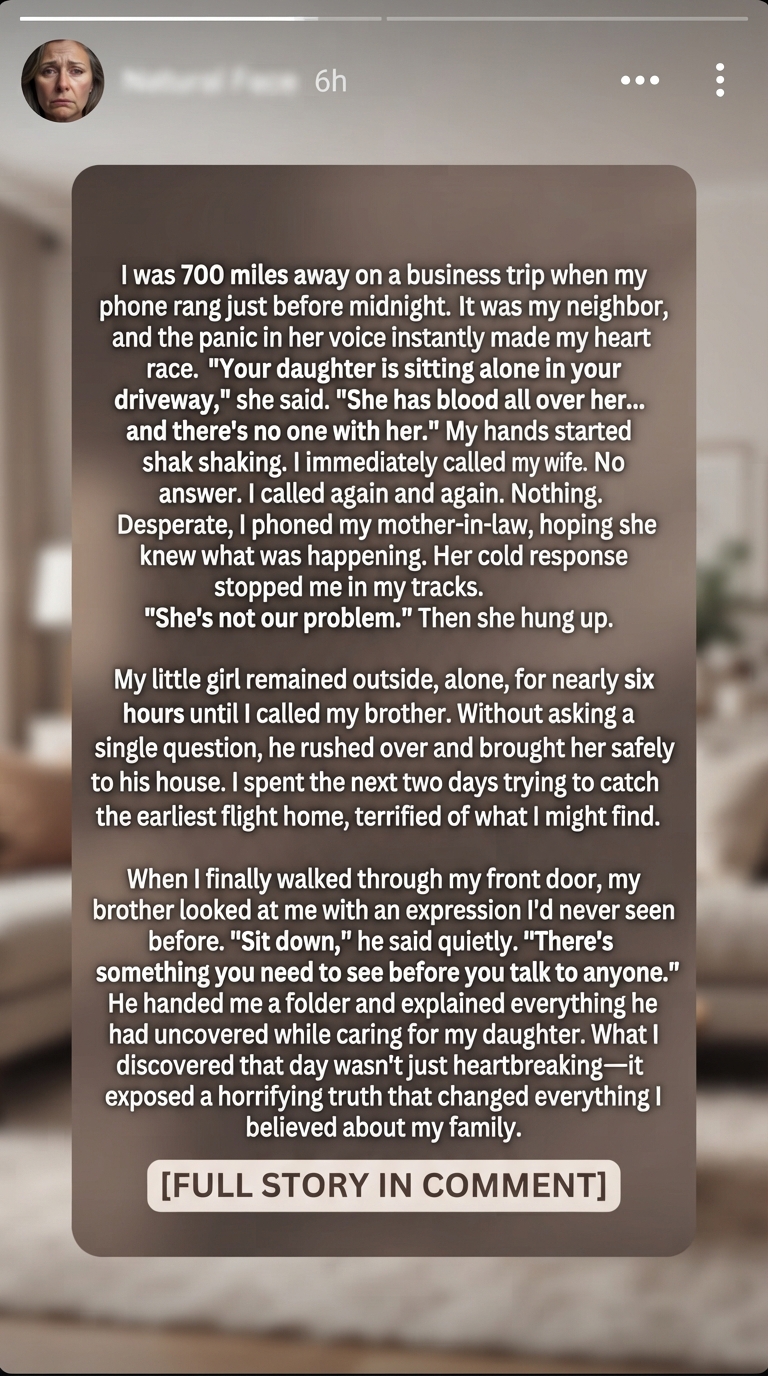
I Was 700 Miles Away When My Neighbor Called to Say My Daughter Was Sitting Alone in Our Driveway Covered in Blood
I was seven hundred miles from home on a business trip when my phone rang at 11:47 p.m.
I almost ignored it.
It was my neighbor, Mrs. Jenkins.
She never called that late.
The moment I answered, I knew something was terribly wrong.
“David,” she said, her voice shaking, “your daughter is sitting in your driveway.”
I stood up so quickly my hotel chair tipped over.
“What?”
“She’s alone.”
“There’s blood on her clothes.”
“I don’t know where your wife is.”
My heart felt like it stopped.
“Is Emma conscious?”
“Yes.”
“She’s crying.”
“But she won’t come inside my house until she talks to you.”
I grabbed my car keys before remembering I was hundreds of miles away.
I called my wife.
Straight to voicemail.
Again.
Voicemail.
Again.
Nothing.
I called my mother-in-law.
Surely she knew where everyone was.
She answered on the second ring.
Before I could finish explaining, she interrupted.
“She’s not our problem.”
Then she hung up.
I stared at the phone in disbelief.
I immediately called my younger brother, Mark.
“I need you.”
“Right now.”
He didn’t ask why.
He only asked for the address.
“I’m leaving.”
By the time he arrived, nearly six hours had passed since my neighbor first found Emma outside.
Mrs. Jenkins had stayed with her the entire time, keeping her warm with blankets while waiting for someone from the family to arrive.
Mark took Emma straight to an urgent care clinic, where doctors determined the blood wasn’t hers.
She had several bruises but no life-threatening injuries.
They also documented everything they observed and recommended follow-up care.
I spent the next two days changing flights, speaking with police by phone, and trying to get home.
I’ve never felt more helpless.
When I finally walked through Mark’s front door, Emma ran into my arms.
I held her until she fell asleep against my shoulder.
Then Mark looked at me.
“Come into the kitchen.”
His expression told me this wasn’t over.
He placed a folder on the table.
“Before you talk to anyone…”
“…read this.”
Inside were copies of the medical discharge papers, photographs of Emma’s injuries taken with the doctor’s recommendation, notes Mark had written about everything she told him, and a timeline of phone calls and text messages.
He hadn’t played detective.
He had simply documented what happened in case it became important later.
One page caught my attention immediately.
Emma had told the doctor that she came home after an argument between adults in the house.
She became frightened and ran outside.
When she tried to go back in, no one answered the door.
The blood on her clothes came from our family dog, who had been injured after getting caught on broken fencing earlier that evening.
Emma had tried to help the dog before running outside.
The veterinarian later confirmed the dog’s injuries were not life-threatening.
My relief that the blood wasn’t hers lasted only a moment.
Because another realization replaced it.
My daughter had been frightened enough to stay outside alone for hours rather than return inside.
That mattered.
The next morning, I contacted an attorney.
Not because I wanted revenge.
Because I wanted to understand my responsibilities as a parent.
I also met with law enforcement and child welfare professionals, who interviewed everyone involved.
The investigation took time.
It wasn’t dramatic.
It was careful.
Exactly as it should have been.
Medical records were reviewed.
Witnesses were interviewed.
Phone records helped establish a timeline.
My wife eventually admitted she had left during an argument without realizing Emma had gone outside after the dog.
She believed Emma was asleep in her bedroom.
It was a terrible mistake.
One that had devastating consequences.
Months later, our marriage ended.
Not because of one mistake alone.
Because trust had been broken in ways we couldn’t repair.
Throughout the legal process, Emma’s well-being remained the court’s highest priority.
She began counseling.
So did I.
One afternoon, nearly a year later, her therapist asked Emma what made her feel safest now.
She looked at me and smiled.
“When grown-ups answer the phone.”
Those seven words stayed with me.
Children don’t measure love by expensive gifts.
They measure it by whether they believe someone will come when they need them.
Mrs. Jenkins came.
Mark came.
The doctors came.
The police came.
Many people showed up for my daughter that night.
I will always be grateful for every one of them.
Today, Emma is thriving.
The dog recovered completely and still sleeps at the foot of her bed.
Mrs. Jenkins remains our next-door neighbor, though Emma now calls her “Grandma Jenkins.”
Every Christmas, Mark laughs when Emma insists he gets the biggest slice of pie.
“You saved me,” she tells him.
He always smiles.
“No.”
“I just answered the phone.”
Looking back, I don’t remember that night because of the fear.
I remember it because it reminded me that family isn’t defined only by biology.
It’s defined by the people who show up without hesitation when a child needs help.
And I learned one lesson I’ll never forget.
When someone calls saying a child is alone and afraid…
You don’t ask whose responsibility it is.
You go.
Every single time.
