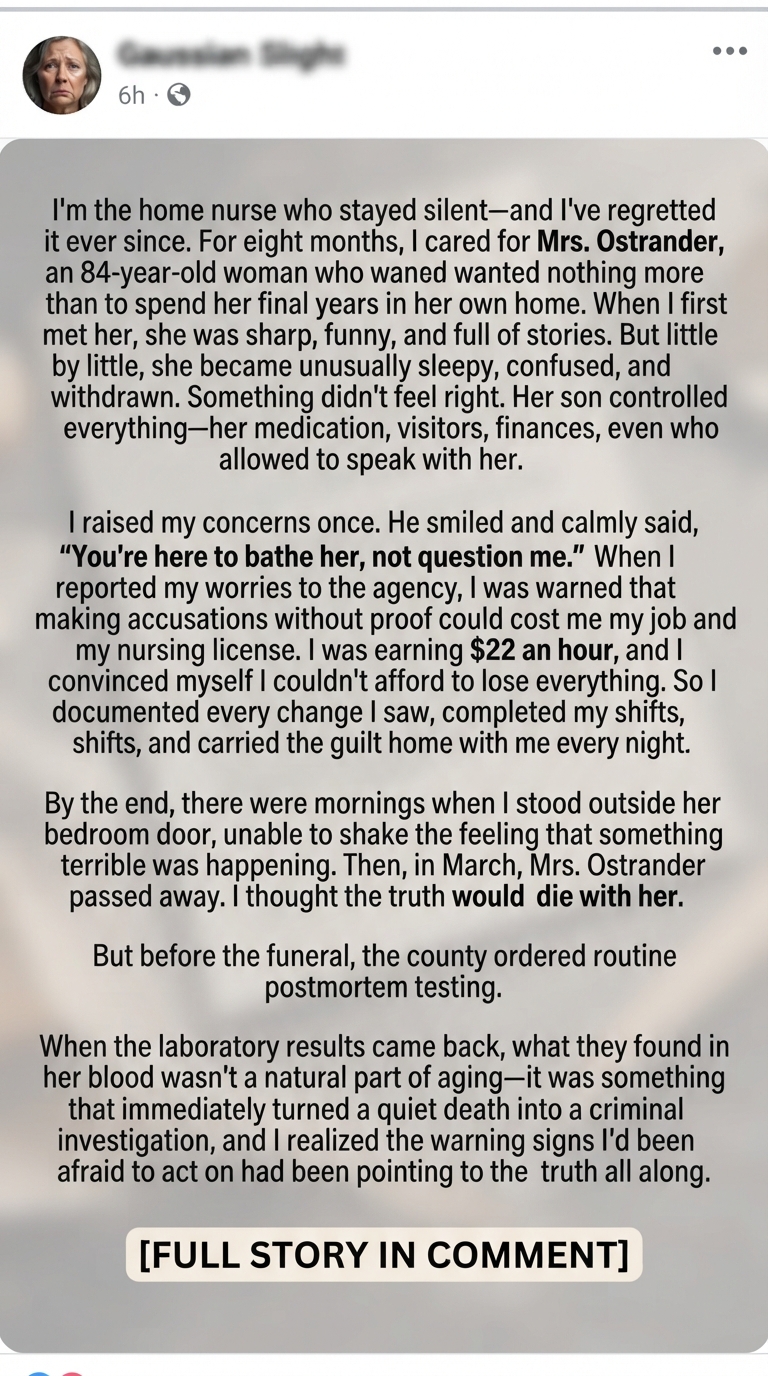
I’m the Home Nurse Who Stayed Silent. I Still Think About Mrs. Ostrander Every Day.
My name is Rebecca.
I’ve been a licensed home health nurse for nearly eighteen years.
There are patients you remember because they were difficult.
Others because they were funny.
Mrs. Eleanor Ostrander is the one I remember because I still wonder if I could have done more.
She was eighty-four when I first met her.
A retired elementary school teacher with silver hair, quick wit, and a habit of telling the same wonderful stories about her students as if they had happened yesterday.
She insisted on making me tea every afternoon, even though I was there to care for her.
“You work harder than I do,” she’d say.
“You deserve it.”
She wanted only one thing.
To spend the rest of her life in the house where she’d lived for more than fifty years.
Her son, Richard, handled everything.
Her medications.
Her appointments.
The bills.
The grocery shopping.
He told me he was simply honoring his mother’s wish to remain at home.
At first, nothing seemed unusual.
Then, over the next several months, Mrs. Ostrander began changing.
She became increasingly sleepy.
She struggled to stay awake during conversations.
She forgot names she had always remembered.
Some mornings she seemed unusually difficult to rouse.
At first, I wondered whether her health was simply declining.
But something kept bothering me.
The changes weren’t gradual.
Some days she was alert and engaged.
The next day she would barely open her eyes.
When I reviewed the medication administration records available to me, everything appeared routine.
Yet her condition often seemed inconsistent with what I expected.
One afternoon, I gently mentioned my concerns to Richard.
He smiled politely.
“You’re here to bathe her,” he said.
“Not question my decisions.”
The conversation ended there.
I documented my observations in my nursing notes.
Changes in alertness.
Appetite.
Mobility.
Mental status.
Nothing dramatic.
Just careful, factual observations.
A week later, I spoke with my supervisor.
“I don’t have proof,” I admitted.
“But something doesn’t feel right.”
She listened carefully.
Then reminded me of an uncomfortable reality.
“We can’t make accusations based on instinct.”
“If you believe your patient is in immediate danger, follow reporting requirements.”
“But be careful to distinguish observations from conclusions.”
She wasn’t telling me to ignore my concerns.
She was reminding me that professional responsibilities require evidence as well as judgment.
Still, I left feeling frustrated.
I earned twenty-two dollars an hour.
I worried constantly about making a mistake that could cost me my career.
So I continued documenting everything I observed.
Every shift.
Every visit.
Every change.
Months later, Mrs. Ostrander died peacefully in her bed.
The death wasn’t entirely unexpected.
She was elderly and medically fragile.
I attended her funeral.
I stood in the back of the church feeling an overwhelming sense of failure.
Then, several weeks later, I received a phone call from a detective.
He asked whether I had cared for Mrs. Ostrander.
My stomach tightened.
He explained that questions had arisen during the routine investigation that sometimes accompanies deaths under particular circumstances.
Additional review of medical records and postmortem findings had prompted a broader inquiry.
He asked whether I would be willing to speak with investigators.
For nearly three hours, I answered questions.
I provided copies of my nursing notes.
The detective paused while reading them.
“You documented this every single visit?”
“Yes.”
“I didn’t know what else to do.”
He looked at me kindly.
“You documented exactly what you observed.”
As the investigation continued, authorities obtained pharmacy records, interviewed healthcare providers, consulted medical experts, and reviewed laboratory findings together with the clinical history.
The investigation ultimately alleged that medications had not always been administered as prescribed and that the pattern of care raised serious concerns.
The laboratory results were not the entire case.
They were one piece of a much larger picture.
My notes became another.
Weeks later, the detective called again.
“I wanted you to know something.”
“Your documentation helped us understand the timeline.”
I sat quietly for a long time after hanging up.
For months, I’d believed I had failed Mrs. Ostrander.
The detective couldn’t erase that feeling.
But he reminded me of something important.
Good documentation matters.
Careful observations matter.
Speaking up through the proper channels matters.
Even when the outcome isn’t immediate.
Today, I teach new home health nurses as part of our agency’s orientation program.
I tell them about Mrs. Ostrander without using her real name.
I don’t tell the story to frighten them.
I tell it because healthcare workers sometimes believe they need absolute certainty before reporting concerns.
We don’t.
We need honest observations.
Professional judgment.
And the courage to follow established reporting procedures when something seems wrong.
Looking back, I still wish I’d asked harder questions.
I still wish I’d pushed for more answers.
Those feelings will probably never leave me.
But guilt alone doesn’t improve patient care.
Learning from it can.
Mrs. Ostrander once told me that the best teachers don’t expect perfect students.
“They expect students who keep learning,” she said.
She probably never imagined those words would become the lesson I carried with me for the rest of my career.
Every patient deserves someone willing to notice when something changes.
Every healthcare worker deserves to know that careful documentation and appropriate reporting can matter more than they realize.
And every time I pick up my clipboard, I still think of the woman who taught me that sometimes the smallest observations become the most important pages in an entire investigation.
