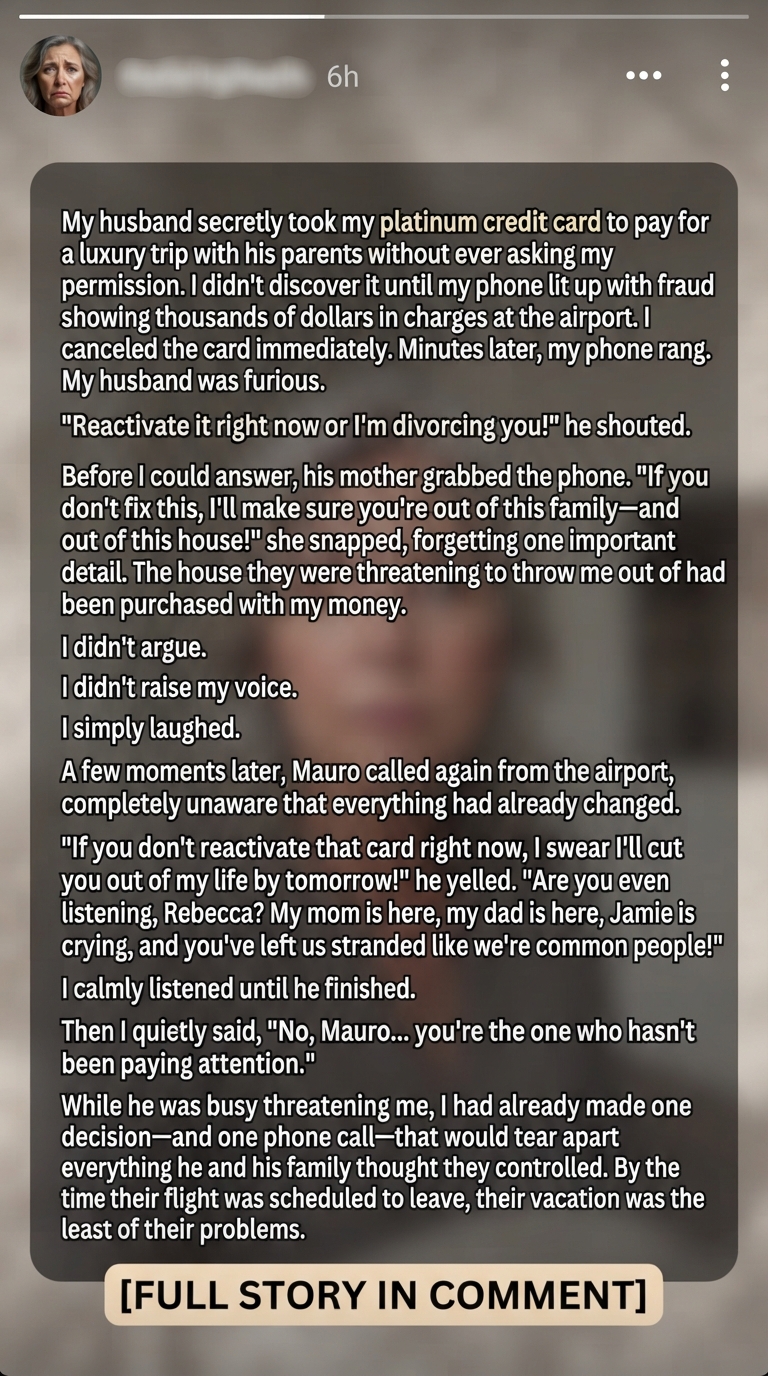
My Husband Took My Platinum Card Without Asking to Pay for His Parents’ Vacation. He Told Me to Reactivate It—or He’d Divorce Me.
The first fraud alert arrived while I was in a meeting.
**Airline purchase approved.**
Then another.
**Airport lounge access.**
Then another.
**Luxury hotel deposit.**
Within two minutes, more than **$9,000** had been charged to my platinum credit card.
I stared at my phone.
I hadn’t traveled in months.
I excused myself from the meeting and immediately opened my banking app.
The charges were real.
I called the card issuer.
“Are you currently attempting these purchases?” the representative asked.
“No.”
“Then we’ll lock the account immediately.”
Within seconds, every pending transaction was frozen.
I expected someone had stolen my card.
Instead, five minutes later, my husband called.
“What did you do?” he shouted before I could even say hello.
“I canceled the card.”
“Why would you do that?”
I blinked.
“You made those charges?”
“Of course I did!”
“My parents, Jamie, and I are standing at the airport.”
“You just ruined our vacation!”
I felt the room spin.
“You took my card without asking?”
“It’s our money.”
“No,” I replied calmly.
“It’s my credit card.”
He laughed.
“Reactivate it right now or I’m divorcing you.”
Before I could answer, I heard rustling on the line.
His mother grabbed the phone.
“If you don’t fix this,” she snapped, “I’ll make sure you’re out of this family—and out of this house.”
I almost smiled.
She had forgotten one important fact.
The house wasn’t in Mauro’s name.
It wasn’t in her name.
I’d purchased it years before we married, and it remained titled solely in mine.
I didn’t argue.
I simply ended the call.
Then I contacted the credit card company again.
The representative confirmed the account would remain blocked while the unauthorized transactions were investigated.
She also advised me to change my online banking passwords and review every account linked to the card.
I spent the next hour doing exactly that.
Then I called a family law attorney.
Not because Mauro had threatened divorce.
Because someone willing to use my financial accounts without permission might also have access to other important information.
The attorney’s advice was practical.
“Secure your finances first.”
“Then decide what you want your marriage to look like.”
That afternoon, I reviewed everything.
Our joint accounts.
Automatic payments.
Insurance.
Digital passwords.
I discovered several subscription services and online shopping accounts linked to my credit card that I hadn’t authorized.
None of the amounts were enormous.
But together they painted a troubling picture.
Mauro had become comfortable treating my financial accounts as his own.
Several hours later, he called again.
This time he sounded desperate.
“The airline won’t let us board.”
“They need another form of payment.”
“I’m sorry,” I said.
“They’re following the card issuer’s instructions.”
“So fix it!”
“I can’t authorize charges I didn’t approve.”
“You embarrassed my parents!”
I answered quietly.
“No.”
“You embarrassed yourself by using someone else’s card without permission.”
There was a long silence.
Then he hung up.
He returned home two days later.
His parents were furious.
Jamie looked confused more than anything else.
I asked Mauro to sit down.
On the table were neatly organized folders.
Property records showing the house had been purchased before our marriage.
Copies of the credit card statements.
The timeline of unauthorized charges.
Notes from my attorney.
He looked at the paperwork.
Then at me.
“You planned all this?”
“No.”
“I prepared after realizing I couldn’t trust you.”
For the first time since we’d met, he didn’t have an answer.
Over the following weeks, we attended counseling.
Some conversations were difficult.
Others were impossible.
Eventually, Mauro admitted he had convinced himself that because we were married, asking permission wasn’t necessary.
I disagreed.
Marriage creates partnership.
It doesn’t erase consent.
Whether the purchase is twenty dollars or twenty thousand, respect begins with a simple question.
“Are you okay with this?”
Our marriage didn’t end because of one credit card.
It ended because that card revealed years of assumptions, entitlement, and disrespect that neither of us had fully acknowledged.
When the divorce was finalized, people asked whether I regretted canceling the card.
Never.
If I had reactivated it simply to avoid conflict, I would have been teaching myself that threats mattered more than boundaries.
Instead, I learned something far more valuable.
Financial trust isn’t measured by how much money two people share.
It’s measured by whether they respect each other’s right to make informed decisions.
A platinum card can be replaced.
A house can be refinanced.
Even a marriage can end.
But once trust is spent without permission, rebuilding it is far more expensive than any luxury vacation could ever be.
