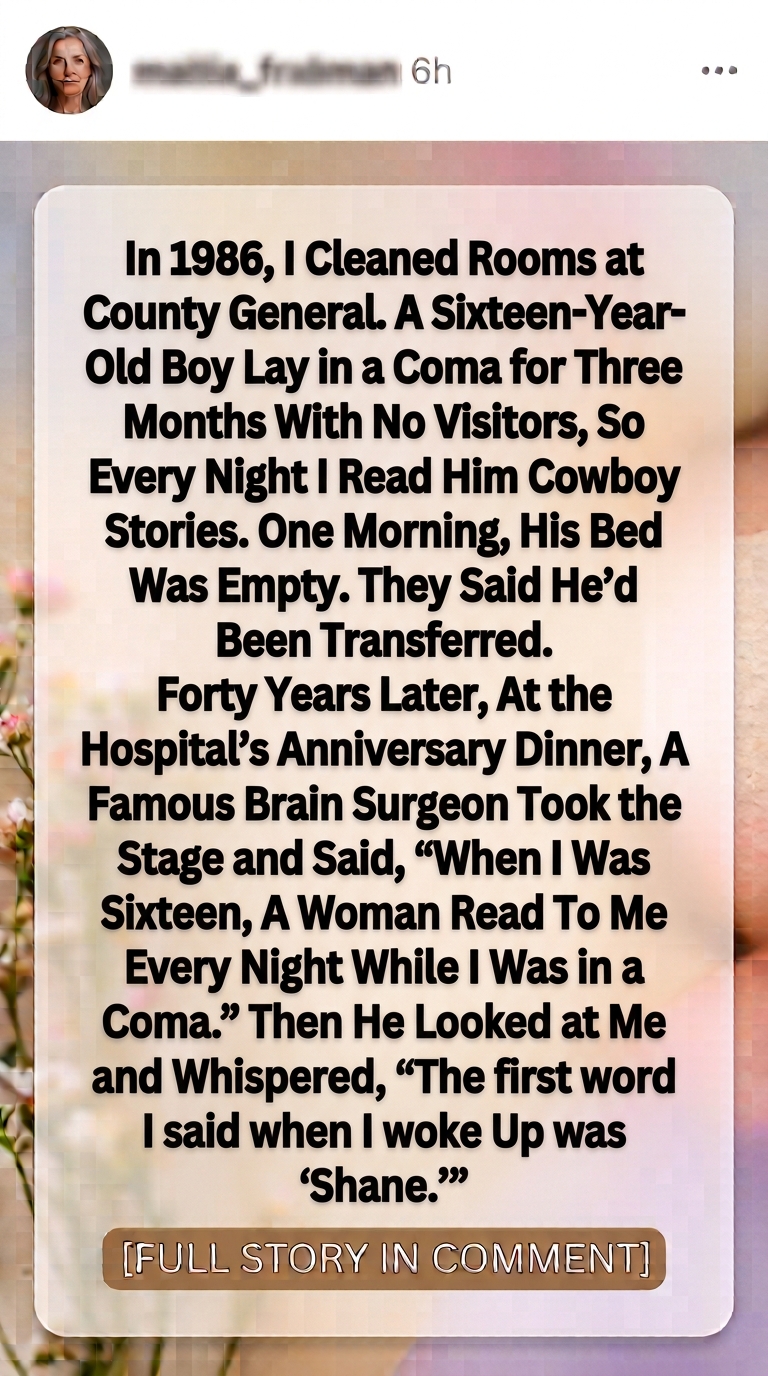
In 1986, I cleaned rooms at County General Hospital. I was thirty-two years old, recently divorced, and working the night shift because the differential pay helped me keep a roof over my head. Most people barely noticed me. I emptied trash cans, mopped floors, changed linens, wiped down surfaces, and made sure the hospital looked clean before morning. I didn’t mind being invisible. In fact, after my divorce, invisible was exactly how I wanted to be. Then I met the boy in Room 4B. His name was Michael. He was sixteen years old and had been brought in after a terrible car accident. His parents lived several states away and couldn’t afford to stay at the hospital. They came once during the first week, then stopped coming. Nurses told me they called occasionally, but eventually even the calls became less frequent. Michael remained in a coma. Three months passed. No visitors. No friends. No family sitting beside his bed. Every night, after I finished cleaning the hallway, I would quietly step into Room 4B. At first, I only checked whether he needed anything. Then one night, I noticed a paperback novel sitting on the windowsill. It was an old Western. I picked it up and looked at the cover. “Shane.” I had read it years earlier. I sat beside his bed and began reading aloud. I didn’t know if he could hear me. The nurses told me there was no way to know. But I kept reading anyway. The next night, I brought another cowboy story. Then another. I read about dusty towns, horses, ranchers, outlaws, and men who rode into difficult situations because someone needed help. Sometimes I read for twenty minutes. Sometimes an hour. On the hardest nights, I stayed until my shift ended. I talked to him too. “You know,” I’d say, “if you wake up, you’re going to have a lot of catching up to do.” He never answered. But I kept coming. One night, I told him about my daughter, who lived with her father after our divorce. I told him I missed her. Another night, I complained about my supervisor. Another night, I simply sat there and read because I had nothing else to say. Three months after the accident, I came into Room 4B one morning and found the bed empty. My heart jumped. I ran to the nurses’ station. “Where is Michael?” The nurse looked up from her chart. “Transferred.” “Transferred where?” “Another facility.” “Why didn’t anyone tell me?” She smiled gently. “It happened early this morning.” I stood there holding the paperback I’d been reading. “Did he wake up?” “I don’t know.” That was it. Michael disappeared from my life. I returned to work. Years passed. I remarried. My daughter eventually came home. I left the hospital after eleven years and started working at a community library. I never forgot Michael, though. Sometimes I’d see a teenager reading a Western and wonder where he had ended up. I always hoped he had woken up. I hoped he had found his family. I hoped someone had told him that someone had been there. Forty years after the night I first read to him, County General held an anniversary dinner. I almost didn’t attend. I wasn’t a nurse. I wasn’t a doctor. I hadn’t worked there in decades. But an old coworker called and insisted. “Come,” she said. “You’ll know half the room.” So I went. There were speeches, photographs, awards, and stories about the hospital’s history. Then the host announced the keynote speaker. “Please welcome Dr. Michael Harrison, internationally recognized neurosurgeon and former patient of County General.” My glass nearly slipped from my hand. Michael Harrison. The name felt familiar. Then he walked onto the stage. He was tall, silver-haired, and confident. But when he smiled, I saw something in his face that transported me back to Room 4B. Sixteen years old. Bruised. Motionless. Alone. The audience applauded. Dr. Harrison began talking about his career, medical research, and the people who had helped him along the way. Then he paused. “But I want to tell you about the first people who saved my life.” The room became quiet. “One was a surgeon who refused to give up on me after my accident.” He thanked several doctors and nurses. Then he said, “The second person wasn’t a doctor.” I looked down at my hands. “She was a woman who cleaned hospital rooms at night.” My heart stopped. Michael looked across the room. His eyes moved slowly over the audience. Then they landed on me. He stopped speaking. For several seconds, he simply stared. Then he smiled. “There you are.” I couldn’t breathe. The woman beside me whispered, “Do you know him?” I nodded. “I think so.” Michael stepped down from the stage. He walked toward me while the entire room watched. When he reached my table, he knelt beside my chair. “You read to me,” he whispered. Tears filled my eyes. “You remember?” He laughed softly. “I remember everything.” “But you were unconscious.” “That’s what everyone thought.” He explained that he had experienced what doctors later described as a minimally conscious state. He couldn’t move or respond, but he could hear fragments of voices. Most sounds were confusing—the machines, alarms, footsteps, conversations. But one voice became familiar. Mine. “I didn’t understand all the words,” he said. “But I knew when you were there.” I started crying. “I thought you never heard me.” “I heard you.” He reached into his jacket pocket and pulled out something small. An old paperback. The cover was worn and faded. “Shane.” I stared at it. “You kept that?” He nodded. “I asked my mother to find it after I woke up.” I touched the cover with trembling fingers. “What happened after you were transferred?” I asked. Michael smiled. “I woke up three days later.” I covered my mouth. “Three days?” “Yes.” He explained that his family had been preparing for the possibility that he might never recover. But when he finally opened his eyes, the first thing he said was a single word. “Shane.” I started laughing through my tears. “The first word?” He nodded. “The doctors thought I was confused.” “You were.” He laughed. “Maybe. But I knew exactly what I meant.” He told me that after waking, he kept asking about the woman who read cowboy stories. Nobody knew who I was. I had never signed anything. I was simply the woman who came in at night and cleaned the room. For years, he tried to find me. “I searched hospital records,” he said. “I contacted County General. I asked former staff members. But nobody could remember your last name.” I shook my head. “I wasn’t important.” His expression changed. “Don’t ever say that again.” The room had become completely silent around us. Michael continued. “When I became a doctor, I realized something. Medicine can keep a body alive. But sometimes a person needs something else to keep fighting.” He looked at me. “You gave me that.” I cried openly now. “I just read books.” “No,” he said. “You gave me a reason to believe someone was waiting for me to wake up.” He stood and helped me to my feet. Then he hugged me. The audience applauded, but I barely heard them. I was back in Room 4B, holding an old paperback and talking to a boy who couldn’t answer. After the dinner, Michael and I sat together in a quiet corner of the hotel. He told me about his life. He became a neurosurgeon because he wanted to understand the brain that had trapped him inside his own body. He married. He had two children. He had spent decades treating patients who reminded him of himself. “Every time I have a patient who can’t respond,” he said, “I talk to them. Even when people tell me they probably can’t hear me.” I smiled. “Why?” He looked at me. “Because you taught me never to assume silence means nobody is listening.” Before we left, Michael handed me the old copy of Shane. “Keep it,” he said. “It’s yours.” “No,” I replied. “It was always yours.” He shook his head. “You gave it to me when I needed it. Now I’m giving it back.” I took the book. Inside the cover was a handwritten note. I opened it and read: “To the woman who read to me when everyone else thought I was gone. You were the first person who believed I could still hear the world.” I couldn’t speak. Michael put his hand over mine. “I spent forty years trying to find you.” I smiled through my tears. “You found me.” “No,” he said. “You found me first.” Years later, when people asked me what I did at County General, I could have told them I cleaned rooms. I could have told them I worked the night shift. I could have told them I changed linens and emptied trash cans. But none of those answers felt important anymore. Because one night in 1986, I sat beside a sixteen-year-old boy everyone thought was unreachable. I read him a story about a man named Shane. I didn’t know whether he could hear me. I didn’t know whether he would survive. I didn’t know that four decades later, he would stand on a stage as a famous brain surgeon and remember the sound of my voice. I only knew that he was alone. So I stayed. And sometimes, that’s all someone needs. Not a miracle. Not a grand gesture. Just one person willing to sit beside them in the dark and say, “I’m here. Keep listening. There’s still a story left to tell.” And forty years later, when Michael looked at me and whispered, “The first word I said when I woke up was Shane,” I realized something I’ll never forget. He may have forgotten the machines. He may have forgotten the hospital room. He may have forgotten the faces of the doctors. But he never forgot the person who read to him when he couldn’t say a word.
