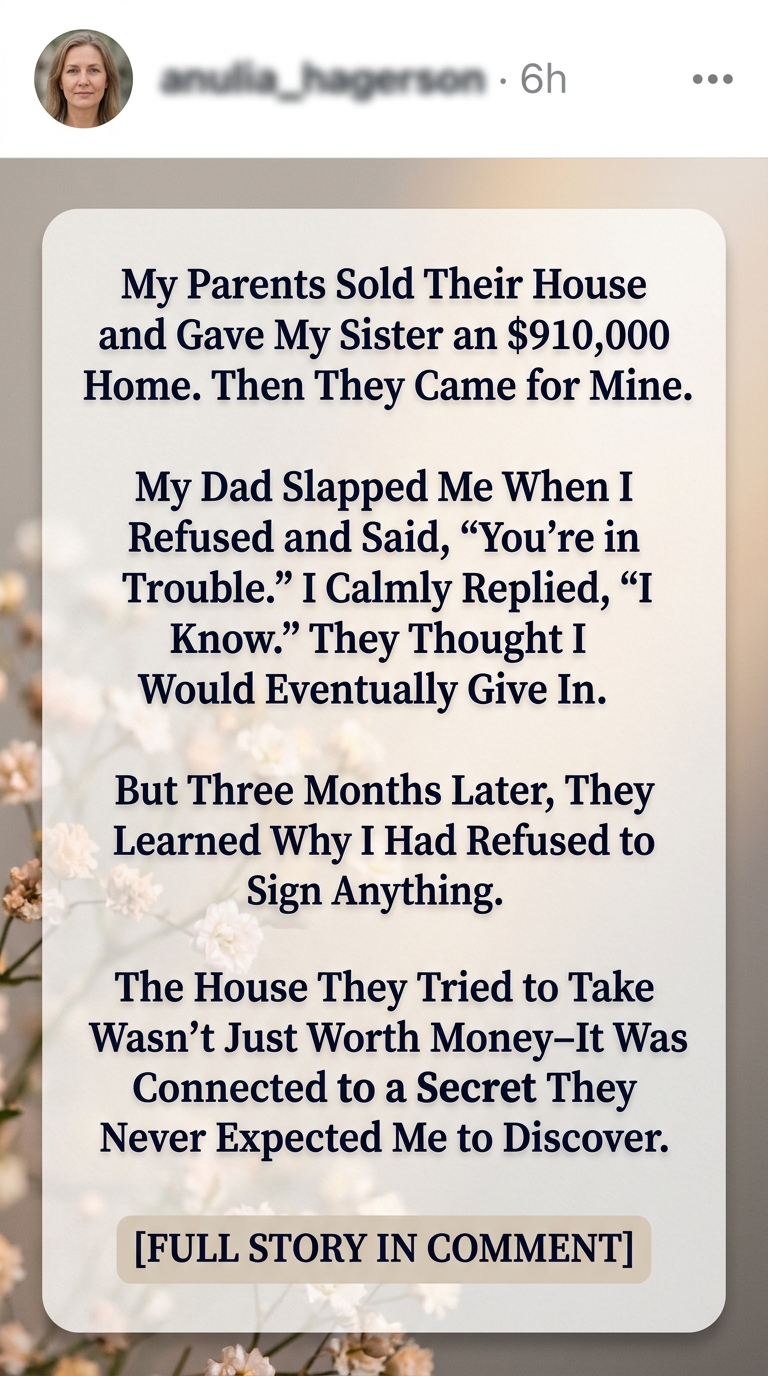
My parents sold their house and gave my sister a $910,000 home. Then they came for mine. My dad slapped me when I refused to sign the papers and said, “You’re in trouble.” I calmly wiped my cheek and replied, “I know.” They thought I would eventually give in. They had always believed that if they applied enough pressure, I would surrender. They were wrong. Three months later, they learned why I had refused to sign anything. The house they tried to take wasn’t just worth money. It was connected to a secret they never expected me to discover. When my parents first told me they were selling their house, I thought they were downsizing. My mother said they wanted something smaller. My father said the market was good. I didn’t question them. Then my sister, Jessica, called me one Saturday morning. “Mom and Dad bought me a house.” “What?” I laughed, thinking she was joking. “A house?” “A $910,000 house.” I stopped smiling. “They bought you a $910,000 house?” “Yes.” She sounded proud. “They said it’s my inheritance early.” I didn’t know what to say. My parents had always told me there wasn’t enough money to help me. When I needed help with college, they said I should take out loans. When I bought my house, they contributed nothing. When my roof needed repairs, my father told me to “learn responsibility.” Yet somehow, they had found $910,000 for Jessica. I tried not to let it bother me. It was their money. They could spend it however they wanted. Then they came to my house. My father walked through the front door without knocking. My mother followed him carrying a folder. “We need you to sign something,” Dad said. I looked at the papers. “What is this?” “Transfer documents.” “Transfer of what?” “The house.” I laughed because I thought it was a joke. Nobody joined me. “You’re serious?” My mother sighed. “You don’t need this much house.” I stared at her. “I bought this house.” “And your sister needs security.” “She just got a $910,000 house.” Dad slammed his hand on the table. “That’s not the point.” “Then what is?” He pointed at the documents. “Sign.” I pushed them back. “No.” His face changed. “Excuse me?” “I’m not signing my house over.” He stepped closer. “You don’t understand how family works.” I looked at him. “I understand exactly how family works. You gave Jessica a house and now you want mine.” My mother started crying. “Your sister deserves it.” “And I don’t?” Dad grabbed my wrist. “Stop being selfish.” I pulled away. “Let go.” Then he slapped me. The sound echoed through the room. I stood completely still. My mother gasped but didn’t move. Dad pointed toward the papers. “You’re in trouble.” I slowly touched my cheek. Then I looked him directly in the eyes. “I know.” He expected me to cry. Instead, I picked up the folder, folded it closed, and handed it back to him. “You should leave.” He stared at me. “You’ll regret this.” “Maybe.” I opened the door. “But I won’t sign.” They left. I locked the door behind them and sat on the floor. I cried that night, but not because I regretted refusing. I cried because I finally understood that my parents weren’t asking for my house because they needed it. They wanted control. The next morning, I called an attorney. I brought every document I had related to the house. The deed. Mortgage records. Tax records. Insurance papers. Everything. My attorney, Daniel Brooks, studied the documents. Then he asked one question. “How long have you owned this property?” “Nine years.” “Did your parents ever contribute to the purchase?” “No.” He nodded. “Then why are they claiming they have rights to it?” “They say it’s a family asset.” He frowned. “That’s not how property ownership works.” I told him about the slap. His expression became serious. “Do you want to file a report?” I hesitated. “I don’t know.” “You don’t have to decide today.” He paused. “But I strongly recommend documenting what happened.” I did. Then something strange happened. Three days later, my father called. “You need to cooperate.” “With what?” “We’re trying to settle this quietly.” “There is nothing to settle.” He became angry. “You don’t know what you’re doing.” “Then explain it.” Silence. “Just sign the papers.” “No.” He hung up. A week later, I received a letter from a law firm claiming that my parents had made “substantial financial contributions” toward my property over the years. I almost laughed. My attorney didn’t. He requested proof. They sent bank statements showing several transfers. I looked at them. The amounts were small. A few thousand dollars here and there. Birthday gifts. Christmas money. One payment for a broken water heater. None of them came close to proving ownership. But then Daniel noticed something else. “These transfers are from an account you don’t recognize?” I looked closer. “That’s my mother’s old account.” “And this payment?” He pointed to a much larger transfer. “What’s that?” I stared at the amount. “I’ve never seen that.” “Neither have your parents, apparently.” The transfer was connected to a trust established decades earlier. My grandfather’s trust. I had never known about it. Daniel began investigating. The more he found, the stranger the story became. My grandfather had owned several properties and businesses. Before he died, he established separate trusts for his grandchildren. My sister’s trust had been distributed years earlier. Mine had apparently remained untouched. But there was a condition. The money could only be used for a property purchased independently by me, and the trust administrator had to verify that no other family member had ownership rights. My house had been purchased exactly within the requirements. But there was more. The original trust documents contained a clause about a property my grandfather had once owned. My house sat on that property. I stared at the map. “Wait. This land belonged to my grandfather?” Daniel nodded. “Decades ago.” “Why didn’t I know?” “Because the property was transferred through several companies before you purchased the house.” He paused. “But there may be something else.” We requested the old property records. Three weeks later, Daniel called me. “You need to come in.” I arrived at his office. He placed an old document on the table. It was a property agreement signed by my grandfather. “What is this?” I asked. “A mineral rights reservation.” I stared at him. “What does that mean?” He explained that when my grandfather sold the original land decades ago, he retained rights connected to underground resources. Those rights had never been properly transferred. My house wasn’t sitting on ordinary land. It was connected to an old family property agreement that could potentially have significant value. But there was something even more shocking. The rights had recently been leased by a development company. My parents had known about it. My sister had known. The reason they had suddenly wanted my house made sense. They weren’t trying to take my home because they needed a place to live. They wanted control over the property rights attached to it. “How much are we talking about?” I asked. Daniel shook his head. “We don’t know yet.” Then he handed me another document. “But your parents apparently knew something.” It was an email from my father to a real estate attorney. The subject line was “Transfer Before Disclosure.” My hands began shaking. The email said, “She doesn’t know about the reservation. Once she signs the transfer, we can resolve the development issue ourselves.” I read it twice. They had known. They had tried to pressure me into signing before I discovered the truth. Suddenly, the $910,000 house given to my sister made sense too. They had transferred money to her because they believed they could recover much more from my property. They weren’t helping her. They were rearranging the family’s assets before the secret became public. I confronted my father. “You knew.” He didn’t answer. “You knew what was under my property.” He finally said, “You don’t understand.” “Then explain it.” “The property was always supposed to stay in the family.” “So you wanted me to sign it away?” “We were going to compensate you.” “How much?” Silence. “How much?” I repeated. Finally, he named an amount. It was less than a fraction of what the property rights could potentially be worth. I laughed bitterly. “You wanted me to give you my house and the rights attached to it for that?” He became angry. “We gave your sister a house!” “Exactly.” I looked at him. “You gave her $910,000 because you expected to take millions from me.” He slammed his hand on the table. “You’re destroying this family!” I shook my head. “No. I’m refusing to let you destroy me.” The legal process took months. The property rights had to be verified. Contracts had to be reviewed. Specialists examined the old documents. The final valuation was far higher than anyone in my family had expected. I won’t pretend it was easy. There were negotiations, legal disputes, and months of uncertainty. But eventually, the ownership structure was clarified. My parents had no legal right to force me to transfer the property. The development agreement had to be renegotiated directly with me. My sister was furious when she learned why she had received the $910,000 house. “They told me it was my inheritance,” she said. “They said they were making things fair.” I looked at her. “Did you know they were trying to take my house?” She hesitated. “I knew they wanted you to sign something.” “And you didn’t ask why?” She began crying. “I thought you were being selfish.” I nodded. “That’s what they told you.” For the first time, she looked ashamed. “I’m sorry.” I didn’t forgive her immediately. But I didn’t hate her either. The family eventually fractured. My father blamed everyone but himself. My mother stopped answering calls. My sister returned the house because she couldn’t bear knowing how it had been financed. As for me, I kept my home. I also established a trust for myself and my future children, with safeguards designed to prevent anyone from manipulating the property again. Three months after my father slapped me, I stood in the same living room where it had happened. He had come to apologize. He looked older. Smaller. “I shouldn’t have hit you,” he said. “No,” I replied. “You shouldn’t have.” “I was desperate.” “You were willing to hurt your own daughter because you wanted something that belonged to her.” He lowered his head. “Can you forgive me?” I thought for a long moment. “I can forgive you eventually. But forgiveness doesn’t mean I trust you again.” He nodded. “I understand.” I looked around the house. The same walls. The same windows. The same place where he had once told me I was in trouble. I remembered my answer. I know. At the time, he thought I meant I knew I was in trouble with him. But that wasn’t what I meant. I knew something was wrong. I knew they were hiding something. And I knew that if I signed those papers, I might never get the chance to find out what it was. I was right. The house they tried to take wasn’t just a building. It was the key to a secret my grandfather had left behind decades earlier. My parents believed money gave them power over me. They believed fear would make me sign. They believed family loyalty meant surrendering whatever they demanded. But they forgot one thing. I had grown up. I wasn’t the sixteen-year-old girl who needed their approval anymore. I was an adult who could read documents, ask questions, and say no. And the day my father slapped me, he thought he was teaching me a lesson. Instead, he taught me the final lesson I needed: never sign away your future just because someone calls themselves family. Three months later, when the truth finally came out, my parents learned exactly why I had refused to sign anything. They hadn’t been trying to take my house. They had been trying to take what my house was worth. And I had finally learned the difference.
