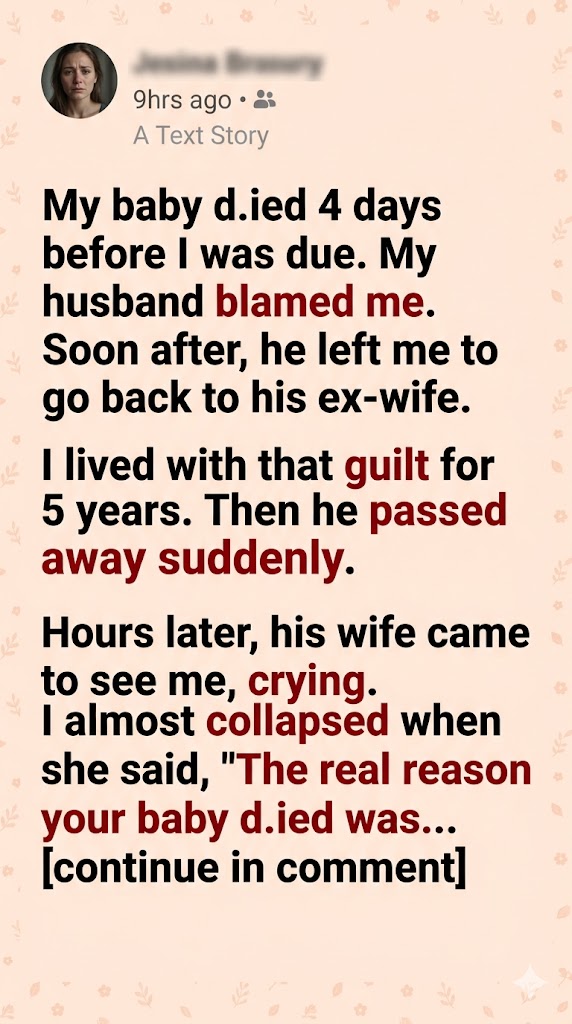
“The real reason your baby died… wasn’t your fault.”
Claire said it quietly, but the words didn’t land gently. They hit something deep inside me, something I had buried for five years, and for a moment, I couldn’t even process what she meant.
“What are you talking about?” I asked, my voice barely steady.
She didn’t answer immediately. Instead, she looked at me the way people do when they know they’re about to change your life—and they’re not sure how to do it without breaking you first.
The day I lost my baby, the world didn’t collapse all at once.
It cracked.
Slowly.
I was four days away from my due date, still answering emails, still trying to finish “just a few more things” before maternity leave, convincing myself that staying busy meant I was being responsible. Daniel had warned me more than once.
“You’re doing too much,” he said that morning, watching me from the doorway.
“I’m fine,” I replied, barely looking up. “I just need to get through today.”
He didn’t argue.
He just nodded.
For illustrative purposes only
By evening, something felt wrong.
Not pain.
Not panic.
Just… silence.
The kind of silence that shouldn’t exist.
At the hospital, everything moved in a strange rhythm, too fast and too slow at the same time, as if the world had shifted into something I couldn’t quite keep up with. I remember the doctor’s voice, careful and distant, but I only truly heard two words.
“I’m sorry.”
After that, everything blurred.
White walls.
Soft voices.
People telling me things I couldn’t hold onto long enough to understand.
Daniel didn’t grieve the way I did.
I cried.
He didn’t.
Instead, something in him hardened.
“You pushed yourself too hard,” he said one night, standing in the doorway of our bedroom. “I told you to rest. You didn’t listen.”
The words weren’t loud.
They didn’t need to be.
They settled into me quietly, like something that belonged there.
I wanted to argue.
To tell him it wasn’t that simple.
But the truth was, a part of me had already started to believe him.
What if I had done this?
I stopped defending myself.
And that silence became everything.
Within months, Daniel left.
He said he couldn’t stay in a house filled with “what could have been,” and just like that, he walked back into his old life, back to Claire, as if our marriage had been something temporary he could undo.
I didn’t fight him.
I didn’t think I had the right to.
For five years, I lived with that weight.
It followed me everywhere, quiet but constant, tightening every time I saw a newborn, every time I passed a park, every time I heard someone talk about the future like it was guaranteed.
You did this.
That thought never left.
Then one morning, my phone rang.
“Daniel passed away,” the voice said gently. “It was sudden. A heart attack.”
I sat there in silence, the phone still pressed to my ear, waiting for something to rise—grief, anger, anything—but all I felt was… stillness.
There was nothing left between us.
Only history.
A few hours later, there was a knock at my door.
When I opened it, Claire was standing there.
She looked nothing like the version of her I had imagined over the years. There was no pride, no bitterness, no sense of victory—just exhaustion, and something fragile in her eyes that made me step aside without thinking.
“I’m sorry to come like this,” she said softly. “But you deserve to know something.”
We sat across from each other in my living room, the silence between us heavier than anything either of us could say, until she finally spoke.
“The doctors confirmed something after he died,” she said carefully. “Something he never told you.”
I felt my chest tighten.
“What do you mean?”
She took a breath, like she was forcing the words out.
“It wasn’t your fault,” she said. “Your baby had a rare genetic condition.”
The room tilted.
“He… knew?” I asked, the words barely forming.
Claire nodded slowly, tears slipping down her face.
“I found his medical records,” she said. “He had been tested years ago. He knew there were risks… but he never told you.”
For a moment, I couldn’t move.
Couldn’t think.
Couldn’t breathe.
Five years.
Five years of blaming myself.
Five years of living smaller, quieter, holding onto guilt that didn’t belong to me.
And in that moment, it started to fall apart.
Claire moved closer, her voice softer now.
“I couldn’t let you keep living like that,” she said. “You deserved the truth.”
I looked at her—this woman I had spent years resenting, the one I thought had taken everything from me—and realized something I hadn’t expected.
She hadn’t come to take anything.
For illustrative purposes only
She had come to give something back.
The truth.
We sat together for hours after that.
She showed me a letter Daniel had written but never sent, filled with apologies he had never had the courage to say out loud, and I showed her the ultrasound photo I had kept hidden for years, the one I couldn’t bring myself to throw away.
We cried.
We didn’t rush the silence when it came.
We didn’t pretend it was simple.
But something changed.
Not all at once.
Not completely.
But enough.
When she stood at the door to leave, she hesitated for a moment, then said quietly, “I hope you can find peace.”
I nodded, because for the first time in years, that didn’t feel impossible.
After she left, I stood there alone, the house quieter than it had ever been, but not empty in the same way.
Something had lifted.
Something I had carried for too long.
That day, I learned something I wish I had known earlier.
Guilt doesn’t always belong to the person carrying it.
And sometimes, the person you think you’ve lost everything to—is the one who gives you your life back.
