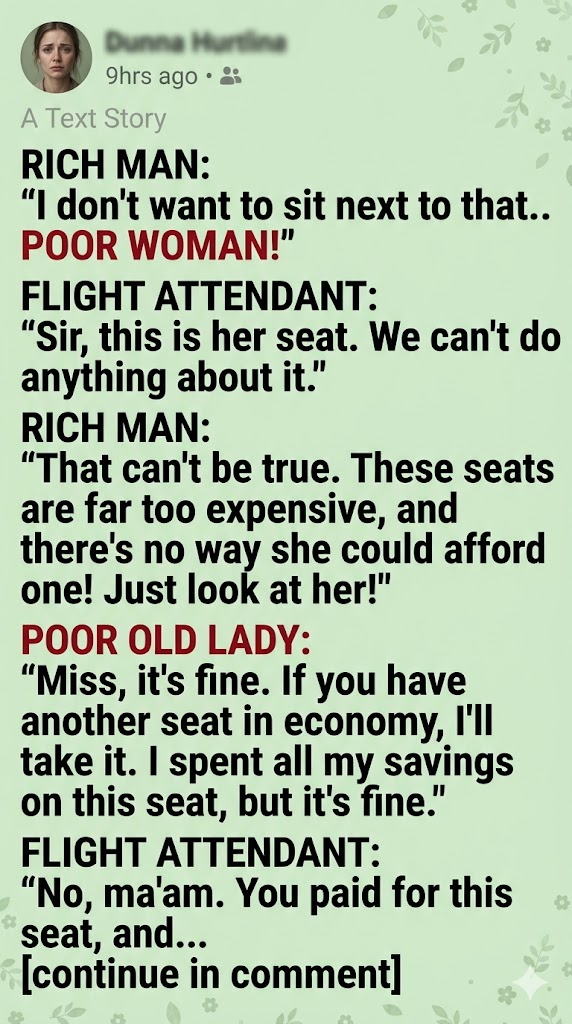
The cabin had just begun to settle into that quiet rhythm familiar to long flights—the soft hum of engines, the shuffle of carry-on bags being tucked away, and the low murmur of passengers adjusting into their seats. That was when the tension began. A sharply dressed man, clearly used to comfort and control, leaned toward the aisle with visible irritation. His voice, though not loud at first, carried enough edge to draw attention. “I don’t want to sit next to that… poor woman,” he said, glancing dismissively toward the elderly passenger already seated beside him. His tone wasn’t just impatient—it was dismissive, as though her presence alone disrupted his sense of entitlement. A nearby flight attendant approached quickly, maintaining professionalism despite the uncomfortable situation. “Sir, this is her assigned seat,” she explained calmly. “There’s nothing we can change right now.” But the man wasn’t satisfied. He shook his head, his expression tightening. “That can’t be right. These seats are expensive. There’s no way she could afford this. Just look at her.” His words lingered in the air, heavier than the recycled cabin oxygen.
The elderly woman sat quietly, her hands folded neatly in her lap. She didn’t respond immediately, but her eyes lowered slightly, as if trying to shrink from the attention. Her clothes were simple, worn but clean, and she carried herself with a quiet dignity that seemed to go unnoticed by the man beside her. After a moment, she spoke softly, her voice steady but gentle. “Miss, it’s alright,” she said to the flight attendant. “If there’s another seat in economy, I’ll take it. I spent all my savings on this ticket, but it’s fine.” Her words weren’t bitter or defensive—they were simply accepting, as if she had long grown accustomed to stepping aside when others made her feel unwelcome. The flight attendant paused, clearly affected, but she straightened and responded firmly, “No, ma’am. You paid for this seat, and you deserve to be here just like anyone else.” The exchange drew quiet attention from nearby passengers, many of whom had been pretending not to listen but were now fully aware of the unfolding moment.
The man scoffed, leaning back in his seat with exaggerated annoyance. “This is ridiculous,” he muttered, loud enough for others to hear. “I didn’t pay for this kind of experience.” But something had already begun to shift in the cabin. A few passengers exchanged glances. Others looked toward the woman with a mix of sympathy and discomfort. It was no longer just an awkward situation—it had become something else entirely, a quiet test of how people respond when faced with unfairness. The flight attendant excused herself briefly, walking toward the front of the plane with a composed urgency. The man assumed she was going to resolve the situation in his favor. He adjusted his jacket, confident that things would soon return to what he considered normal. Meanwhile, the elderly woman remained still, her gaze fixed gently ahead, as though she had already accepted whatever outcome might come.
A few minutes later, the flight attendant returned—but she wasn’t alone. The chief purser accompanied her, his expression calm but serious. He addressed the man directly. “Sir, we understand your concerns,” he began, his tone measured. The man nodded slightly, as if expecting validation. But then the purser continued, “We’ve reviewed the seating, and everything is correct. However, we do have an alternative arrangement available.” The man leaned forward slightly, anticipating an upgrade or relocation. Instead, the purser turned to the elderly woman. “Ma’am,” he said respectfully, “we would like to offer you a seat in first class, if you would be willing to move.” For a moment, the cabin fell completely silent. The woman blinked, clearly surprised. “Oh… I couldn’t,” she began, but the flight attendant gently reassured her. “You can, and we would be honored.” The offer wasn’t just about comfort—it was about acknowledgment, about restoring dignity in a moment where it had been questioned.
The reaction was immediate. A ripple of quiet approval moved through the nearby rows. Some passengers smiled. Others nodded subtly. The woman hesitated only briefly before accepting, rising slowly from her seat. As she gathered her small belongings, a few people nearby offered soft words of encouragement. She didn’t look at the man as she passed him—there was no need. The moment had already spoken for itself. The man, meanwhile, sat frozen, his earlier confidence replaced by a stiff silence. What he had expected to be a simple complaint had turned into something entirely different. He wasn’t being rewarded—he was being left behind in the very seat he had tried to elevate above someone else. The contrast was clear, and it didn’t require anyone to point it out.
As the woman was escorted toward the front of the plane, something deeper settled into the cabin. It wasn’t just relief that the situation had been resolved—it was a shared understanding. The incident had revealed something simple but often overlooked: value isn’t determined by appearance, wealth, or assumption. It’s reflected in how people treat one another, especially in moments when it would be easier not to care. The flight attendant returned to her duties, her composure intact, but there was a quiet pride in her actions. She hadn’t argued or escalated—she had simply acted with fairness and respect. And in doing so, she had shifted the entire tone of the flight.
For the rest of the journey, the man remained quiet. Whether he reflected on what had happened or simply chose to withdraw was unclear, but the earlier tension never returned. The passengers continued with their routines—reading, resting, watching the slow passage of time above the clouds—but the memory of that moment lingered. It served as a reminder that kindness doesn’t need to be loud to be powerful, and that dignity, once defended, has a way of reshaping the space around it. When the plane finally landed, people gathered their belongings and prepared to disembark, but there was a subtle difference in the air—a sense that something meaningful had taken place, something small yet significant.
And for those who had witnessed it, the lesson remained long after the flight ended. It wasn’t about wealth or status or who sat where. It was about recognizing the humanity in others, even when it’s inconvenient or overlooked. It was about understanding that respect isn’t earned through appearances—it’s given freely, or not at all. And sometimes, in the most ordinary places—a seat on a plane, a brief exchange between strangers—that truth becomes impossible to ignore.
